
The SR-71 Blackbird's Titanium Legacy: Why Aviation's Greatest Spy Plane Remains Unreplicated
Breaking airline news and aviation industry updates for 2026.

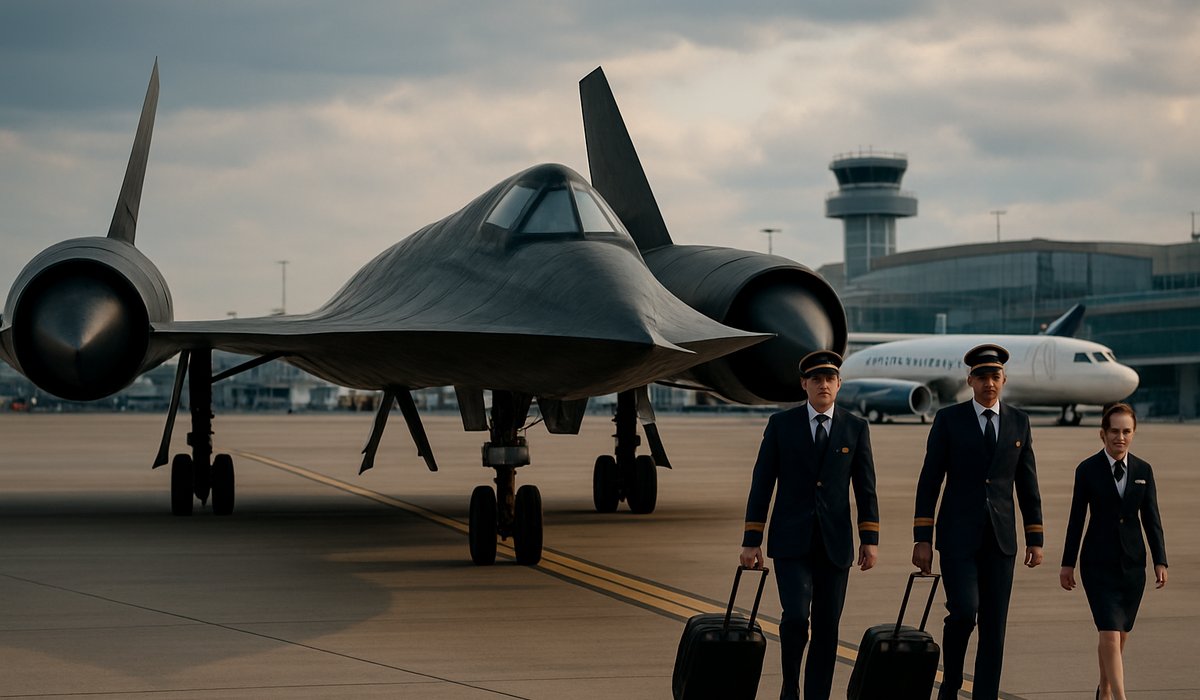
Image generated by AI
The SR-71 Blackbird's Titanium Legacy: Why Aviation's Greatest Spy Plane Remains Unreplicated
Decades after its retirement, the engineering and procurement challenges that built the Cold War's most advanced aircraft continue to baffle modern aerospace manufacturers
A Masterpiece That Defied Replication
The Lockheed SR-71 Blackbird stands as one of aviation's most audacious engineering achievements—and simultaneously, as a cautionary tale about the limits of aerospace manufacturing. Nearly six decades after its first flight, no successor has emerged, and the fundamental reason lies not in aerodynamic theory or propulsion systems, but in the brutally complex reality of sourcing and fabricating an airframe composed of 93 percent titanium.
The Blackbird's titanium construction represented a quantum leap in materials science during the 1960s. Operating at speeds exceeding Mach 3 generated skin temperatures near 600 degrees Celsius—conditions that rendered conventional aluminum airframes structurally unsound. Titanium alone could withstand such extremes while maintaining the aircraft's required strength-to-weight ratio. Yet this material advantage came with extraordinary manufacturing penalties that continue to plague aerospace engineering today.
The Supply Chain Nightmare
The procurement challenges were so severe that the Central Intelligence Agency deployed multiple shell companies specifically to acquire sufficient titanium alloy supplies. Cold War geopolitics further complicated matters: the Soviet Union controlled significant global titanium reserves, forcing American defense contractors into Byzantine supply-chain gymnastics. Lockheed's engineers had to develop specialized techniques for welding, machining, and heat-treating titanium at scales previously unattempted in aviation manufacturing.
The raw material costs alone were astronomical for the era. Beyond expense, however, lay manufacturing complexity that demanded unprecedented precision. Titanium's brittleness at certain temperatures and its tendency toward stress corrosion cracking necessitated painstaking quality control at every production stage. The Blackbird required hand-fitting of thousands of components—work that could not be automated with 1960s technology and remains partially manual even today.
Why Successors Never Materialized
Several factors explain the absence of a Blackbird successor. Modern surveillance relies increasingly on satellite imagery and unmanned systems, reducing the strategic imperative for manned reconnaissance aircraft. Additionally, the geopolitical environment that justified such extraordinary expense has shifted. The estimated $1.2 billion per aircraft in contemporary dollars represents an unsustainable investment for most modern air forces.
More fundamentally, the titanium supply chain has never recovered its Cold War capacity. Industrial demand from aerospace, defense, and medical sectors now competes for limited reserves. Manufacturing expertise specific to the Blackbird's unique construction techniques has largely dispersed, with few living engineers retaining hands-on experience in these specialized processes.
The SR-71 remains a monument to what becomes possible when engineering ambition outpaces economic rationality—and an unintended demonstration of why such achievements rarely repeat.
FAQ: Understanding the SR-71 Blackbird's Irreplaceable Design
Why was titanium essential for the SR-71's construction? Titanium's exceptional heat resistance enabled the airframe to withstand skin temperatures exceeding 600 degrees Celsius generated by sustained Mach 3+ speeds. Aluminum would have lost structural integrity under such conditions.
Could modern manufacturing techniques replicate the SR-71 today? While contemporary fabrication technology is more advanced, the fundamental supply-chain constraints and raw material costs remain prohibitive. Modern aerospace programs prioritize cost-efficiency over exotic materials whenever alternatives exist.
What happened to the CIA's titanium procurement network after the Cold War? Most shell companies were dissolved. The specialized supply chains were dismantled as the strategic imperative for the aircraft diminished and surveillance capabilities shifted toward satellite and unmanned systems.
Are any successor aircraft using similar titanium-intensive designs? Modern military jets employ titanium selectively in heat-critical areas but rely on composite materials and advanced alloys for weight savings. Full titanium airframes are economically unjustifiable in current aerospace markets.
How many SR-71 Blackbirds were ever built? Thirty-two airframes were constructed during the program's operational life, with most eventually retired or lost in accidents. Their extraordinary construction costs and limited operational advantages made large-scale production impractical.
Related Travel Guides
Flight Delay Compensation Guide 2026
Understanding Airline Route Changes
Airport Security Process Updated (2026)
External Resources
Disclaimer
This article is for informational and educational purposes only. It does not constitute legal, financial, or professional advice. While we strive to provide accurate and up-to-date information, travel policies, regulations, and conditions change rapidly. Always verify information with official sources before making travel decisions. Nomad Lawyer makes no representations about the accuracy, reliability, completeness, or suitability of the information provided. Readers should consult qualified professionals for advice specific to their circumstances. The views expressed in this article are those of the author and do not necessarily reflect the views of Nomad Lawyer.
Raushan Kumar
Founder & Lead Developer
Full-stack developer with 11+ years of experience and a passionate traveller. Raushan built Nomad Lawyer from the ground up with a vision to create the best travel and law experience on the web.
Learn more about our team →