
Why Airbus Engineered the A380 With Four Turbofan Engines: The Design Decision Behind Aviation's Most Ambitious Superjumbo
Breaking airline news and aviation industry updates for 2026.

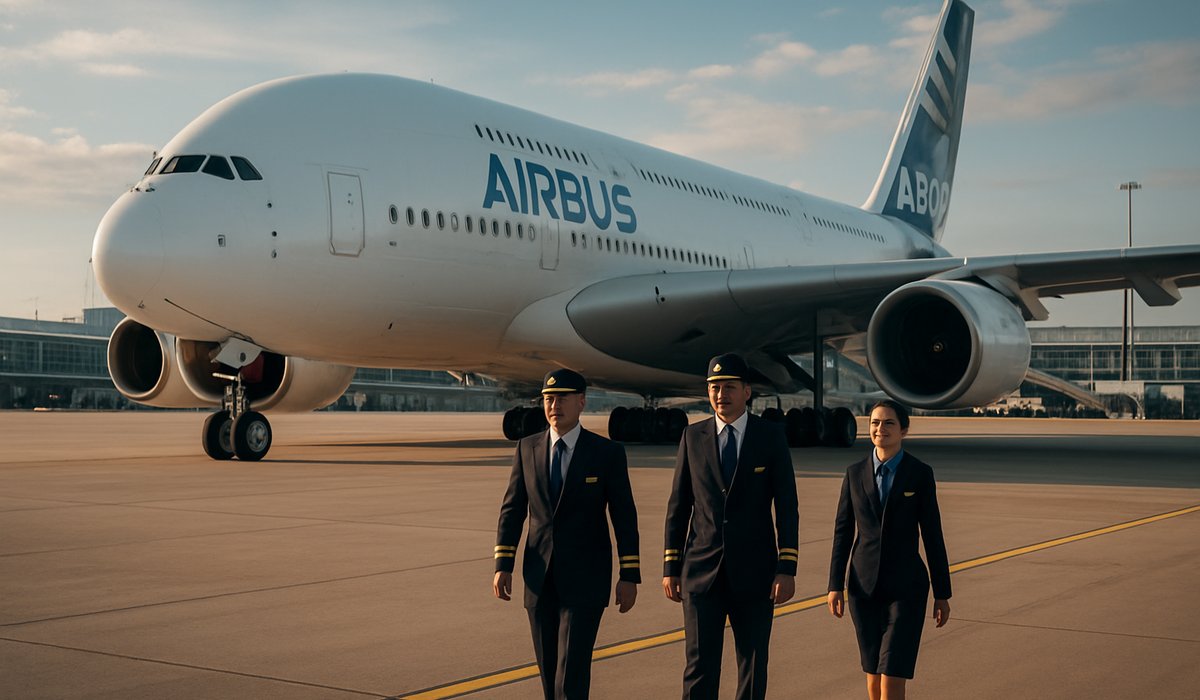
Image generated by AI
Why Airbus Engineered the A380 With Four Turbofan Engines: The Design Decision Behind Aviation's Most Ambitious Superjumbo
The aircraft that promised to revolutionize long-haul travel instead revealed the harsh economics of ultra-large aircraft operations
The Engineering Challenge Behind Aviation's Largest Passenger Aircraft
When Airbus unveiled the A380 to the world, it represented an audacious bet on the future of commercial aviation: a double-decked behemoth capable of carrying over 800 passengers across continents. Yet beneath its revolutionary design lay a critical engineering decision that would ultimately constrain its commercial viability—the installation of four powerful high-bypass turbofan engines.
The quad-engine configuration wasn't arbitrary. At approximately 80 meters (262 feet) in wingspan and weighing nearly 600 tonnes when fully loaded, the A380 demanded extraordinary thrust to achieve the performance standards required for long-range international operations. Four engines became the mathematical necessity rather than a luxury feature, providing the redundancy, reliability, and raw power needed to lift this aviation leviathan into the stratosphere while maintaining safety protocols mandated by international aviation authorities.
When Size Became an Economic Liability
However, the engineering triumph masked a fundamental flaw: the superjumbo's operational economics simply didn't align with modern airline business models. The four turbofan powerplants that made the A380 possible also made it expensive to operate. Jet fuel consumption—already a significant line item in airline budgets amid volatile energy markets—became prohibitively costly on routes where passenger demand couldn't justify the aircraft's massive capacity.
Industry analysts consistently highlighted a stark reality: while the A380 could theoretically carry more passengers than any rival, most global routes couldn't sustain the load factors necessary to offset the aircraft's thirsty fuel appetite. Airlines found themselves with an airplane that was simultaneously over-capacity for typical demand patterns and economically inefficient for the premium long-haul routes it was designed to serve.
Industry Implications and Market Reality
The A380's struggles reflect broader trends in aviation economics. As jet fuel prices fluctuated dramatically—particularly during geopolitical disruptions affecting energy markets—airlines increasingly favored smaller, more fuel-efficient wide-body aircraft like the Boeing 777 and Airbus A350. These twin-engine alternatives offered superior per-seat economics while maintaining sufficient range and comfort for premium transcontinental travel.
The superjumbo's fate underscores a critical lesson for aircraft manufacturers: engineering capability and market demand operate in different universes. While Airbus successfully engineered an aircraft of unprecedented scale, the commercial aviation market ultimately voted with its purchasing power for efficiency over maximum capacity.
FAQ: Understanding the A380 and Modern Aviation Economics
Why did Airbus choose four engines for the A380 instead of two? The A380's extraordinary size and maximum takeoff weight required four high-bypass turbofan engines to generate sufficient thrust for reliable, long-range international operations while meeting strict safety and performance requirements established by aviation regulators.
What is jet fuel consumption, and why does it matter for aircraft economics? Jet fuel accounts for 20-35% of airline operating costs depending on global fuel prices. The A380's four engines consume significantly more fuel per flight hour than twin-engine competitors, making per-seat fuel costs prohibitively high unless passenger load factors exceed typical market demand.
How do airline fees and baggage charges relate to aircraft fuel efficiency? As fuel costs rise due to geopolitical events or market pressures, airlines must recover additional expenses through ancillary revenues—baggage charges, seat selection fees, and service charges—making operations with fuel-thirsty aircraft less profitable and less competitive.
Is the A380 still in production? No. Airbus discontinued A380 production in 2021 after delivering 254 aircraft, citing insufficient global demand and the aircraft's inability to generate returns comparable to smaller, more efficient wide-body jets.
What aircraft replaced the A380 in airline fleets? Twin-engine aircraft like the Boeing 777, Airbus A350, and newer models like the Boeing 787 Dreamliner now dominate long-haul route networks, offering superior fuel efficiency and lower operating costs per available seat kilometer.
Related Travel Guides
Flight Delay Compensation Guide 2026
Understanding Airline Route Changes
Airport Security Process Updated (2026)
External Resources
Disclaimer
This article is for informational and educational purposes only. It does not constitute legal, financial, or professional advice. While we strive to provide accurate and up-to-date information, travel policies, regulations, and conditions change rapidly. Always verify information with official sources before making travel decisions. Nomad Lawyer makes no representations about the accuracy, reliability, completeness, or suitability of the information provided. Readers should consult qualified professionals for advice specific to their circumstances. The views expressed in this article are those of the author and do not necessarily reflect the views of Nomad Lawyer.
Raushan Kumar
Founder & Lead Developer
Full-stack developer with 11+ years of experience and a passionate traveller. Raushan built Nomad Lawyer from the ground up with a vision to create the best travel and law experience on the web.
Learn more about our team →