
Vietnam Government Fights Severe Travel Chaos by Slapping Airlines With Massive Compensation Fines for Flight Cancellations and Airport Disruptions: Latest Airline News
In a desperate bid to halt the rolling travel chaos paralyzing Southeast Asian hubs, Vietnam's new Civil Aviation Law forces airlines to pay massive cash penalties for causing airport disruptions.

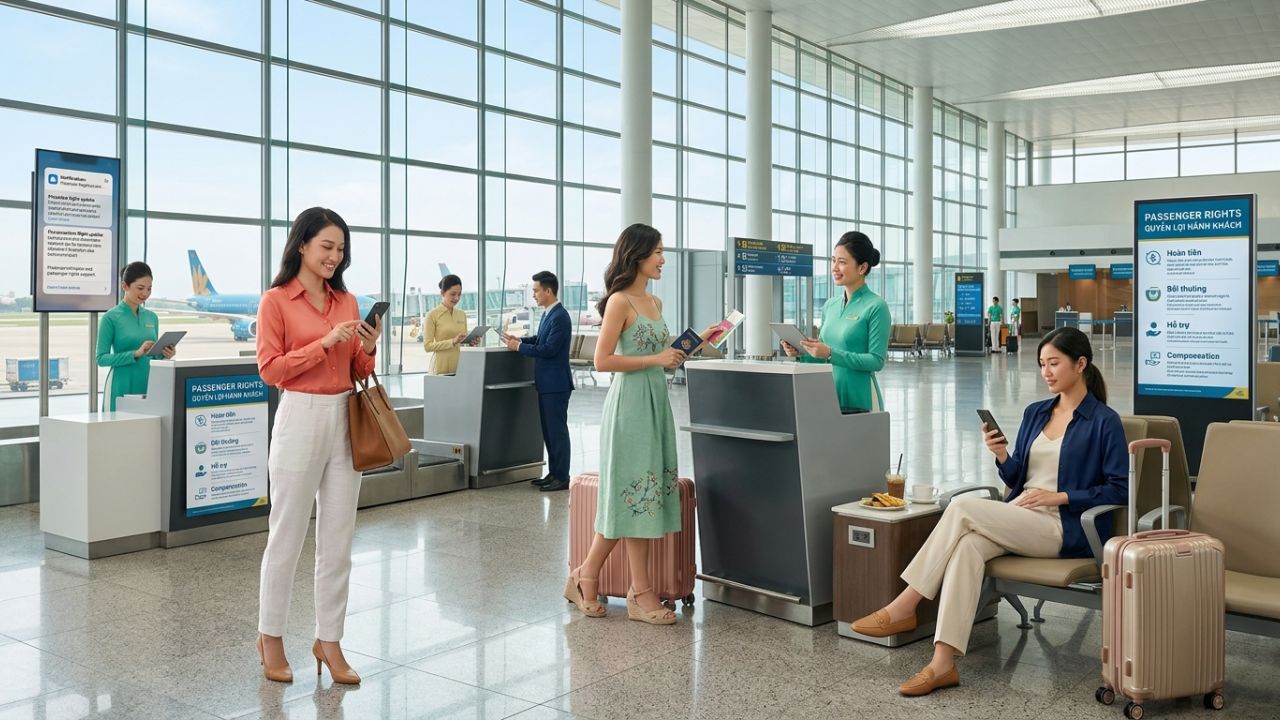
Image generated by AI
In a massive, sweeping legislative offensive designed to permanently halt the devastating travel chaos and rolling flight cancellations currently paralyzing Southeast Asia, Vietnam has formally weaponized its passenger rights framework. Effective July 1, 2026, the revised Civil Aviation Law of Vietnam drastically alters the power dynamic between stranded passengers and failing airlines. Following months of severe airport disruptions driven by intense regional congestion, the government is now forcing domestic and international carriers to take immediate financial accountability. Under these draconian new regulations, airlines that trap passengers in airports due to operational or technical issues face mandatory, highly inflated compensation payouts, hyper-accelerated refund timelines, and legally enforceable duty-of-care obligations. This historic reform completely overhauls passenger survival tactics during major airspace meltdowns, making this legislative crackdown the premier headline in today's breaking airline news and absolutely vital global aviation updates.
By introducing direct passenger coordination and dynamic scheduling backups, the regional aviation hubs target growing passenger demand across vital commerce sectors. The choice to coordinate flight departures in phases helps to manage gate capacity, supporting the country's broader regional transportation network.
Context: The Breaking Point of Regional Congestion
For the millions of global tourists and domestic travelers navigating Vietnam's booming aviation grid, relying on airlines to "do the right thing" during a crisis is no longer necessary.
Historically, when airlines operating in Vietnam encountered severe weather or technical failures, they simply abandoned passengers in the terminal. The resulting travel chaos was absolute: travelers faced overnight airport disruptions with zero access to hotel vouchers, food, or transparent rebooking options. Seeking refunds for these massive flight cancellations often took months, destroying passenger confidence in the region's aviation sector. The new Civil Aviation Law actively destroys this dynamic. Authorities have recognized that airlines will only improve operational discipline if they are heavily financially penalized for failure. Under the new law, airlines must verify all reported causes of delays with operational data, ensuring they can no longer use vague "weather" excuses to avoid financial responsibility when the true cause of the disruption is airline negligence or poor crew scheduling.
To view live flight schedules, verify your exact legal rights regarding cash compensation, or to track active Southeast Asian airspace restrictions, travelers must consult official Vietnamese aviation directories. For direct booking access into carriers operating under this strict new compliance framework, travelers should check the official airline portals. To explore live flight tracking and monitor the exact severity of the regional airspace bottlenecks causing the flight cancellations you may now be compensated for, passengers can consult the official FlightAware tracking service.
Section-Wise Breakdown of the Legislative Crackdown
Clear Legal Obligations: Forcing Transparency
Under the updated law, carriers operating in Vietnam are now legally responsible when flight disruptions occur due to operational or technical issues within their direct control. Airlines cannot simply apologize; they must offer immediate alternative arrangements or full, unconditional refunds. The government oversight and enforcement arm will actively track the accuracy of disruption reporting, completely ending the era where airlines could obscure the real cause of a delay.
Increased Compensation Levels: Hitting the Bottom Line
The revised framework introduces substantially higher financial compensation for passengers trapped by airline delays and cancellations. Designed to reflect massive inflation adjustments and the true cost of emergency travel, the payouts are highly structured based on flight distance. Because international flight delays over 5,000 km now require payouts of up to $180 USD per passenger, airlines are mathematically incentivized to fix their operational bottlenecks rather than simply absorbing minor, older penalty fees.
Mandatory Ground Support: Ending Terminal Abandonment
The era of passengers sleeping on terminal floors is legally over. Airlines are now strictly required to provide immediate assistance during long delays caused by airline fault. These obligations are legally binding and enforceable by Vietnam’s civil aviation authorities. The moment a delay crosses a legal threshold, the airline must instantly deploy free meals, transport, and overnight hotel accommodations, ensuring passenger welfare is prioritized above the airline's profit margin.
Technical Roster: Compensation Matrices and Refund Timelines
To ensure absolute factual accuracy regarding the specific financial payouts you are legally entitled to, the exact refund deadlines airlines must obey, and the mandatory support required during ground-level airport disruptions, the following tables detail the exact integration data:
International Flight Compensation Limits
| Flight Distance | Mandatory Passenger Compensation |
|---|---|
| Under 1,000 km | 30 USD |
| 1,000–2,499 km | 60 USD |
| 2,500–4,999 km | 100 USD |
| Over 5,000 km | Up to 180 USD |
Domestic Flight Compensation Limits
| Flight Distance | Mandatory Passenger Compensation |
|---|---|
| Under 500 km | Approx. 250,000 VND |
| 500–999 km | Higher tiered compensation applies |
| 1,000 km and above | Up to 500,000 VND |
Strict New Payment and Refund Timelines
| Refund Method | Legal Airline Deadline |
|---|---|
| Flight Vouchers | Within 7 days |
| Cash or Bank Transfer | Within 21 days |
| Compensation Claim Payouts | Within 30 working days (After confirmation of claim) |
| Credit Card Payments | Up to 45 days |
| Travel Agency Bookings | Up to 60 days |
Mandatory Passenger Support During Extended Delays
| Disruption Support Requirement | Airline Legal Obligation |
|---|---|
| Nutritional Support | Must provide free meals and refreshments. |
| Emergency Lodging | Must provide hotel accommodation for overnight delays. |
| Ground Logistics | Must provide transport between the airport and the hotel. |
| Rebooking Protection | Must offer assistance with alternative travel arrangements without additional charges. |
| Right of Refusal | Passengers may refuse flights when delays exceed legal thresholds and claim refunds for unused segments. |
Passenger Impact: Weaponizing Your Travel Rights
For the everyday backpacker in Ho Chi Minh City and the high-yield corporate traveler flying out of Hanoi, the July 1, 2026, Civil Aviation Law reform represents the ultimate weapon against travel anxiety.
The immediate passenger impact is the utter elimination of the "helpless traveler" dynamic. Previously, a flight cancellation meant the passenger absorbed massive out-of-pocket expenses to survive an overnight airport disruption. Now, passengers are empowered with highly expanded rights for travel flexibility. You can legally refuse a flight when a delay exceeds the threshold, demand an alternative routing without paying arbitrary fare differences, or opt out of travel entirely during a forced stopover and demand a refund for the unused segments. This shifts the massive financial risk of operational disruptions away from the passenger and places it entirely on the airline's balance sheet.
Industry Analysis: Global Alignment or Fleet Crisis?
Aviation industry analysts view Vietnam’s updated passenger rights framework as a highly aggressive, necessary alignment with strict international aviation consumer protection standards seen in the EU (like EU261).
Analysts note that as Vietnam continues to rapidly expand its airport capacity to accommodate booming passenger volumes, operational discipline among carriers was failing. By legally enforcing defined compensation bands, mandatory care obligations, and strict refund timelines, the government is forcing airlines to optimize their fleets. The industry consensus is that airlines operating in Vietnam must fundamentally change their scheduling practices. Carriers can no longer schedule impossibly tight turnarounds. If an airline attempts to run an aircraft 18 hours a day and suffers a technical fault, the resulting cascading delays will cost the airline hundreds of thousands of dollars in mandated passenger compensation. This forces airlines to build massive buffer times into their schedules, which increases reliability but significantly raises operational costs.
Actionable Advice for Surviving Vietnamese Disruptions
If you are a global traveler flying into, out of, or within Vietnam after July 1, 2026, execute this strategic planning checklist immediately to weaponize these new laws against severe travel chaos:
- Never Accept the "Weather" Excuse Unchallenged: Under the new law, airlines must verify all reported causes of delays with operational data. If an airline claims a weather delay, but other flights are taking off, immediately file a formal claim with the aviation authority to demand your cash compensation for an operational failure.
- Demand Your Hotel Voucher Immediately: If your flight is delayed overnight, do not book a hotel out of pocket. Walk directly to the airline desk and demand your legally mandated hotel room and transport. The airline is required by law to provide it instantly.
- Reject Useless Vouchers: If the airline cancels your flight and offers you a travel voucher, remember that you are legally entitled to a cash or bank transfer refund within 21 days. Always take the cash rather than letting the airline hold your money hostage.
- Keep Every Single Receipt: If an airline illegally refuses to provide mandatory meals or hotel accommodations during a massive airport disruption, pay out of pocket, save every receipt, and file a formal legal claim for reimbursement under the expanded passenger rights framework the moment you return home.
FAQ: Vietnam Passenger Rights & Travel Chaos 2026
What is the new Vietnam Civil Aviation Law reform?
Effective July 1, 2026, the revised law introduces sweeping passenger protections, legally forcing airlines to provide faster refunds, massive cash compensation, and mandatory hotel support during severe flight cancellations and delays.
How much compensation can I get for a canceled flight in Vietnam?
Compensation depends on distance. For domestic flights, it ranges from 250,000 to 500,000 VND. For international flights, compensation scales from $30 USD to a maximum of $180 USD for flights over 5,000 km.
How long does an airline have to refund my canceled ticket?
The new strict timelines require airlines to process cash or bank transfer refunds within 21 days, and finalize compensation payments within 30 working days after confirming a passenger's claim.
The Supremacy of Consumer Protection
The massive legislative crackdown by the Vietnamese government proves definitively that the only way to defeat systemic travel chaos is through ruthless financial accountability. By legally mandating severe compensation payouts and strict hotel obligations, the revised Civil Aviation Law provides domestic and international travelers with a heavily armored, disruption-free shield against failing airlines. As archaic carriers desperately struggle to maintain sloppy schedules without triggering massive financial penalties—reducing rolling flight cancellations and severe airport disruptions—travelers must accept a critical new reality: avoiding brutal travel anxiety requires knowing your exact legal rights and ruthlessly enforcing them the moment an airline attempts to delay your flight.
Key Takeaways
- The July 2026 Crackdown: Vietnam's revised Civil Aviation Law heavily financially penalizes airlines for causing travel chaos, flight cancellations, and massive delays.
- Massive Cash Payouts: Passengers are legally entitled to receive up to $180 USD for international flight disruptions and up to 500,000 VND for domestic delays.
- Ending Terminal Abandonment: Airlines are now legally required to provide free meals, hotel accommodations, and ground transport the moment a severe delay occurs.
- Strict Refund Deadlines: Airlines can no longer hold passenger funds hostage; they must process cash refunds within 21 days and complete compensation payouts within 30 working days.
- Passenger Survival: Travelers must aggressively assert their new legal rights, demanding immediate hotel vouchers and refusing travel vouchers in favor of hard cash refunds during massive airport disruptions.
Related Travel Guides
Massive European Infrastructure Collapse Triggers 1,200 Delays
Disclaimer
This article is for informational and educational purposes only. It does not constitute legal, financial, or professional advice. While we strive to provide accurate and up-to-date information, travel policies, regulations, and conditions change rapidly. Always verify information with official sources before making travel decisions. Nomad Lawyer makes no representations about the accuracy, reliability, completeness, or suitability of the information provided. Readers should consult qualified professionals for advice specific to their circumstances. The views expressed in this article are those of the author and do not necessarily reflect the views of Nomad Lawyer.
Kunal K Choudhary
Co-Founder & Contributor
A passionate traveller and tech enthusiast. Kunal contributes to the vision and growth of Nomad Lawyer, bringing fresh perspectives and driving the community forward.
Learn more about our team →