
Uzbekistan and Jordan Eye Tourism Boom with Visa Waivers and Direct Charter Flight Plans

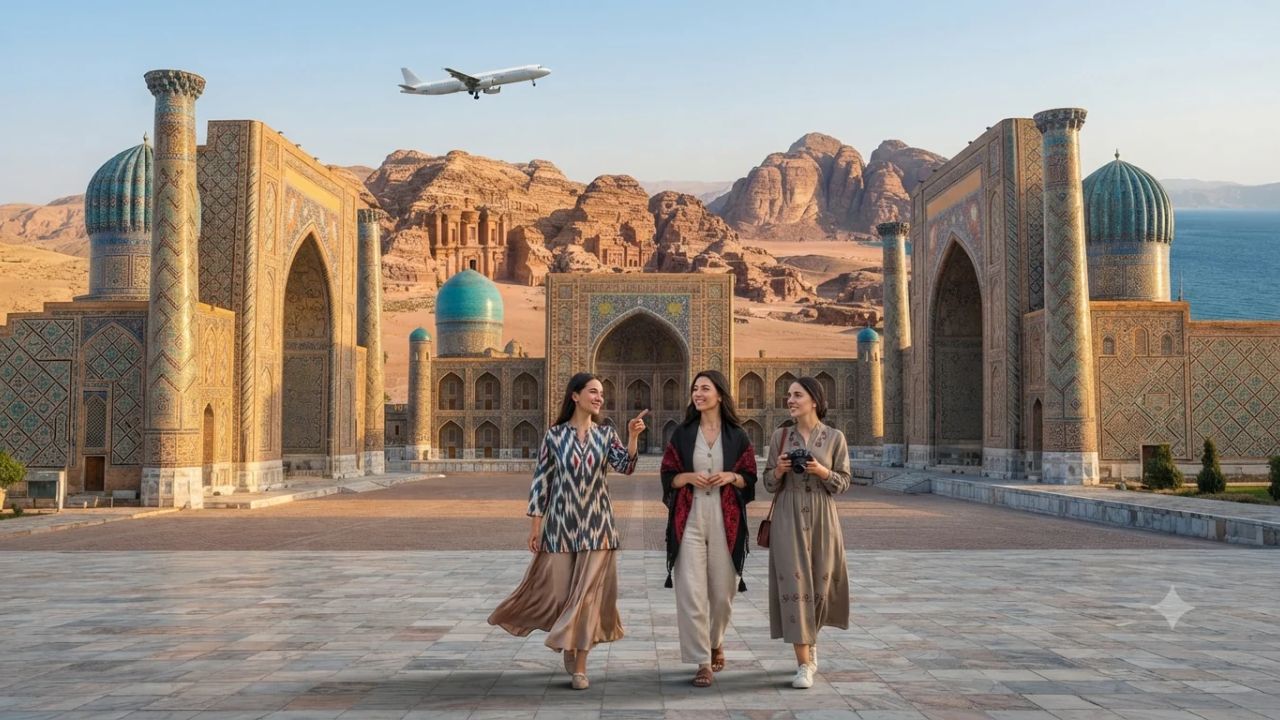
Uzbekistan and Jordan have initiated a transformative bilateral tourism expansion, connecting Central Asia’s legendary Silk Road architecture with the historic landscapes of the Levant through reciprocal visa-free entry, shared Islamic heritage initiatives, and direct charter flights between Tashkent and the Red Sea resort of Aqaba.
The burgeoning strategic alliance between Tashkent and Amman bridges two of the world's most historically rich civilizations. Underpinned by shared cultural values, common spiritual traditions, and decades of steady diplomatic cooperation dating back to 1993, the initiative elevates tourism from a conventional economic sector into a primary driver of trans-regional diplomacy. By eliminating visa friction and expanding aviation links, the two governments are constructing an innovative travel corridor that allows international tourists, business executives, and cultural explorers to combine the turquoise-domed madrasahs of Samarkand and Bukhara with the rose-red sandstone facades of Petra and the marine reserves of the Red Sea.
UZBEKISTAN–JORDAN TOURISM CORRIDOR: CORE BENCHMARKS
| Category / Entity | Details / Impact |
|---|---|
| Partnership Dimension | Diplomatic Benchmark & Tourism Data |
| Diplomatic Relations Initiated | 1993 (Over three decades of bilateral ties) |
| Landmark Bilateral Summit | August 25–26, 2025 (Tashkent State Visit) |
| Key Signed Instruments | Joint Declaration & 15 Bilateral Agreements |
| Visa Policy Framework | Reciprocal Mutual Visa Exemption Agreement |
| Inbound Tourism Momentum | Jordanian tourist visits to Uzbekistan |
| surged by over 200% during 2025 | |
| Active Scheduled Flight Route | Tashkent (TAS) <-> Amman Queen Alia (AMM) |
| Planned Direct Charter Route | Tashkent (TAS) <-> Aqaba King Hussein (AQJ) |
| Primary Tourism Niches | Silk Road heritage, Islamic Ziyarah, |
| Red Sea wellness, and multi-country packages |
Diplomatic Foundation: The August 2025 Summit as a Turning Point
While formal diplomatic relations between the Republic of Uzbekistan and the Hashemite Kingdom of Jordan were established in 1993, the bilateral relationship entered a qualitatively new era following the historic state visit to Uzbekistan on 25–26 August 2025.
During high-level summit talks between the heads of state, both nations reaffirmed an overarching commitment to elevate political dialogue, economic cooperation, and cultural engagement. The negotiations culminated in the signing of a landmark Joint Declaration on Strengthening Partnership alongside fifteen comprehensive bilateral agreements spanning trade, investment, transport logistics, and education.
STRATEGIC PILLARS OF THE 2025 BILATERAL ACCORD
| Entity / Route | Metrics | Operational Status |
|---|---|---|
| Operational Parameter | Legacy Consular Process | New Visa-Free Framework |
| Advance Visa Requirement | Mandatory consular visa | None (Entry stamp at gate) |
| Letter of Invitation (LOI) | Frequently required | Completely abolished |
| Consular Processing Wait Time | 7 to 15 business days | Instantaneous border entry |
| Administrative Consular Fees | $50 to $100 per applicant | $0 (Reciprocal exemption) |
| Booking Flexibility | Planned weeks in advance | Enables spontaneous travel |
| Commercial Mobility Impact | Constrained business MICE | Rapid executive deployment |
Unlocking Spontaneous Leisure and Business Travel
The elimination of visa barriers transforms travel psychology. For Jordanian families and independent travelers, Uzbekistan is no longer an exotic, administratively complex destination; it becomes an accessible, affordable cultural holiday just a few flight hours away.
Equally important, Uzbek entrepreneurs, textiles traders, and agricultural exporters gain direct access to Jordanian and broader Levantine markets without submitting business files weeks in advance.
The visa waiver serves as the regulatory cornerstone for tourism boards to build structured group tours, incentive travel programs, and cultural exchange delegations.
A Tale of Two Civilizations: The Cultural Synergies of Samarkand and Petra
The core appeal of the Uzbekistan–Jordan tourism alliance lies in the complementary nature of their destination portfolios. Rather than competing for the same market share, the two nations offer radically different, mutually reinforcing environments that can be integrated into world-class travel itineraries.
CIVILIZATIONAL SYNERGIES: UZBEKISTAN AND JORDAN
| Entity / Route | Metrics | Operational Status |
|---|---|---|
| Destination Dimension | Uzbekistan Portfolio | Jordan Portfolio |
| Core Heritage Identity | Great Silk Road cities | Ancient Nabataean, Roman, |
| & Islamic architecture | & Biblical antiquities | |
| Primary Iconic Landmarks | Registan Square, Po-i- | Petra (Rose-Red City), |
| Kalyan, Ichan Kala | Jerash, Mount Nebo | |
| Natural & Landscape Appeal | Kyzylkum Desert, Chimgan | Wadi Rum desert, Dead Sea, |
| mountains, Fergana Valley | Dana Biosphere Reserve | |
| Coastal & Aquatic Assets | Charvak Reservoir, Aral | Aqaba Red Sea diving, |
| Sea ecological corridors | marine coral sanctuaries | |
| Spiritual & Ziyarah Focus | Imam al-Bukhari, Sufi | Tombs of the Sahaba, |
| Naqshbandi brotherhoods | Baptism Site of Jesus | |
| Optimal Travel Windows | Spring (Apr–Jun) & | Autumn (Sep–Nov) & |
| Autumn (Sep–Nov) | Spring (Mar–May) |
Uzbekistan: The Architectural Splendour of the Silk Road
Uzbekistan stands as the supreme cultural and scholarly heartland of Central Asia. For more than two millennia, legendary oasis settlements like Samarkand, Bukhara, and Khiva governed trans-continental trade along the Great Silk Road, fostering an extraordinary synthesis of science, philosophy, astronomy, and architectural engineering.
Visitors to Uzbekistan encounter:
- Samarkand: Anchored by the breathtaking monumental ensemble of Registan Square, the soaring turquoise portal of the Bibi-Khanym Mosque, and the sacred avenue of mausoleums at Shah-i-Zinda.
- Bukhara: An open-air architectural museum containing over 140 preserved monuments, centered around the 12th-century Kalyan Minaret, which survived the Mongol invasions, and ancient domed trading bazaars.
- Khiva: The perfectly preserved walled city of Ichan Kala, where labyrinthine stone alleys, carved wooden minarets, and tiled palaces evoke the medieval caravan trade.
- Tashkent: A vibrant modern metropolis blending Soviet neoclassical boulevards, avant-garde metro stations, and contemporary cultural museums.
Jordan: From Nabataean Wonders to the Red Sea Coast
Jordan presents an equally compelling mosaic of ancient civilizations, sacred history, and dramatic geological formations packed into an exceptionally safe, compact territory.
Visitors to Jordan experience:
- Petra: The UNESCO World Heritage-listed Nabataean capital carved directly into sandstone canyon cliffs, entered through the winding, dramatic chasm of the Siq.
- Jerash: One of the grandest and best-preserved Roman provincial cities in the world, featuring colonnaded avenues, monumental theatres, and grand public plazas.
- Wadi Rum: The "Valley of the Moon," an awe-inspiring protected desert wilderness of monolithic granite cliffs, red sand dunes, and ancient petroglyphs.
- The Dead Sea and Biblical Sites: The lowest point on Earth, offering mineral-rich thermal waters alongside profound spiritual landmarks, including Mount Nebo and Bethany Beyond the Jordan (the baptism site of Jesus).
- Aqaba: Jordan’s coastal gateway on the Red Sea, offering world-class scuba diving, coral reefs, year-round sunshine, and luxury marine resorts.
Spiritual and Ziyarah Tourism: Reconnecting Ancient Islamic Scholarly Paths
A primary driver behind the bilateral tourism push is Ziyarah (pilgrimage) tourism, rooted in profound historical and religious connections between Central Asia and the Levant. Both nations occupy pivotal positions in the spiritual memory of the Islamic world, creating organic demand for faith-based and scholarly travel.
SPIRITUAL & ZIYARAH TOURISM: THE SACRED PILGRIMAGE CORRIDOR
| Flight Route Route Segment | Operational Status & Strategic Impact |
|---|---|
| Tashkent (TAS) <-> Amman (AMM) | Scheduled Commercial Passenger Flights |
| - Operates between national capital gateways | |
| - Serves business delegations, diplomats, & | |
| independent cultural tourists | |
| Tashkent (TAS) <-> Aqaba (AQJ) | Planned Direct Seasonal Charter Services |
| - Bypasses northern metropolitan congestion | |
| - Direct access to Jordan's Red Sea resorts | |
| - Immediate gateway to Petra & Wadi Rum | |
| - Generates high-volume leisure package flows |
The Strategic Value of Direct Charters to Aqaba
While scheduled commercial flights between Tashkent International Airport (TAS) and Amman’s Queen Alia International Airport (AMM) provide essential point-to-point capital connectivity, the proposed launch of direct charter flights between Tashkent and King Hussein International Airport in Aqaba (AQJ) represents an operational breakthrough.
Aqaba is situated at the southern tip of Jordan on the Gulf of Aqaba. Flying directly into Aqaba offers decisive logistical advantages:
- Direct Access to the Golden Triangle: Aqaba is located less than an hour's drive from the desert canyons of Wadi Rum and under two hours from Petra. Landing in Aqaba allows Central Asian tourists to immerse themselves in Jordan's top attractions without enduring the four-hour highway transfer south from Amman.
- Winter Sun and Coastal Wellness: For Uzbek travelers seeking a warm winter holiday, Aqaba offers year-round sunshine, five-star beachfront luxury resorts, and world-class diving along coral reefs. It provides a compelling alternative to established beach destinations like Sharm el-Sheikh or Dubai.
- Optimized Multi-Destination Group Logistics: Tour operators can design circular routes: arriving via direct charter in Aqaba, exploring Wadi Rum and Petra, traveling north along the scenic King's Highway past Karak and the Dead Sea to Amman, and returning directly on scheduled flights to Tashkent.
INTEGRATED 10-DAY TRANS-REGIONAL TOUR ITINERARY
| Category / Entity | Details / Impact |
|---|---|
| Implementation Pillar | Specific Operational Program & Initiatives |
| 1. Joint Cultural Exhibitions | Hosting bilateral tourism roadshows and |
| artisan craft fairs in Amman and Tashkent | |
| 2. Media & Operator FAM Trips | Organizing sponsored familiarization tours |
| for leading travel agencies and journalists | |
| 3. Hospitality Skills Exchange | Professional training partnerships between |
| Jordanian hotel schools & Uzbek academies | |
| 4. Digital Promotion Campaigns | Targeted social media marketing showcasing |
| seasonal contrasts, halal dining, & safety |
1. Joint Exhibitions and B2B Travel Roadshows
Tourism authorities from both nations are organizing dedicated B2B roadshows and participating jointly in international travel trade expos. These events allow destination management companies (DMCs), hotel chains, and tour operators from Samarkand, Tashkent, Amman, and Aqaba to forge direct commercial contracts, negotiate group hotel allocations, and coordinate transport fleets.
2. Familiarization (FAM) Tours for Travel Professionals
Designing successful multi-country itineraries requires firsthand destination knowledge. Both governments are financing targeted familiarization tours for prominent travel agency directors, tour designers, and travel journalists.
Jordanian agents are hosted across Tashkent, Samarkand, and Bukhara to inspect hotel infrastructure, evaluate culinary options, and design cultural itineraries. Concurrently, Uzbek travel professionals are guided through Amman, Petra, Wadi Rum, and Aqaba to establish dependable local ground-handling partnerships.
3. Elevating Hospitality and Service Standards
Jordan possesses a highly mature hospitality and hotel management ecosystem, anchored by international luxury brands and world-renowned tourist service standards. Uzbekistan, which is currently undergoing a hotel construction boom and modernizing its tourism sector, stands to gain immense practical value from bilateral training partnerships.
The signed agreements include structured exchanges between Jordanian hotel management institutes and Uzbek tourism universities, focusing on front-desk management, multilingual guest service, culinary excellence, and international service delivery.
Economic Multipliers: How Tourism Expansion Catalyzes Broader Bilateral Commerce
The ripple effects of this growing travel corridor extend far beyond leisure hotel bookings and museum ticket sales. In modern international relations, tourism functions as the leading edge of trade and investment.
+-----------------------------------------------------------------------------------+
|               THE BILATERAL ECONOMIC MULTIPLIER ARCHITECTURE                      |
+-----------------------------------------------------------------------------------+
                                         |
     +-------------------+---------------+-------------------+
     |                   |                                   |
     v                   v                                   v
[1. Agro-Trade & Commodities] [2. Pharmaceutical & Tech]    [3. MICE & Regional Forums]
- Uzbek fruits, silk, & cotton - Jordanian pharmaceutical - Corporate conventions
  exported directly to Levant    firms expanding to Tashkent  alternating capitals
- Jordanian olive oil & Dead   - Joint tech incubators and  - Government trade expos
  Sea minerals to Central Asia   cross-border investments     driving B2B joint ventures
1. Expanding Trade in Agricultural and Artisanal Goods
As direct flight links and business visits multiply, trade in high-value goods naturally expands. Uzbekistan is a major global producer of premium textiles, silk, dried fruits, nuts, and agricultural produce, which find ready demand across Jordan and the wider Levant.
Conversely, Jordan’s established pharmaceutical manufacturers, olive oil producers, and Dead Sea cosmetic laboratories gain direct distribution channels into Central Asia’s most populous consumer market of over 37 million people.
2. Cross-Regional Investment Partnerships
Corporate mobility facilitated by the reciprocal visa waiver encourages joint investment ventures. Jordanian investment capital is increasingly exploring opportunities in Uzbekistan’s rapidly privatizing energy, mining, and hospitality sectors.
Simultaneously, Uzbek financial groups and commercial enterprises are utilizing Jordan’s stable, business-friendly legal environment as an investment beachhead for expanding commercial ties across the Middle East and North Africa (MENA) region.
3. Integrating the Trans-Regional MICE Market
Both Amman and Tashkent have invested heavily in convention centers, exhibition halls, and business hotel infrastructure. The combination of visa-free travel and direct flight connections enables international organizations, medical associations, and business federations to host bilateral summits and corporate retreats, alternating host venues between Central Asia and the Levant.
Frequently Asked Questions About the Uzbekistan–Jordan Tourism Partnership
Do citizens of Uzbekistan and Jordan need a visa to visit each other's countries?
No. Under the reciprocal mutual visa waiver arrangement confirmed following the August 2025 bilateral summit, citizens of both Uzbekistan and Jordan can enter each other's territory without obtaining an advance consular visa, receiving visa-free entry upon arrival for qualifying short-stay tourist and business visits.
How much did Jordanian tourist visits to Uzbekistan grow recently?
Official figures revealed that the number of Jordanian tourists traveling to Uzbekistan surged by more than 200% during 2025, driven by heightened diplomatic visibility, cultural exchanges, and simplified travel procedures.
Are there direct flights between Uzbekistan and Jordan?
Yes. Regular scheduled commercial passenger flights operate directly between Tashkent International Airport (TAS) and Amman Queen Alia International Airport (AMM). In addition, aviation authorities are finalizing plans to launch direct seasonal leisure charter flights connecting Tashkent directly to King Hussein International Airport in Aqaba on the Red Sea.
Why is the proposed Tashkent–Aqaba charter flight significant?
Direct charter flights between Tashkent and Aqaba provide travelers with immediate access to Jordan’s southern "Golden Triangle"—placing the rose-red city of Petra, the desert of Wadi Rum, and the beach resorts of the Red Sea within short driving distance while avoiding the four-hour road transfer south from Amman.
What are the main attractions for tourists visiting Uzbekistan?
Uzbekistan is renowned for its historic Great Silk Road cities, including:
- Samarkand: Registan Square, Shah-i-Zinda, and the Bibi-Khanym Mosque.
- Bukhara: The Kalyan Minaret, Ark Fortress, and historic trading domes.
- Khiva: The walled fortress city of Ichan Kala.
- Tashkent: Cultural museums, broad boulevards, and architectural monuments.
What makes Jordan an appealing destination for travelers from Central Asia?
Jordan offers a diverse, compact portfolio of ancient and natural wonders, including:
- The ancient Nabataean rock-carved city of Petra.
- The well-preserved Roman ruins of Jerash.
- The desert landscape of Wadi Rum.
- Health and wellness resorts along the Dead Sea.
- Scuba diving and coastal leisure in Aqaba on the Red Sea.
What is "Ziyarah tourism" and how does it connect both nations?
Ziyarah tourism refers to spiritual and faith-based pilgrimage travel. Both countries possess deep Islamic heritage: Jordan is home to the venerated tombs of the Prophet’s Companions (Sahaba) in Mut'ah and the Jordan Valley, while Uzbekistan is the historical home of foundational Islamic scholars, including Imam al-Bukhari, Imam al-Tirmidhi, and prominent Sufi masters such as Bahauddin Naqshbandi.
What are the best seasons to take a combined Uzbekistan and Jordan tour?
The ideal travel windows are spring (April to May) and autumn (September to November). During these months, both Central Asia and the Levant experience mild, pleasant temperatures ideal for sightseeing across open-air architectural sites, hiking in deserts and mountain valleys, and outdoor cultural touring.
What agreements were signed between the two nations in August 2025?
During the August 2025 state visit to Tashkent, the heads of state signed a historic Joint Declaration on Strengthening Partnership alongside fifteen bilateral agreements covering mutual visa exemptions, tourism cooperation, transport corridors, trade facilitation, and educational exchanges.
Can travelers easily combine both countries into a single 10-day itinerary?
Yes. With direct flight connectivity and reciprocal visa waivers, travelers can spend five days exploring the Silk Road monuments of Tashkent, Samarkand, and Bukhara, take a 4.5-hour direct flight to Jordan, and spend five days visiting Amman, Jerash, the Dead Sea, Petra, and Wadi Rum.
Related Travel Guides
- Slovenia Restricts New Tourist Visas for Russians but Keeps Essential Travel Open
- Christchurch and Nine Other Destinations Emerge as the UK’s Top Retirement Hotspots
- Uganda and Rwanda Seek Major Airfare Cuts to Boost Tourism
- Germany Leads France And More As European Destinations Bet Big On AI For Tourism Growth
This article is for informational purposes. Flight routes, passenger regulations, visa rules, and transit advisories are subject to change by airlines and aviation authorities. Readers are advised to verify schedules and travel documentation with relevant carriers and border agencies before departure.
Related Stories
12 Underrated Cities in China That International Travelers Are Starting to Discover
Saudi Arabia and More in Focus as Qatar Opens Five Historic Landmarks to Global Travellers