
USA Flight Chaos 2026: 3,168 Delays and 349 Cancellations Hit Atlanta, NYC, and Philadelphia Hubs
Widespread aviation disruptions across the United States have resulted in 3,168 delays and 349 cancellations, with American Airlines and United facing the heaviest operational impacts.
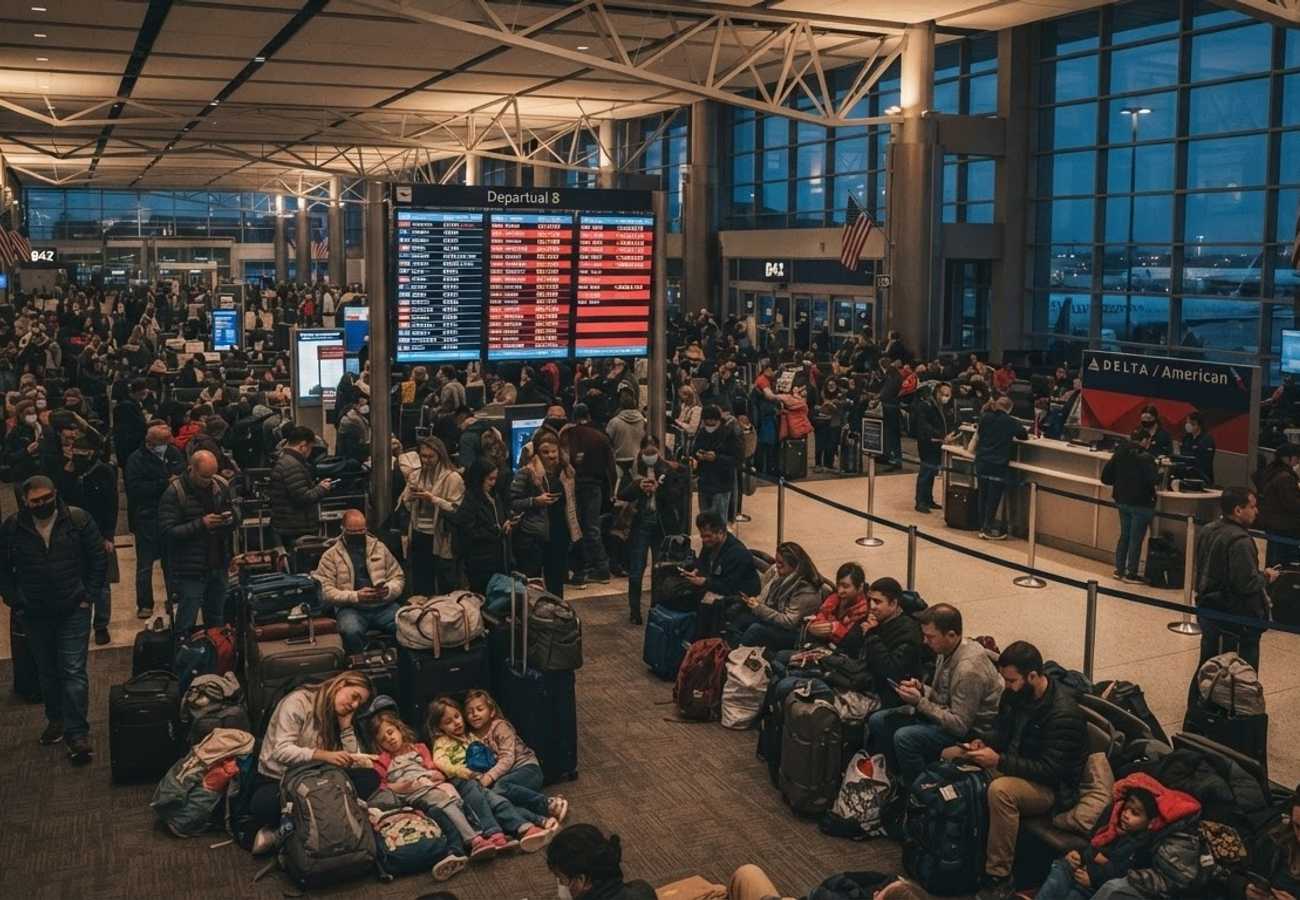
Image generated by AI
A massive wave of aviation disruptions has paralyzed travel across the United States, resulting in 3,168 delays and 349 cancellations in a single day. Major hubs including Atlanta, New York City, and Philadelphia are reporting severe bottlenecks, with American Airlines and United Airlines bearing the brunt of the operational collapse.
The current instability in the national airspace has left thousands of passengers stranded or facing significant itinerary changes. Reports indicate that the disruptions are concentrated in the Northeast and Southeast corridors, though the ripple effects are being felt as far west as Los Angeles and Las Vegas. The crisis is a combination of systemic traffic management issues, localized weather patterns, and specific ground incidents.
Severe Disruptions at Major US Aviation Hubs
The scale of the disruption is most evident when analyzing the individual airport data. Philadelphia International Airport has emerged as the most critical failure point regarding total flight removals, recording the highest cancellation count of any US airport.
In the Southeast, Hartsfield-Jackson International Airport in Atlanta has become a primary bottleneck, logging 268 delays and 12 cancellations. Similarly, Orlando International Airport is struggling with 251 delays and 10 cancellations, where passengers are facing an average wait time of 75 minutes—a figure that officials indicate is continuing to climb.
The Northeast corridor is experiencing a near-total systemic slowdown. John F. Kennedy International Airport (JFK) has seen 180 delays and 48 cancellations, while LaGuardia Airport has added another 114 delays and 45 cancellations to the New York City total. Newark Liberty International Airport is not far behind, reporting 161 delays and 61 cancellations.
| Airport Name | Total Delays | Total Cancellations |
|---|---|---|
| Philadelphia International | 162 | 79 |
| Newark Liberty International | 161 | 61 |
| John F. Kennedy International | 180 | 48 |
| LaGuardia Airport | 114 | 45 |
| Boston Logan International | 163 | 21 |
| Chicago O’Hare International | 174 | 19 |
| Hartsfield-Jackson (Atlanta) | 268 | 12 |
| Charlotte Douglas International | 161 | 12 |
| Orlando International | 251 | 10 |
| Reagan National (Washington D.C.) | 114 | 26 |
| Fort Lauderdale International | 107 | 14 |
| Los Angeles International | 128 | 0 |
Airline Carriers Facing Highest Operational Failures
While the disruptions are widespread, specific carriers are experiencing significantly higher rates of failure. American Airlines is currently the hardest-hit carrier, recording 365 delays and 66 cancellations, the highest volume of cancellations among all US airlines.
United Airlines follows closely with 334 delays and 59 cancellations. JetBlue has also seen a substantial impact on its schedule, reporting 229 delays and 42 cancellations.
Regional and partner carriers are also struggling. PSA Airlines has recorded 78 delays and 38 cancellations, showing a disproportionately high cancellation rate relative to its total delay count. Endeavor Air has logged 65 delays and 32 cancellations.
Root Causes of National Airspace Instability
Industry reports suggest that no single event caused the collapse, but rather a "perfect storm" of operational hurdles. In Orlando and Fort Lauderdale, officials specifically pointed to weather conditions and traffic-management initiatives as the primary drivers of the delays.
In the West, Harry Reid International Airport in Las Vegas faced specific challenges due to a disabled aircraft on the runway, which throttled departure capacity.
Beyond these specific events, the aviation industry is battling the "domino effect" of aircraft rotation. When a single plane is delayed in a hub like Chicago O'Hare—which saw 174 delays and 19 cancellations—every subsequent flight assigned to that aircraft for the remainder of the day is automatically pushed back. This is compounded by crew scheduling limits and mandatory maintenance windows, meaning a morning delay in one city often becomes a cancellation in another by evening.
Critical Steps for Stranded Passengers
With the current volatility, passengers are advised to move beyond standard check-in procedures. Experts suggest the following immediate actions to mitigate the impact of cancellations:
- Digital Monitoring: Prioritize airline apps and real-time flight tracking over airport monitors, which can sometimes lag.
- Immediate Rebooking: Contact airline representatives immediately via phone or app; waiting in physical queues at the airport often results in the best alternative flights being taken.
- Baggage Verification: For those who have already checked luggage, it is imperative to confirm the physical location of the bags to avoid them being routed to a different city than the passenger.
- Documentation: Maintain digital and physical copies of all booking confirmations to expedite the claims process for delays or expenses.
Why This Matters: The Legal and Logistical Reality
For the modern traveler, these figures represent more than just numbers; they signify a fragile aviation infrastructure. From a logistical standpoint, the high cancellation rate at Philadelphia (79) compared to the delay rate (162) suggests that the airport reached a "saturation point" where it was more efficient to cancel flights entirely than to attempt to manage the queue.
From a legal and consumer rights perspective, this creates a complex environment for compensation. When "traffic-management initiatives" or "weather" are cited, airlines often categorize these as "extraordinary circumstances" to avoid paying passenger compensation. However, the high number of cancellations for carriers like American and United suggests operational strain that may fall under the airline's responsibility. Travelers should meticulously document the specific reason given for their cancellation to support future claims.
As the aviation sector struggles to reset its schedules, passengers should anticipate lingering volatility for the next 48 to 72 hours.
Related Travel Guides
Disclaimer
This article is for informational and educational purposes only. It does not constitute legal, financial, or professional advice. While we strive to provide accurate and up-to-date information, travel policies, regulations, and conditions change rapidly. Always verify information with official sources before making travel decisions. Nomad Lawyer makes no representations about the accuracy, reliability, completeness, or suitability of the information provided. Readers should consult qualified professionals for advice specific to their circumstances. The views expressed in this article are those of the author and do not necessarily reflect the views of Nomad Lawyer.