
Mount Etna Volcanic Ash Shuts Down Catania Airport: Travel Alerts for Sicily 2026
Mount Etna's recent eruptive activity has triggered a RED alert, suspending all flights at Catania Airport and leaving thousands of travelers stranded in eastern Sicily.

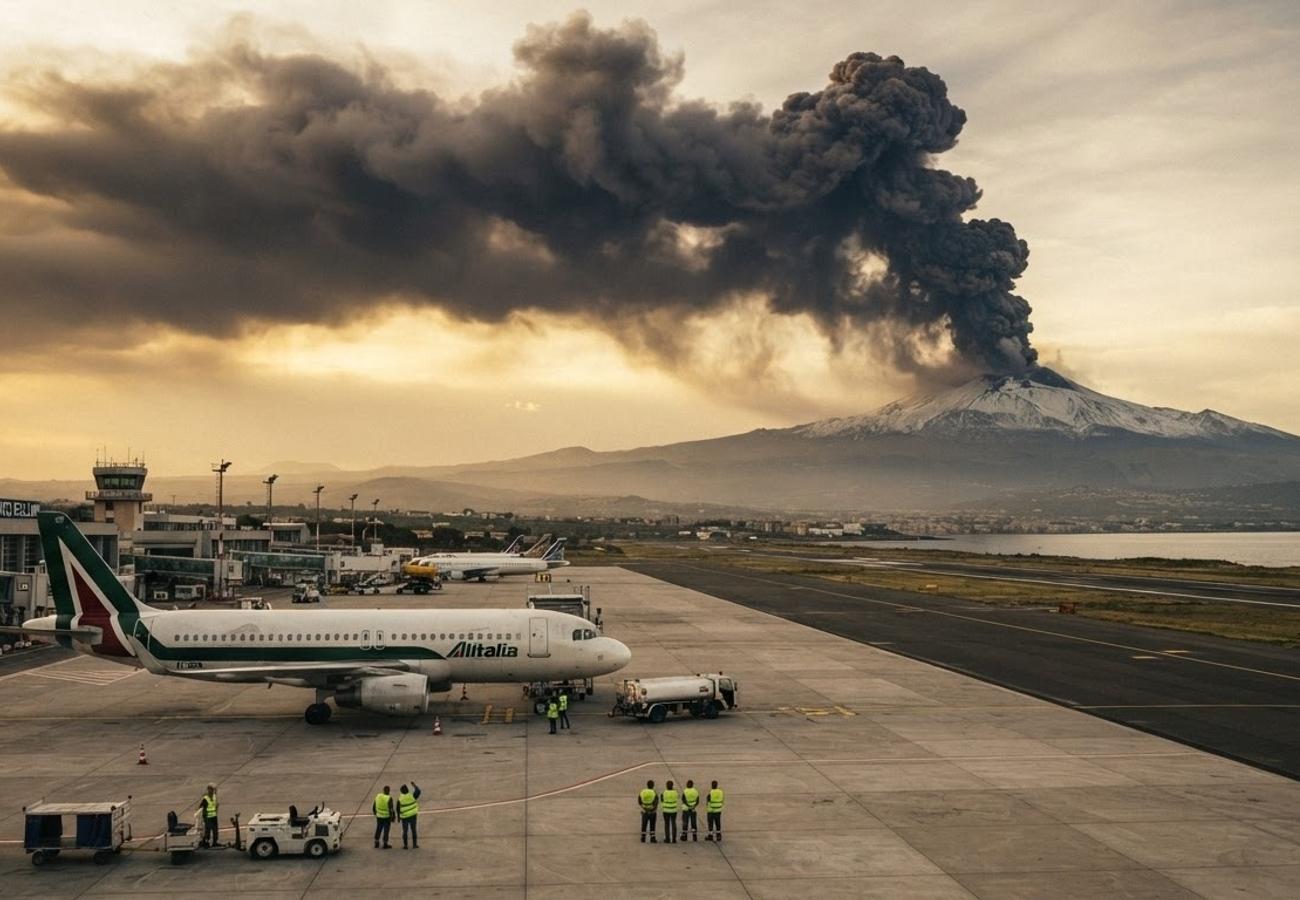
Image generated by AI
The tallest active volcano in Europe has the power to freeze an entire region's air traffic in minutes. On September 14, 2026, Mount Etna demonstrated this dominance once again, forcing the total suspension of all arrivals and departures at Vincenzo Bellini Catania Airport as a massive plume of volcanic ash drifted across eastern Sicily.
The Volcanic Disruption of Eastern Sicily
The current crisis began early on Monday, September 14, when Italy's National Institute of Geophysics and Volcanology (INGV) issued a Volcano Observatory Notice for Aviation at 6:43 a.m. local time. The alert level for the UNESCO World Heritage Site was elevated to RED, the highest possible warning, indicating that ash emissions were ongoing and posing a severe risk to aircraft engines.
Initial restrictions targeted only incoming flights, with a suspension set until 4 p.m. local time. However, as the volcanic cloud reached an estimated altitude of 13,100 feet and migrated south, airport authorities were forced to expand the shutdown. By the afternoon, all departures were also halted, and the suspension was extended until 10 p.m. local time.
This is not an isolated event, but rather the climax of an unusually volatile summer. The region has seen a pattern of systemic failures in air connectivity due to Etna's activity. On July 7, departures were blocked until at least 2 p.m. The situation escalated further in August; on August 7, incoming commercial flights were paused, and by August 10, all arrivals ceased. The peak of the disruption occurred between August 10 and August 14, during which more than a third of nearly 2,000 scheduled flights were canceled, and 630 flights were rerouted to other Sicilian or mainland Italian hubs. Normal operations only resumed on August 18 after the alert level dropped from RED to ORANGE.
What Makes Sicily's Volcanic Geography Unique
Sicily exists in a state of permanent tension between breathtaking beauty and geological instability. Mount Etna is not merely a mountain but a living entity that shapes the local economy, agriculture, and infrastructure. The volcanic soil is responsible for some of the world's finest vineyards and citrus groves, yet the same minerals that enrich the earth create the abrasive ash that can shred jet turbines.
For the traveler, this means that visiting eastern Sicily requires a level of flexibility not needed in other parts of Italy. The proximity of Catania Airport to the volcano means that "weather delays" here often involve particulate matter rather than rain or snow. The experience of seeing the volcano erupt from a distance is a draw for many, but as recent events show, the boundary between a tourist attraction and a logistical nightmare is thin.
Visitor Insider Tips
Navigating Sicily during a volcanic event requires a shift in strategy. If you are basing yourself in Catania or Taormina, follow these local protocols:
Flight Management Never assume your flight is operating just because the airport is "open." Use the official ENAC (Italian Civil Aviation Authority) portal or your airline's app to verify status before leaving your hotel. In Sicily, "suspended until 10 p.m." often means a ripple effect of delays that lasts for 48 hours.
Alternative Transport If Catania Airport shuts down, your best bet is to pivot to Palermo Airport (PMO) on the opposite side of the island. While it adds several hours of driving, it is rarely affected by Etna's ash. Renting a car is the only reliable way to navigate between cities when flight networks collapse.
Etiquette and Safety When the RED alert is active, avoid attempting to hike to the higher craters. Local guides and park authorities strictly enforce closures for a reason—volcanic gases and sudden ash falls can be lethal. Respect the barriers and follow the directions of the forestry police.
Local Flavor While waiting out a delay in Catania, seek out "Pasta alla Norma," a regional specialty featuring fried eggplant and salted ricotta, which reflects the volcanic terroir of the region.
Cultural and Environmental Context
The relationship between the people of Sicily and Mount Etna is one of "respectful coexistence." The volcano is often referred to as "Muntagna" (The Mountain), treated almost as a family member who is occasionally temperamental. This cultural acceptance means that while international tourists may panic during a flight shutdown, locals view it as a natural rhythm of life.
However, the environmental impact of these eruptions extends beyond airport runways. The ash blankets farmland and puts immense pressure on local municipal cleaning services. There is an ongoing tension between the desire to promote Etna as a premier tourist destination and the need to manage the safety of thousands of visitors who may not understand the risks of an active volcanic zone. The constant cycle of eruptions and closures tests the resilience of the local tourism infrastructure, forcing hotels and tour operators to maintain highly flexible cancellation policies.
FAQ: Visiting Sicily 2026
What is the best time to visit Sicily to avoid disruptions? While Etna can erupt at any time, the peak travel season (July and August) often coincides with higher volatility and extreme heat. Spring (April to June) and Autumn (September to October) offer more stable weather and slightly lower crowds.
Do I need a visa to visit Sicily? Sicily is part of Italy and the Schengen Area. U.S. citizens typically do not need a visa for short stays (up to 90 days), though you should check current ETIAS requirements for 2026 before traveling.
What are my rights if my flight from Catania is canceled? Under EU passenger rights, you are entitled to a refund, rerouting, or rebooking. Airlines must provide meals and hotel accommodations if you are stranded. However, because volcanic eruptions are "extraordinary circumstances," you are generally not entitled to additional monetary compensation.
Is it safe for solo travelers in Catania? Yes, Catania is generally safe for solo travelers. Use registered taxis or ride-sharing apps and stay in well-lit areas of the city center. Always keep a digital copy of your passport and travel insurance.
When the mountain speaks, the world waits.
Related Travel Guides
Disclaimer
This article is for informational and educational purposes only. It does not constitute legal, financial, or professional advice. While we strive to provide accurate and up-to-date information, travel policies, regulations, and conditions change rapidly. Always verify information with official sources before making travel decisions. Nomad Lawyer makes no representations about the accuracy, reliability, completeness, or suitability of the information provided. Readers should consult qualified professionals for advice specific to their circumstances. The views expressed in this article are those of the author and do not necessarily reflect the views of Nomad Lawyer.
Preeti Gunjan
Contributor & Community Manager
A passionate traveller and community builder. Preeti helps grow the Nomad Lawyer community, fostering engagement and bringing the reader experience to life.
Learn more about our team →