
Historic US Travel Chaos: Thunderstorms Trigger 674 Flight Cancellations and Ground Southwest, American, and Delta Nationwide
A severe national thunderstorm system paralyzes the US aviation grid, triggering 674 flight cancellations and massive travel chaos across Texas, New York, and Chicago.

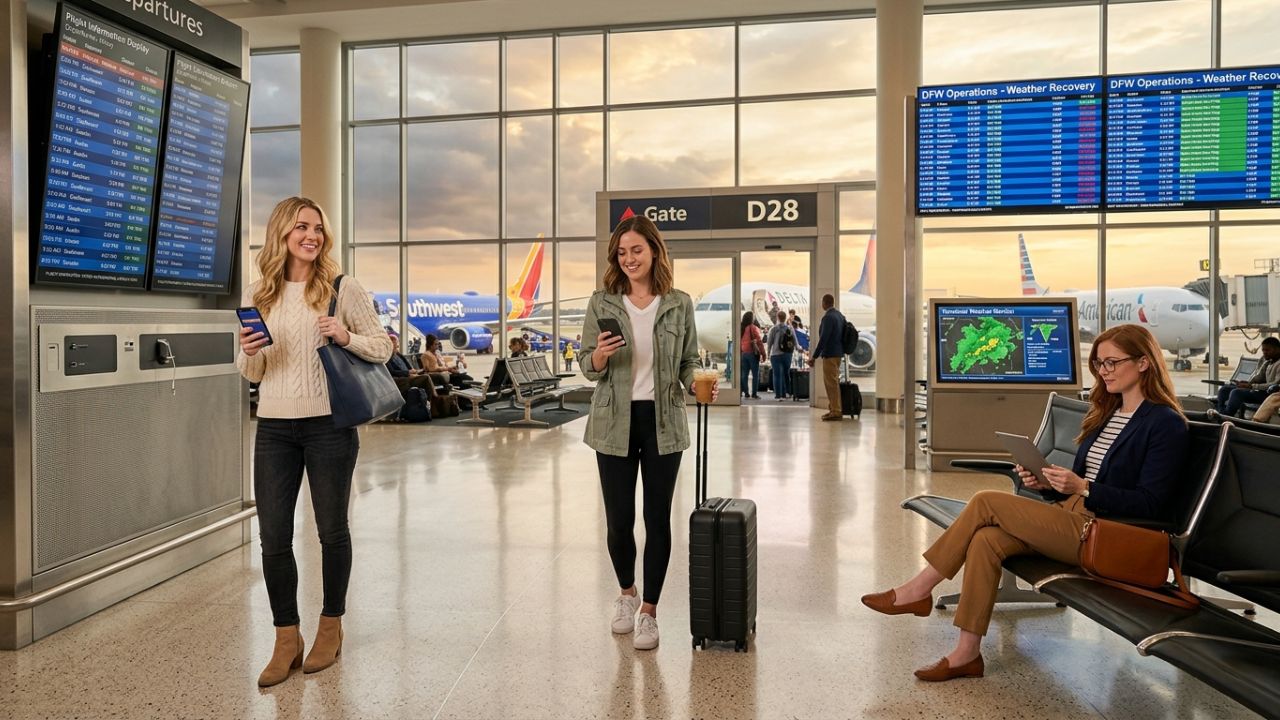
Image generated by AI
A highly destructive, incredibly powerful severe thunderstorm system has violently torn across the United States, plunging the entire national airspace into absolute travel chaos. As lightning strikes, torrential downpours, and violently turbulent winds battered critical aviation arteries, federal regulators were immediately forced to issue sweeping ground stops. The catastrophic meteorological gridlock viciously targeted massive operational hubs across Texas, Illinois, Denver, Cleveland, and New York. In a matter of hours, air traffic control mandated 4,879 flight delays while safety hazards forced airlines to scratch 674 flight cancellations entirely off the board. This breaking airline news and aviation updates report heavily explores how the cascading operational failures instantly collapsed the schedules of massive industry titans, explicitly paralyzing Southwest, American, SkyWest, Delta, and United Airlines.
Expanded Overview: The FAA Grounds the Hubs
The sheer severity of the thunderstorms instantly triggered a massive, nationwide aviation crisis. The Federal Aviation Administration (FAA) aggressively deployed immediate ground stops, sweeping traffic management initiatives, and severe weather route swaps, bringing the absolute largest U.S. hubs to a virtual standstill.
The massive Texas market bore the absolute brutal brunt of the atmospheric chaos. Dallas-Fort Worth International Airport (DFW) was confirmed as the hardest-hit grid in the nation. It suffered a devastating ground stop alongside a massive ground delay program that aggressively pushed average departure wait times to an excruciating 176 minutes. Just across town, Dallas Love Field (DAL) faced identical, terrifying struggles, dealing with its own immediate ground stop and soaring departure delays averaging 30 minutes.
The Midwestern and Northeast corridors were equally devastated. Massive transit points including Chicago O’Hare (ORD), Detroit Metro (DTW), and Boston Logan (BOS)—alongside all three major New York area fields (JFK, Newark, and LaGuardia)—were violently forced into ground stops as lightning choked the local airspaces. Even airports outside the immediate path, such as Nashville (BNA) and Canada's Toronto Pearson (YYZ), suffered prolonged ground delay programs due to massive cascading backlogs. Flights slowed to an agonizing crawl at Philadelphia (PHL), Teterboro (TEB), and Washington Dulles (IAD) as controllers utilized Severe Weather Avoidance Plans (SWAP) to meticulously reroute trapped aircraft.
Disruption Data: The Stranded Airports
The massive scale of this national operational failure is fully exposed in the official airport data recorded during the violent peak of the storm system.
| Affected US Airport | Verified Flight Disruptions |
|---|---|
| Dallas-Fort Worth Intl (DFW) | 430 Cancellations, 632 Delays |
| Chicago O’Hare Intl (ORD) | 53 Cancellations, 422 Delays |
| Dallas Love Fld (DAL) | 53 Cancellations, 97 Delays |
| Denver Intl (DEN) | 12 Cancellations, 286 Delays |
| Nashville Intl (BNA) | 9 Cancellations, 241 Delays |
| Detroit Metro Wayne Co (DTW) | 17 Cancellations, 224 Delays |
| San Francisco Int’l (SFO) | 11 Cancellations, 213 Delays |
| Phoenix Sky Harbor Intl (PHX) | 10 Cancellations, 201 Delays |
| Harry Reid Intl (LAS) | 13 Cancellations, 199 Delays |
| Hartsfield-Jackson Intl (ATL) | 27 Cancellations, 192 Delays |
| Houston Bush Int’ctl (IAH) | 13 Cancellations, 163 Delays |
| Los Angeles Intl (LAX) | 13 Cancellations, 160 Delays (Blocks) |
| Orlando Intl (MCO) | 15 Cancellations, 145 Delays |
| Seattle-Tacoma Intl (SEA) | 10 Cancellations, 143 Delays |
| Austin-Bergstrom Intl (AUS) | 16 Cancellations, 134 Delays |
| Boston Logan Intl (BOS) | 10 Cancellations, 134 Delays |
| Reagan National (DCA) | 6 Cancellations, 127 Delays |
| Minneapolis/St Paul Intl (MSP) | 10 Cancellations, 125 Delays |
| LaGuardia (LGA) | 9 Cancellations, 121 Delays |
| San Diego Intl (SAN) | 11 Cancellations, 103 Delays |
| Charlotte/Douglas Intl (CLT) | 7 Cancellations, 100 Delays |
| John F Kennedy Intl (JFK) | 8 Cancellations, 94 Delays |
| Salt Lake City Intl (SLC) | 8 Cancellations, 90 Delays |
| St Louis Lambert Intl (STL) | 6 Cancellations, 80 Delays |
| Tampa Intl (TPA) | 8 Cancellations, 79 Delays |
| Kansas City Intl (MCI) | 12 Cancellations, 63 Delays |
| San Antonio Intl (SAT) | 8 Cancellations, 62 Delays |
| Louis Armstrong New Orleans (MSY) | 14 Cancellations, 54 Delays |
| William P Hobby (HOU) | 3 Cancellations, 53 Delays |
| OKC Will Rogers Intl (OKC) | 6 Cancellations, 52 Delays |
| Chicago Midway Intl (MDW) | 3 Cancellations, 52 Delays |
| Anchorage Intl (ANC) | 7 Cancellations, 49 Delays |
| Fort Lauderdale Intl (FLL) | 6 Cancellations, 48 Delays |
| Cleveland-Hopkins Intl (CLE) | 7 Cancellations, 46 Delays |
| John Glenn Columbus Intl (CMH) | 10 Cancellations, 39 Delays |
| Newark Liberty Intl (EWR) | 3 Cancellations, 28 Delays |
| Luis Munoz Marin Intl (SJU) | 12 Cancellations, 26 Delays |
| Springfield (SGF) | 8 Cancellations, 16 Delays |
Disruption Data: The Paralyzed Airlines
The catastrophic network failures devastated both legacy mainline carriers and their vital regional feeders.
| Affected Airline Carrier | Verified Flight Disruptions |
|---|---|
| Southwest Airlines | 75 Cancellations, 1,127 Delays |
| American Airlines | 213 Cancellations, 665 Delays |
| SkyWest Airlines | 91 Cancellations, 418 Delays |
| United Airlines | 14 Cancellations, 349 Delays |
| Delta Air Lines | 42 Cancellations, 346 Delays |
| Endeavor Air (DAL) | 6 Cancellations, 156 Delays |
| Envoy Air (AAL) | 131 Cancellations, 133 Delays |
| PSA Airlines (AAL) | 44 Cancellations, 112 Delays |
| Alaska Airlines | 10 Cancellations, 71 Delays |
| CommuteAir (UAL) | 2 Cancellations, 47 Delays |
| Horizon Air (ASA) | 1 Cancellation, 40 Delays |
| Tradewind Aviation | 13 Cancellations, 1 Delay |
| Hawaiian Airlines | 1 Cancellation, 9 Delays |
Industry Analysis: The Operational Domino Effect
A highly critical analysis of this immense disruption data explicitly reveals how heavily localized weather completely compromises the fragile national airspace structure. The crisis was ultimately defined by two highly distinct airline operational realities: the Hub Bottleneck and the Point-to-Point Cascade.
Because Dallas-Fort Worth bore the absolute brunt of the physical storms, American Airlines aggressively attempted to protect its primary mainline fleet, actively pushing its flight cancellations directly down to its regional network. While mainline American recorded 213 cancellations and 665 delays, its regional feeders, Envoy Air and PSA Airlines, suffered 131 and 44 cancellations respectively. This tactical move turned the DFW regional terminal into a massive bottleneck. Combined with SkyWest’s 91 cancellations and 418 delays, the regional networks completely buckled under the violent strain.
In stark contrast, Southwest Airlines implemented an entirely different operational strategy to avoid airport disruptions. Rather than preemptively cancelling hundreds of routes, Southwest desperately attempted to push through the severe weather, yielding an eye-popping 1,127 delays against a highly modest 75 cancellations. Because Southwest fiercely utilizes a point-to-point network rather than isolated hubs, actively keeping these planes moving meant that a violent thunderstorm in Dallas or Chicago actively delayed flights in completely sunny, unaffected markets like Phoenix (201 delays), Las Vegas (199 delays), and Los Angeles (160 delays). Meanwhile, legacy carriers United and Delta maintained tighter control over their highly structured operational schedules but still fell heavily victim to massive air traffic constraints across the Northeast and Chicago corridors.
Conclusion: Securing Your Passenger Rights
With thousands of flyers currently stranded at chaotic terminal gates across the United States, actively surviving the brutal aftermath of this weather event requires a highly proactive strategy. Because frantic customer service desks are facing immense crowds, passengers must instantly bypass physical lines and ruthlessly utilize airline mobile applications to secure automatic rebooking options. If domestic call center wait times are excessive, stranded passengers should actively dial the airline’s international customer support lines (such as Peru or Australia) to bypass the queue. Finally, passengers must aggressively understand their federal refund rights; if a flight was fully cancelled due to these severe storms and the passenger refuses the airline’s rebooking options, they are legally entitled to a full cash refund to their original form of payment—not just a travel voucher—regardless of the meteorological cause.
Key Takeaways
- Nationwide Toll: 674 flight cancellations and 4,879 total delays.
- Top Airport: Dallas-Fort Worth (DFW) suffered a catastrophic 430 cancellations and 176-minute departure waits.
- Top Cancellation Airline: American Airlines recorded 213 cancellations.
- Top Delay Airline: Southwest Airlines absorbed an astonishing 1,127 delays via its point-to-point cascade.
- Midwest/East Coast Ground Stops: Chicago (ORD), Boston (BOS), JFK, Newark (EWR), and LaGuardia (LGA) completely paralyzed.
- Regional Collapse: Envoy Air (131 cancellations) and SkyWest (91 cancellations) completely buckled.
- Passenger Rights: Travelers are legally entitled to a full cash refund if they reject rebooking after a weather cancellation.
Related Travel Guides
Disclaimer
This article is for informational and educational purposes only. It does not constitute legal, financial, or professional advice. While we strive to provide accurate and up-to-date information, travel policies, regulations, and conditions change rapidly. Always verify information with official sources before making travel decisions. Nomad Lawyer makes no representations about the accuracy, reliability, completeness, or suitability of the information provided. Readers should consult qualified professionals for advice specific to their circumstances. The views expressed in this article are those of the author and do not necessarily reflect the views of Nomad Lawyer.
Kunal K Choudhary
Co-Founder & Contributor
A passionate traveller and tech enthusiast. Kunal contributes to the vision and growth of Nomad Lawyer, bringing fresh perspectives and driving the community forward.
Learn more about our team →