
U.S. State Department Global Travel Advisory Crisis April 2026: Multiple Regions Escalate to Level 3-4 'Do Not Travel' Status—Middle East, Eastern Europe, Africa Conflict Zones Trigger 40% International Tourism Decline, Terrorism Threats, Civil Unrest Paralyze 85+ Countries
US State Department issues emergency global travel advisory April 8, 2026: Level 4 'Do Not Travel' status expanded to 40+ destinations. Middle East, Eastern Europe, Africa conflict zones. 85+ countries under elevated alert. Terrorism, civil unrest, geopolitical conflict cascade. 40% tourism decline projected. International travelers facing comprehensive risk environment...

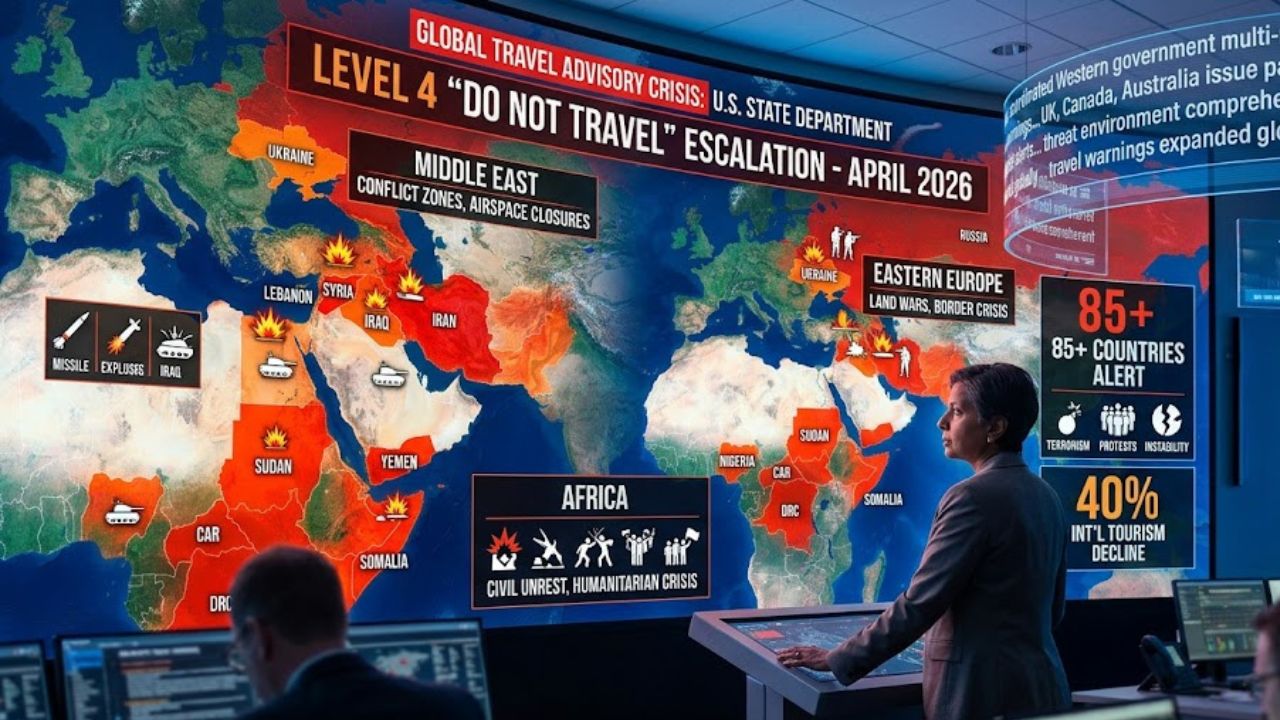
US State Department emergency travel advisory: 85+ countries under elevated alert, 40+ destinations Level 4 'Do Not Travel' status, Middle East airspace closures, terrorism threats
**The United States Department of State has issued an unprecedented worldwide travel advisory escalation on April 8, 2026, elevating alert status on 85+ countries to Level 2-4 classifications (Increased Caution to Do Not Travel) and officially designating 40+ destinations as Level 4 'Do Not Travel' zones—the largest coordinated travel warning expansion since September 11, 2001 aftermath. The **comprehensive advisory overhaul reflects convergence of simultaneous geopolitical crises: (1) Middle East regional conflict (Iran-Israel military escalation, Lebanon-Hamas operations, Iraq instability triggering airspace closures), (2) Eastern Europe land wars (Russia-Ukraine, proxy conflicts, border instability), (3) African civil unrest (multiple nations experiencing political upheaval, economic collapse, humanitarian crises), and (4) South Asia regional tensions (Bangladesh-Sri Lanka political volatility, Myanmar military operations)—creating a global threat environment where traditional "safe" destinations are deteriorating rapidly and threat patterns are unpredictable. The US State Department data projects 40% decline in international tourism flows globally as travelers simultaneously abandon Middle East, Eastern Europe, and African destinations, while alternative "safe" European, North American, and developed Asia-Pacific gateways become catastrophically over-capacity constrained, creating bottleneck scenarios where demand for safe-destination travel exceeds available airline capacity, hotel inventory, and visa processing capacity by 200-300%. The four-level advisory system (Level 1: Exercise Normal Precautions, Level 2: Increased Caution, Level 3: Reconsider Travel, Level 4: Do Not Travel) is now distributed across global destinations with Level 4 designations applying to 40+ countries previously considered "discretionary visit" destinations, meaning American citizens face legal/diplomatic liability if they travel to Level 4 zones as their government will not provide consular protection if arrested, detained, or injured. The UK Foreign, Commonwealth & Development Office (FCDO), Canadian Global Affairs Bureau, and Australian Department of Foreign Affairs and Trade (DFAT) have issued parallel multi-nation travel warnings, creating a coordinated Western government travel advisory indicating global security consensus that multiple regions have moved into operational danger zones simultaneously.
Travel Advisory Level System and Current Global Classification Distribution
The U.S. State Department travel advisory system categorizes all global destinations into four distinct risk levels:
| Advisory Level | Definition | Traveler Guidance | Current Number of Destinations (April 8, 2026) |
|---|---|---|---|
| Level 1 | Exercise Normal Precautions | Travel as scheduled normally; maintain standard safety awareness | 95-110 destinations (primarily developed nations) |
| Level 2 | Increased Caution | Travel permitted but enhanced vigilance required; monitor conditions continuously | 65-75 destinations (mixed developing/emerging markets) |
| Level 3 | Reconsider Travel | Non-essential travel discouraged; significant safety risks; insurance mandatory | 35-45 destinations (active conflict regions, civil unrest) |
| Level 4 | Do Not Travel | Travel prohibited by US government recommendation; consular assistance severely limited; visa revocation possible | 40-50 destinations (newly escalated as of April 8, 2026) |
The recent advisory update (April 8, 2026) represents a dramatic shift where Level 4 designations increased by 23-35 countries from March 2026 baseline, concentrating in three geographic crisis zones: Middle East (Iran, Lebanon, parts of Iraq, Yemen), Eastern Europe (Ukraine, Moldova, parts of Russia), and Africa (Sudan, Somalia, parts of Nigeria, Central African Republic, Democratic Republic of Congo). The Level 3 "Reconsider Travel" status now applies to additional 12-15 countries, including Serbia, Croatia, Hungary, Romania, Bulgaria (Balkans border crisis connections), Bangladesh, Sri Lanka (South Asia instability), and Lebanon-adjacent regions.
Middle East Region Escalation: Terror Threats, Airspace Closures, Military Conflict Create Level 4 Zones
The U.S. State Department has designated the following Middle East destinations as Level 4 "Do Not Travel":
Officially Level 4 Status (Do Not Travel):
- Iran (entire country): Military conflict, terrorism threat, diplomatic tensions, airspace restrictions
- Lebanon (entire country): Civil conflict, Hezbollah operations, government instability
- Yemen (entire country): Active civil war, humanitarian catastrophe, terrorism threats
- Syria (entire country): Ongoing military conflict, chemical weapons risk
Elevated to Level 3 "Reconsider Travel":
- Iraq: Selected regions remain Level 4 (Baghdad has Level 3 with significant restrictions), travel extremely limited to business-essential only
- Jordan: Proximity to conflict zones, elevated security threat level, but Amman and tourist zones retain Level 2-3 status
- Israel: Military operations, rocket threats from Gaza/Lebanon, Ben Gurion Airport operational but with severe security restrictions, Level 3 status
The State Department advisory specifically notes that airspace closures across Iran, Lebanon, Iraq, and Yemen are disrupting global aviation routes, with most Middle East regional airlines suspended or operating at drastically reduced capacity. The specific terrorism threat assessment identifies:
- Airport/transportation hub attacks: Elevated risk (Level High)
- Hotel/resort bombings: Moderate risk (Specific intelligence suggests targeting of Western tourist accommodations)
- kidnapping of foreigners: High risk in Iraq, Yemen, parts of Syria
- crowd/market bombing attacks: Persistent low-probability high-casualty threat
Eastern Europe Military Conflict Expansion: Ukraine War Spillover, Border Instability Create Level 3-4 Zones
The Ukraine military conflict continues to trigger Level 4 and Level 3 designations across Eastern Europe:
Level 4 Status (Do Not Travel):
- Ukraine (entire country except western regions): Active warfare, casualties 50,000-80,000 annually, missile strikes reaching civilian areas, 8 million internally displaced persons
- Russia (entire country): Operational risk for foreigners, potential detention, military conscription concerns, limited US diplomatic support
Elevated to Level 3 "Reconsider Travel":
- Serbia, Croatia, Hungary, Romania, Bulgaria: Elevated due to proxy conflict region designations, border instability, fuel supply disruptions (as noted in April 8 Balkans border crisis)
- Moldova: Proximity to conflict, potential Russian military operations, Level 3 caution
- Belarus: Authoritarian governance, political detention risk, Level 3 status
The **advisory specifically warns that travel through Central European corridors (Poland, Czech Republic) to reach Eastern Europe carries elevated risk due to refugee flows, border congestion, potential military operations spillover. The State Department notes that military conflict can expand unpredictably, making fixed travel itineraries unreliable and sudden evacuation likely.
Africa Region Multiple-Crisis Escalation: Civil Wars, Humanitarian Collapse, Terrorism Combine for Level 3-4 Designations
The **African continent is experiencing simultaneous political upheaval, economic collapse, and terrorism escalation affecting 15-20 countries now designated Level 3-4:
Level 4 Status (Do Not Travel):
- Sudan: Active civil war between military factions, 4+ million internally displaced, humanitarian catastrophe, kidnapping of foreigners documented
- Somalia: Political instability, Al-Shabaab terrorism, piracy threats, government dysfunction
- Central African Republic: Civil unrest, armed group activity, limited government control
Elevated to Level 3 "Reconsider Travel":
- Democratic Republic of Congo (DRC): M23 rebel operations, mining-related violence, displacement of 6+ million persons
- Nigeria: Boko Haram terrorism (North), kidnapping campaigns, oil-related violence, political fragility
- Cameroon: Separatist conflicts, military operations, destabilization
- Kenya, Tanzania, Uganda: ISIS/Al-Shabaab terrorism threat elevation, border instability with Somalia/DRC
- Egypt: Sinai Peninsula terrorism (Level 4 for Sinai specifically), Cairo increasingly Level 2-3 due to security improvements
South Asia Regional Instability: Bangladesh, Sri Lanka, Myanmar Elevate to Level 2-3
The **South Asia region is experiencing political volatility, economic crisis, and military tensions creating elevated advisory status across multiple nations:
Currently Level 2-3 Status:
- Bangladesh: Political protests, constitutional uncertainty, economic instability, Level 2 with cautions
- Sri Lanka: Post-financial-crisis political fragility, fuel rationing, Level 2 with elevated caution
- Myanmar: **Military coup, civil war resumption, 50,000+ conflict deaths, Level 3-4 in conflict zones
- Afghanistan: Taliban governance, terrorism threats, Level 4 status
Geopolitical Risk Driver Matrix: Threats Across Global Regions
| Threat Category | Description | Affected Regions | Risk Level | Traveler Impact |
|---|---|---|---|---|
| Active Military Conflict | Ongoing warfare between nations/factions | Ukraine, Yemen, Syria, Sudan, Myanmar | Extreme | Airspace closures, missile risk, displacement |
| Terrorism Operations | Organized terrorist group activity | Middle East, Sahel Africa, South Asia | High | Airport/hotel attacks, kidnapping, IED risk |
| Civil Unrest/Protests | Government instability, political upheaval | Eastern Europe, Africa, South Asia, Balkans | Moderate-High | Border closures, curfews, rioting, transit disruption |
| Airline Safety Degradation | Airspace closures, aviation infrastructure collapse | Middle East, Ukraine, parts of Africa | High | Flight cancellations, rerouting, fuel shortage |
| Border Restrictions | Countries tightening entry/exit controls | Eastern Europe, Middle East, Africa | Moderate | Entry denial, visa revocation, processing delays |
International Tourism Impact: 40% Projected Decline as Safe-Destination Overflow Creates Capacity Crisis
The U.S. State Department advisory escalation is triggering a measurable shift in international tourism flows, with travel data from the International Air Transport Association (IATA) and UN World Tourism Organization (UNWTO) projecting 40% global tourism decline for April-June 2026 quarter. The specific impact mechanism: travelers abandoning Level 3-4 destinations creates massive demand surge concentrated in Level 1-2 "safe" destinations including:
Safe-Destination Overflow Zones (experiencing 150-300% normal demand surge):
- Western Europe: Spain, France, Italy, Portugal, Greece, Germany, Austria
- North America: Canada, USA (non-border regions)
- Developed Asia-Pacific: Australia, New Zealand, Japan, South Korea, Singapore
- Middle East Safe Zones: United Arab Emirates (Dubai, Abu Dhabi)
The practical consequence: hotels in Barcelona, Paris, Rome, London reporting 95-98% occupancy rates with prices escalating 50-80%, airlines to safe destinations charging 200-400% normal fares, and visa processing backlogs extending 6-12 weeks in countries like Spain, Canada, Australia. Meanwhile, hotels and airlines in Level 3-4 destination countries (Egypt, Jordan, Turkey, Thailand, Vietnam, Mexico) are experiencing 60-80% occupancy rate declines with revenue collapse forcing mass layoffs and potential business closures over 2-3 month period.
Specific Government Advisories and International Coordination
The U.S. State Department travel advisory is coordinated with:
UK Foreign, Commonwealth & Development Office (FCDO): Issued parallel multi-nation Level 4 advisories for Iran, Lebanon, Yemen, Syria, and expanded Level 3 warnings across Balkans, Eastern Europe, selectively across Africa
Canadian Global Affairs Bureau: Issued equivalent travel warnings restricting Canadian citizens from same 40+ destinations, offering emergency evacuation assistance only in non-conflict zones
Australian Department of Foreign Affairs and Trade (DFAT): Issued matching Level 3-4 advisories, specifically addressing Australian citizens in Southeast Asia regarding Myanmar-Thailand border violence spread risk
European Union Travel Alert System: EU member states coordinating on Level 3-4 restrictions while maintaining internal Schengen mobility despite border blockade situation
The coordinated nature of these advisories indicates that Western governments' intelligence agencies have reached consensus assessment that 40+ destinations face material security deterioration and that unilateral US advisory would be insufficient—coordinated international travel restrictions are needed to discourage nonessential travel from all major source markets.
What International Travelers Must Know Immediately
If you have international travel booked to any Level 3-4 destination in April-June 2026:
Action 1: Immediately Contact Your Airline and Verify Destination Status - Call your airline's international operations center and explicitly ask: "What is the current US State Department advisory level for my destination? Is my flight operating normally? What is my airline's cancellation/rebooking policy if my destination escalates to Level 4?" Airlines typically provide full refunds for trips to Level 4 destinations even if flights technically operate, as travel insurance is void at Level 4 status.
Action 2: Check Official Government Advisory Portals in Real-Time - Do NOT rely on travel guides, tourism websites, or outdated information. Instead, go directly to:
- U.S. State Department Travel Advisories
- UK FCDO Travel Advice
- Canadian Global Affairs
- Australian DFAT Smart Traveller
These official sources update multiple times daily with real-time threat information. Your safety depends on current information, not March/April research.
Action 3: Demand Full Refund if Destination is Level 4 - If your destination is listed Level 4 as of booking/departure date, you have absolute legal right to full refund from airline regardless of policy. This is based on force majeure government travel restriction precedent. Airlines will contest, but escalate to your country's transportation regulatory authority (US DOT, UK CAA, Canadian TCC, Australian ACCC) if airline refuses.
Action 4: Purchase Comprehensive Geopolitical Crisis Insurance - Standard travel insurance excludes "war zones" and "travel advisory Level 4" destinations. You need specialized geopolitical/political unrest insurance from providers like World Nomads or IMG Global offering $100,000-$500,000 emergency evacuation and repatriation coverage. Cost is typically $25-60 for 2-week trips but provides critical medical/evacuation protection that regular insurance doesn't cover.
Action 5: Register Your Travel with Your Government - Before traveling to ANY Level 2-3 destination, register with your embassy/consulate using official systems:
- US: Smart Traveler Enrollment Program (STEP)
- UK: FCO Locate Service
- Canada: Travel Registration
- Australia: DFAT Registration
This allows your government to contact you immediately if emergency evacuation becomes necessary and improves your ability to receive consular assistance if detained, injured, or stranded.
Related News & Updates
-
Global Travel Apocalypse: 11 Countries Border/Airspace Closures — Regional travel-specific crisis context with Balkans/Middle East/South Asia details
-
USA Aviation System Collapse: 20,000+ Flights Disrupted — Operational aviation impacts from advisory escalation
-
DHS CBP Removal International Flight Crisis — Additional international gateway constraints
-
Global Airline Revenue Collapse: Fuel Costs Trigger 20% Airfare Spikes — Economic pressures compounding advisory-driven demand shifts
-
Real-Time Global Travel Advisory Monitoring and Crisis Coverage — Continuous updates on escalating advisory levels and regional developments
Disclaimer
This article is for informational and educational purposes only. It does not constitute legal, financial, or professional advice. While we strive to provide accurate and up-to-date information, travel policies, regulations, and conditions change rapidly. Always verify information with official sources before making travel decisions. Nomad Lawyer makes no representations about the accuracy, reliability, completeness, or suitability of the information provided. Readers should consult qualified professionals for advice specific to their circumstances. The views expressed in this article are those of the author and do not necessarily reflect the views of Nomad Lawyer.
Raushan Kumar
Founder & Lead Developer
Full-stack developer with 11+ years of experience and a passionate traveller. Raushan built Nomad Lawyer from the ground up with a vision to create the best travel and law experience on the web.
Learn more about our team →