
US Flight Cancellations and Delays Spike Across Texas Hubs: Complete Air Passenger Survival Guide
Over 5,500 flight delays and 195 cancellations ripple through Texas and Midwest hubs due to weather and runway projects. Here is how travelers can navigate rebookings and claim cash refunds.

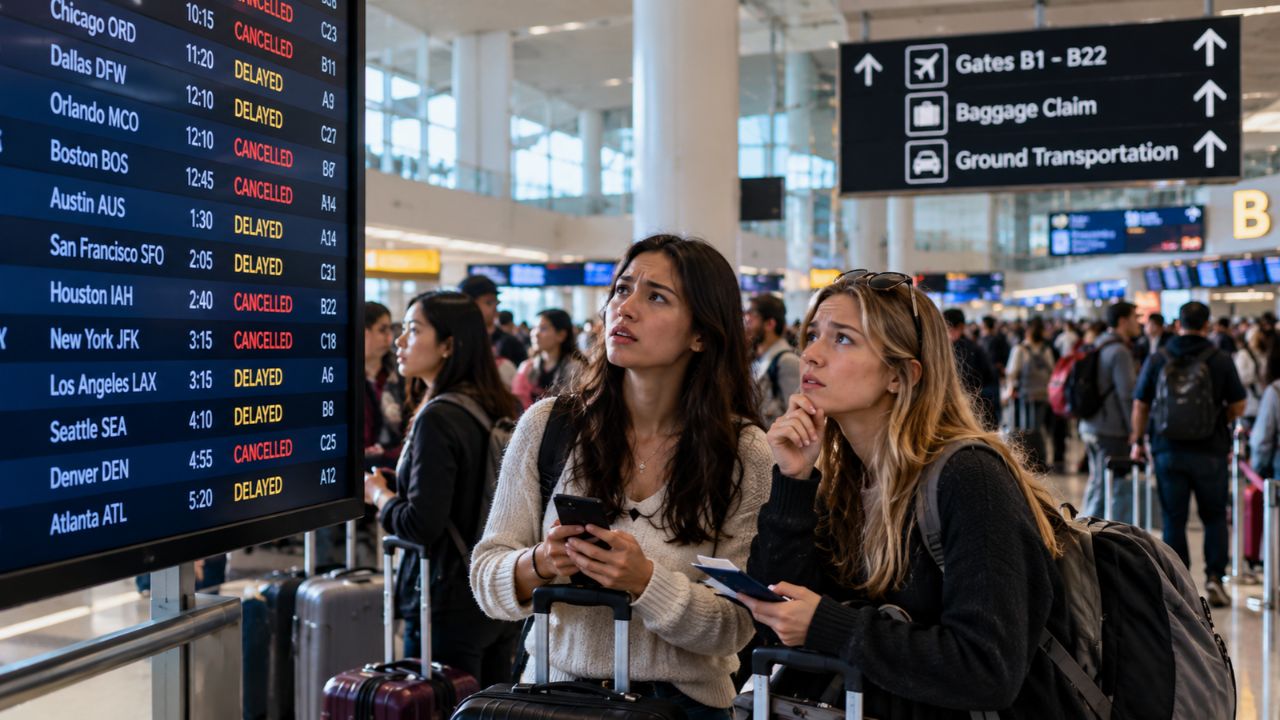
Austin-Bergstrom International Airport registered a staggering 26% departure and 29% arrival delay rate as runaway construction and regional thunderstorm aftermath converged to trigger over 5,535 delays and 195 cancellations across the American airspace network. At Dallas-Fort Worth alone, 389 flights fell behind schedule alongside 27 complete cancellations, stranding thousands of connecting passengers across major cross-country air corridors.
Compounding Airspace Bottlenecks Across Texas and Midwest Gateways
The nationwide aviation disruption initially logged 3,621 flight delays and 169 cancellations before snowballing to 5,535 delayed services and 195 outright cancellations by 6:30 p.m. Eastern Time. Rather than stemming from a single isolated failure, the disruption represents a multi-layered chain reaction where severe convective storms, planned airport infrastructure overhauls, and dense air traffic volume collided across high-capacity transit nodes.
The core breakdown originated in Texas, where severe storms lingering over the Dallas-Fort Worth metroplex displaced flight crews and left aircraft out of position. Dallas-Fort Worth International Airport (DFW) recorded 389 delays (a 16% departure delay rate and 19% arrival delay rate) and 27 cancellations. Nearby Dallas Love Field (DAL) logged 90 delays and 13 cancellations, with 12% of both departures and arrivals running behind schedule. Because American Airlines routes a vast portion of its transcontinental fleet through DFW, and Southwest Airlines centers operations around Dallas Love, the regional backlog quickly rippled into secondary hubs.
Infrastructure constraints further intensified delays in the Northeast and Central Texas. The Federal Aviation Administration instituted ground delay programs averaging 65 minutes at Boston Logan International Airport (BOS) and 68 minutes at Austin-Bergstrom International Airport (AUS) due to active runway reconstruction projects. Boston Logan experienced 247 delays and 6 cancellations (a 14% departure and 22% arrival delay rate), while Austin saw 230 delays and 7 cancellations.
In Florida, the FAA enforced temporary ground stops at Orlando International Airport (MCO) due to intense lightning storms, resulting in 177 delays, 4 cancellations, and a 16% arrival delay rate. On the West Coast, low cloud ceilings and marine fog layers prompted air traffic controllers at San Francisco International Airport (SFO) to widen aircraft separation intervals, generating FAA ground holds averaging 69 minutes alongside 218 delays and 2 cancellations. At Chicago O'Hare International Airport (ORD), managed by the Chicago Department of Aviation, heavy connecting passenger volume produced 290 delays and 23 cancellations despite clear local weather.
Major Carrier Operational Impacts and Regional Hotspots
Airlines with heavy concentrations in Texas and the Midwest absorbed the heaviest operational hits. Southwest Airlines led domestic carriers in total schedule disruptions, logging 1,013 delays and 24 cancellations. American Airlines recorded 582 delays and 16 cancellations, driven primarily by connection backlogs at its DFW home base. United Airlines posted 251 delays and 26 cancellations across Chicago O'Hare and Houston George Bush Intercontinental Airport (IAH), where Houston itself logged 117 delays (8% departures, 9% arrivals) and 7 cancellations.
Regional carriers also experienced severe operational friction:
- Envoy Air: 96 delays and 16 cancellations serving regional American Eagle connections.
- Alaska Airlines: 66 delays and 31 cancellations across West Coast routes.
- Tradewind Aviation: 27 cancellations with zero reported delays on specialized island links.
- Island and Remote Hubs: Daniel K. Inouye International in Honolulu logged 30 delays and 12 cancellations; Anchorage recorded 33 delays and 14 cancellations; Luis Muñoz Marín in San Juan posted 30 delays and 13 cancellations; Nantucket recorded 8 delays and 14 cancellations.
Airport Disruption and Delay Benchmark Comparison
| Airport Hub | Code | Total Delays | Total Cancellations | Departure Delay Rate | Arrival Delay Rate | Primary Disruption Factor |
|---|---|---|---|---|---|---|
| Dallas-Fort Worth | DFW | 389 | 27 | 16% | 19% | Severe storm aftermath & crew displacement |
| Chicago O'Hare | ORD | 290 | 23 | 10% | 9% | Cascading connecting volume |
| Boston Logan | BOS | 247 | 6 | 14% | 22% | Runway construction (avg 65m ground delay) |
| Austin-Bergstrom | AUS | 230 | 7 | 26% | 29% | Runway maintenance (avg 68m ground delay) |
| San Francisco | SFO | 218 | 2 | Variable | Variable | Low cloud ceilings (avg 69m ground hold) |
| Orlando | MCO | 177 | 4 | Variable | 16% | Active thunderstorm ground stops |
| Houston Bush | IAH | 117 | 7 | 8% | 9% | Flow control & regional transfers |
| Dallas Love Field | DAL | 90 | 13 | 12% | 12% | Southwest network rotation delays |
Visitor Insider Tips
- Triggering Mandatory Cash Refunds Under DOT Rules: If your flight is canceled or experiences a significant delay (defined as 3 hours or more for domestic itineraries and 6 hours for international flights), federal regulations established by the U.S. Department of Transportation mandate a prompt, full cash refund to your original payment method. To receive this automatic cash reimbursement, you must explicitly decline any rebooking alternatives or airline travel vouchers offered at the gate or through the mobile app.
- The Dual-Channel Rebooking Tactic: When a cancellation occurs and you wish to travel, do not join a two-hour terminal customer service line. Immediately open your airline's smartphone app to search for open seats on later flights while simultaneously dialing the airline's international English-language support line (such as the UK, Australian, or Canadian call centers), which generally have zero wait times.
- Distinguishing Controllable from Uncontrollable Delays: Airlines are legally bound by their published commitments on the DOT Customer Service Dashboard to provide complimentary meal vouchers and hotel accommodations during controllable delays (such as maintenance issues or crew scheduling shortages). For weather-related ground stops or FAA flow control programs, carriers are not required to cover accommodation, making comprehensive travel insurance essential.
- Routing Around Construction Bottlenecks: When booking connecting flights through Texas or the Northeast during active runway construction periods, select morning departures scheduled before 8:30 AM. Morning flights benefit from freshly positioned aircraft and crews, avoiding the cascading 60-to-70-minute ground delays that build across afternoon arrival banks.
Cultural and Environmental Context
Modern commercial aviation operates on razor-thin turnaround margins, meaning weather events in one state trigger flight cancellations thousands of miles away. As major airports undertake long-overdue runway rehabilitation projects to accommodate quieter, next-generation aircraft, short-term capacity reductions inevitably create travel friction.
Simultaneously, intensifying seasonal thunderstorm patterns across the Gulf Coast and Southern Plains highlight the growing vulnerability of hub-and-spoke transit models. Airlines and regional transport authorities are increasingly investing in localized rail corridors and decentralized point-to-point flights to reduce reliance on mega-hubs vulnerable to single-point weather closures.
FAQ: Navigating US Flight Disruptions in 2026
What qualifies as a significant flight delay eligible for a cash refund?
Under Department of Transportation regulations, a domestic delay of at least 3 hours or an international delay of at least 6 hours qualifies for a full cash refund if you decline the alternative flight.
Will airlines pay for my hotel if my flight is canceled due to bad weather?
No. Weather events, FAA ground delays, and natural conditions are classified as uncontrollable delays, exempting airlines from federal mandates to provide complimentary lodging or meals.
Are airlines required to book me on a competing carrier after a cancellation?
Federal rules do not require airlines to book you on a rival carrier unless they have voluntarily committed to doing so within their official customer service agreement.
Why do morning flights experience fewer delays during network disruptions?
Early morning flights use aircraft parked at gates overnight and fresh flight crews, escaping the compound delays that accumulate as air traffic control slows later afternoon arrival banks.
Mastering Department of Transportation refund rules and airport connection dynamics is the ultimate defense against nationwide air travel gridlock.
Related Travel Guides
Disclaimer
This article is for informational and educational purposes only. It does not constitute legal, financial, or professional advice. While we strive to provide accurate and up-to-date information, travel policies, regulations, and conditions change rapidly. Always verify information with official sources before making travel decisions. Nomad Lawyer makes no representations about the accuracy, reliability, completeness, or suitability of the information provided. Readers should consult qualified professionals for advice specific to their circumstances. The views expressed in this article are those of the author and do not necessarily reflect the views of Nomad Lawyer.
Raushan Kumar
Founder & Lead Developer
Full-stack developer with 11+ years of experience and a passionate traveller. Raushan built Nomad Lawyer from the ground up with a vision to create the best travel and law experience on the web.
Learn more about our team →