
US Air Travel Chaos 2026: 4,658 Flight Delays and 198 Cancellations Hit Chicago, Dallas, and SFO
Massive disruptions across the United States have resulted in 4,658 flight delays and 198 cancellations, with Chicago O'Hare experiencing the most severe impact due to thunderstorms.

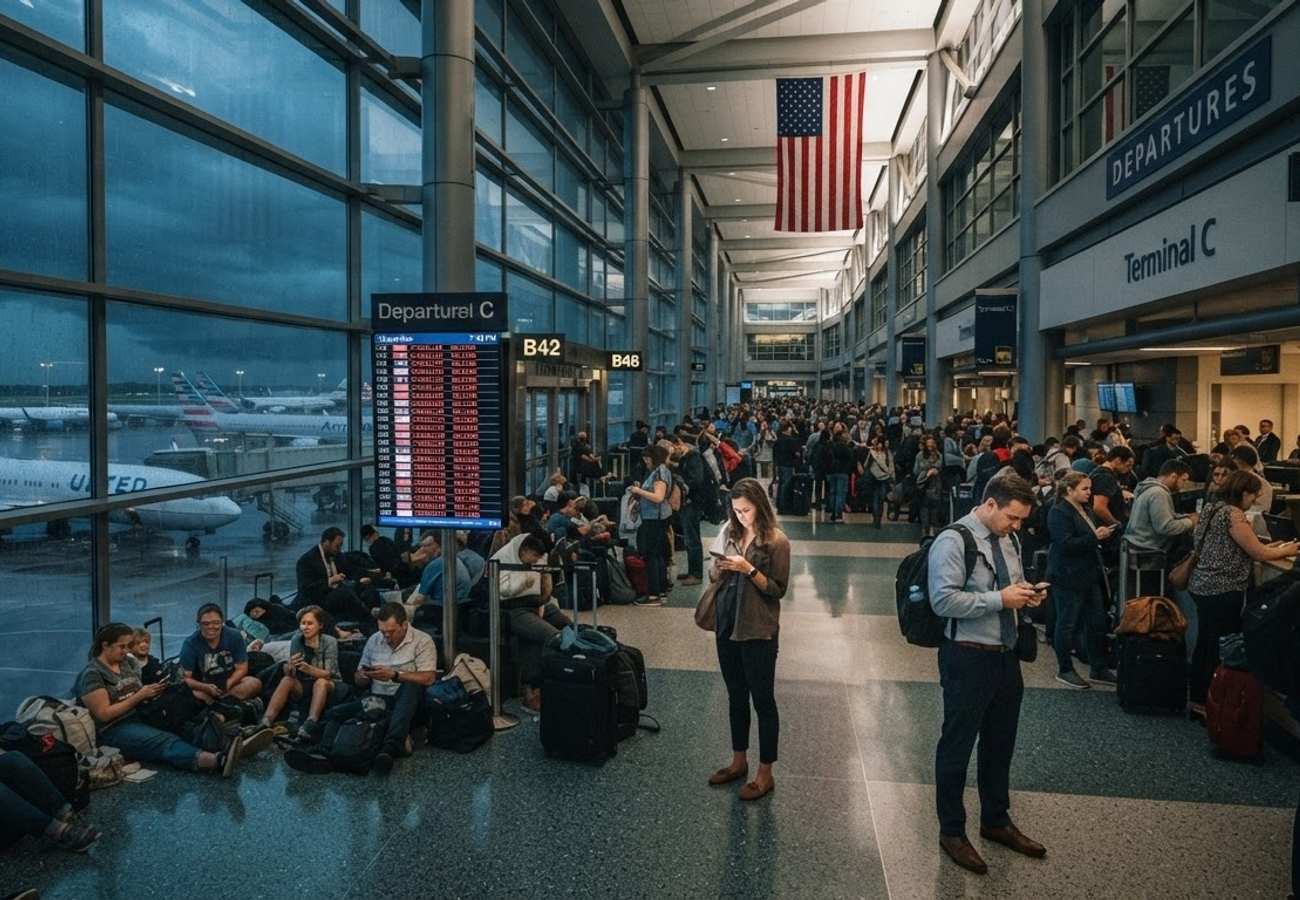
Image generated by AI
Severe weather and operational bottlenecks have triggered a nationwide aviation crisis, leaving 4,658 flights delayed and 198 cancelled across the United States. The disruption is centered heavily in major hubs including Chicago, San Francisco, and Dallas, forcing thousands of passengers into unexpected airport waits.
The current instability in the US airspace is a result of a "perfect storm" of meteorological challenges and volume-based congestion. While some regions are battling severe thunderstorms, others are facing visibility issues and sheer traffic saturation. According to flight tracking data, the ripple effects are being felt from the East Coast to the West Coast, with several major carriers struggling to maintain their schedules.
Chicago O'Hare Faces Severe Thunderstorm Disruptions
Chicago O’Hare International Airport (ORD) has emerged as the primary epicenter of today's travel turmoil. The facility is reporting a staggering 1,282 delays and 127 cancellations, the highest figures of any single airport in the country.
Federal Aviation Administration (FAA) data indicates that departures from O'Hare are currently averaging 90 minutes behind schedule. Officials warn that these delays are not static but are actively increasing as thunderstorms continue to move through the region. For passengers transiting through the Midwest, this represents the most significant time loss in the current national network.
Visibility Issues Trigger San Francisco Ground Delays
On the West Coast, San Francisco International Airport (SFO) is grappling with a different set of challenges. Low ceilings—a meteorological condition where cloud cover remains close to the ground—have severely limited visibility for arriving and departing aircraft.
This has resulted in 326 delays and five cancellations. The FAA has implemented a ground delay averaging 66 minutes, meaning aircraft are being held at their origin airports to prevent congestion in the San Francisco airspace.
Operational Pressure at Phoenix, Dallas, and Denver
The disruption extends deep into the interior of the US, where three major hubs are reporting significant bottlenecks. Phoenix Sky Harbor International Airport has recorded 284 delays and nine cancellations.
Similarly, Dallas-Fort Worth International Airport is seeing 259 delays and six cancellations, while Denver International Airport reports 251 delays and five cancellations. These figures highlight a broader trend of instability affecting the central US flight corridors.
Traffic Management Impacts Orlando and East Coast Hubs
In Florida, Orlando International Airport is reporting 174 delays and three cancellations. The FAA has noted an average departure delay of 30 minutes, which is currently trending upward. This specific disruption is attributed to a combination of weather and strategic traffic-management initiatives.
Further north and east, other major gateways are feeling the strain:
- Boston Logan International Airport: 191 delays and 19 cancellations.
- Hartsfield-Jackson International Airport (Atlanta): 188 delays and eight cancellations.
- San Diego International Airport: 177 delays and nine cancellations.
Notably, San Diego is experiencing an FAA ground delay averaging 27 minutes, which officials have attributed specifically to airport volume rather than weather.
Regional Breakdown of Airport Disruptions
The following data provides a comprehensive look at the current operational status across key US airports:
| Airport | Delays | Cancellations | FAA Average Delay | Primary Cause |
|---|---|---|---|---|
| Chicago O'Hare (ORD) | 1,282 | 127 | 90 Minutes | Thunderstorms |
| San Francisco (SFO) | 326 | 5 | 66 Minutes | Low Ceilings |
| Phoenix Sky Harbor | 284 | 9 | N/A | Operational/Weather |
| Dallas-Fort Worth | 259 | 6 | N/A | Operational/Weather |
| Denver International | 251 | 5 | N/A | Operational/Weather |
| Boston Logan | 191 | 19 | N/A | Operational/Weather |
| Atlanta Hartsfield-Jackson | 188 | 8 | N/A | Operational/Weather |
| San Diego International | 177 | 9 | 27 Minutes | Airport Volume |
| Orlando International | 174 | 3 | 30 Minutes | Weather/Traffic Mgmt |
| LaGuardia | 148 | 13 | N/A | Operational/Weather |
| Houston Bush Intercontinental | 86 | 5 | N/A | Operational/Weather |
| Washington Dulles | 84 | 5 | N/A | Operational/Weather |
Carrier Performance and Cancellation Rates
The instability is not distributed evenly across airlines. Southwest Airlines currently holds the highest number of delays in the US with 694 reported instances, though it has only eight cancellations. American Airlines follows closely with 612 delays and six cancellations.
However, when looking at total flight removals, SkyWest is the most impacted carrier.
| Airline | Delays | Cancellations |
|---|---|---|
| Southwest | 694 | 8 |
| American Airlines | 612 | 6 |
| United | 605 | 18 |
| SkyWest | 536 | 41 |
| Envoy Air | 240 | 27 |
| Republic | 138 | 16 |
Why This Matters: The Legal and Logistical Reality for Travelers
For the modern traveler, these numbers represent more than just statistics; they represent a potential breakdown in the "contract of carriage" between the passenger and the airline. From a logistical standpoint, the variety of causes—ranging from "Acts of God" (thunderstorms) to "controllable" issues (airport volume)—changes the nature of passenger rights.
When delays are caused by weather, airlines are generally not required to provide hotel vouchers or meals. However, when delays are caused by "airport volume" or "traffic management," passengers may have stronger grounds to request assistance or compensation under specific airline policies.
Furthermore, the disparity in delay times (from 27 minutes in San Diego to 90 minutes in Chicago) means that a "one size fits all" approach to airport arrival is no longer viable. Travelers are now required to monitor real-time FAA restrictions rather than relying on their original itinerary.
Current aviation data suggests that until the weather systems clear the Midwest, the ripple effect will continue to impact connecting flights across the entire North American network.
Related Travel Guides
Disclaimer
This article is for informational and educational purposes only. It does not constitute legal, financial, or professional advice. While we strive to provide accurate and up-to-date information, travel policies, regulations, and conditions change rapidly. Always verify information with official sources before making travel decisions. Nomad Lawyer makes no representations about the accuracy, reliability, completeness, or suitability of the information provided. Readers should consult qualified professionals for advice specific to their circumstances. The views expressed in this article are those of the author and do not necessarily reflect the views of Nomad Lawyer.
Raushan Kumar
Founder & Lead Developer
Full-stack developer with 11+ years of experience and a passionate traveller. Raushan built Nomad Lawyer from the ground up with a vision to create the best travel and law experience on the web.
Learn more about our team →