
United Airlines Flight UA1815 Diverts to Huntsville International Airport During San Francisco to Nashville Route
United Airlines Flight UA1815 was forced to divert to Huntsville International Airport on August 4, 2026, after an unplanned route change during its journey from San Francisco to Nashville.

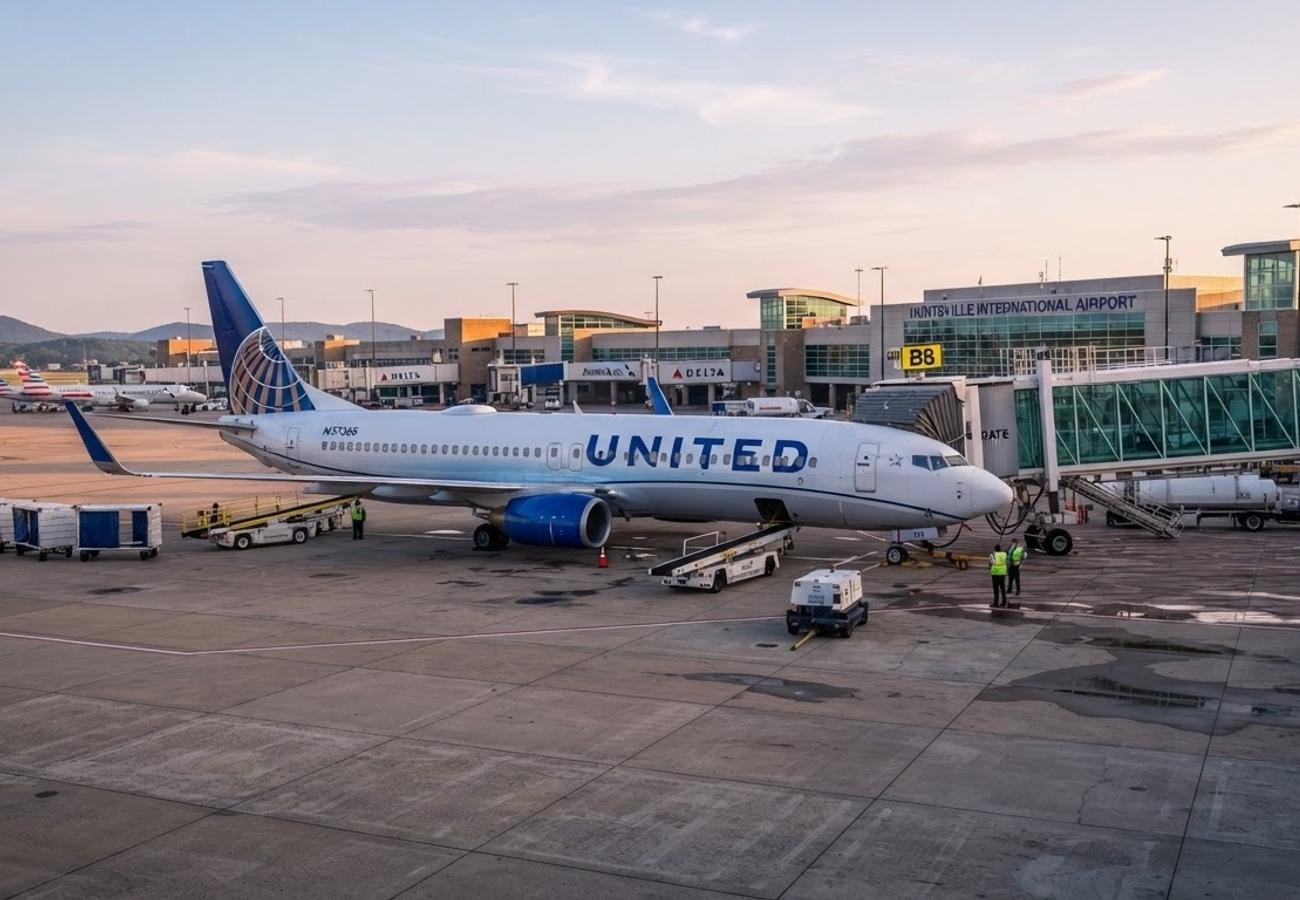
Image generated by AI
[Huntsville, AL] — A scheduled United Airlines flight from the West Coast was forced to change course on August 4, 2026, resulting in an unplanned landing at Huntsville International Airport. Flight UA1815, bound for Nashville, diverted to the Alabama facility, causing significant arrival delays for all passengers on board.
The incident involved a Boeing 737-900, which successfully touched down at the alternate airport after departing from California. While the aircraft arrived safely, the deviation from the original flight path required immediate logistical adjustments by both the flight crew and ground operations teams.
Flight Path Disruption from San Francisco to Nashville
The journey began on the night of Monday, August 3, 2026, with Flight UA1815 (also identified by flight code UAL1815) preparing for its transit from San Francisco International Airport (SFO) to Nashville International Airport (BNA). The aircraft, a Boeing 737-900 registered as N81449, was tasked with connecting the California coast to Tennessee.
According to flight tracking data, the aircraft pushed back from Gate F14 at San Francisco International Airport at approximately 12:51 AM PDT. The flight was proceeding according to its scheduled window until a decision was made to divert the aircraft to Huntsville International Airport (HSV) in Alabama.
The aircraft eventually touched down at Gate B8 in Huntsville at approximately 7:41 AM CDT on Tuesday, August 4. This unplanned stop fundamentally altered the travel itinerary for those on board, extending the total travel time and delaying the final leg of the journey to Tennessee.
Operational Factors Leading to the Huntsville Diversion
While the diversion is confirmed, official reports have not yet released a specific catalyst for the route change. In commercial aviation, such redirections are typically triggered by a narrow set of operational necessities. Industry observers indicate that diversions generally stem from one of the following categories:
- Environmental Conditions: Severe weather or unexpected turbulence at the destination airport.
- Technical Considerations: Mechanical anomalies that do not pose an immediate emergency but require inspection before further flight.
- Passenger Welfare: On-board medical emergencies requiring urgent hospital access.
- Air Traffic Control (ATC) Mandates: Airport congestion or runway closures at the primary destination.
The decision to land at Huntsville International Airport suggests that the flight crew identified HSV as the most viable and safest alternative based on the aircraft's fuel state and the nature of the disruption. The successful execution of the landing confirms that standard aviation safety protocols were followed.
Impact on Passengers and Nashville Arrival Logistics
The diversion created immediate complications for passengers who had expected a direct arrival in Nashville. By landing in Huntsville at 7:41 AM CDT, the aircraft arrived significantly later than the original scheduled time for Nashville International Airport.
For the travelers on UA1815, this disruption likely triggered a domino effect of logistical issues. Passengers with tight connecting flights, pre-arranged ground transportation, or time-sensitive business appointments in Tennessee faced unexpected delays.
In these scenarios, airlines are tasked with coordinating "recovery" logistics. This typically includes arranging shuttle services, rebooking connecting flights, or providing hotel vouchers if the delay extends overnight. The final resolution for the passengers depended on the specific reason for the diversion and the availability of replacement aircraft or crew.
Aviation Network Resilience and Safety Protocols
The UA1815 incident serves as a practical example of the redundancies built into the U.S. aviation system. The ability to pivot from a major hub like Nashville to a regional facility like Huntsville International Airport demonstrates the critical role of alternate landing sites.
Commercial aviation relies on a constant stream of communication between the cockpit, dispatch centers, and air traffic controllers. When a flight cannot proceed to its destination, the priority shifts from "schedule adherence" to "risk mitigation." The use of a Boeing 737-900—a workhorse of the United Airlines fleet—allows for flexibility in landing at various airport sizes, provided the runway length and ground support are adequate.
Logistics Summary of Flight UA1815
| Detail | Information |
|---|---|
| Flight Number | UA1815 / UAL1815 |
| Aircraft Model | Boeing 737-900 |
| Registration | N81449 |
| Departure Airport | San Francisco International (SFO) |
| Departure Gate | F14 |
| Departure Time | 12:51 AM PDT (Aug 3/4) |
| Planned Destination | Nashville International (BNA) |
| Diversion Airport | Huntsville International (HSV) |
| Arrival Gate (HSV) | B8 |
| Arrival Time (HSV) | 7:41 AM CDT (Aug 4) |
Why This Matters: The Traveler's Perspective
For the modern traveler, a diversion is more than a delay; it is a legal and logistical gray area. From a passenger rights standpoint, the "reason" for the diversion—whether it was "weather" (uncontrollable) or "mechanical" (controllable)—determines the level of compensation or assistance the airline is mandated to provide under the Department of Transportation (DOT) guidelines.
When a flight diverts to a city like Huntsville instead of Nashville, passengers are often left in a state of limbo. The experience highlights the necessity for travelers to maintain flexible travel insurance and to keep digital copies of their itineraries. Furthermore, it emphasizes that while "safe landing" is the primary goal of the pilot, the "passenger experience" often suffers during the transition from the aircraft to the final destination.
For those monitoring their flights, this incident underscores why real-time tracking and direct communication with airline apps are more valuable than relying on airport departure boards, which may lag behind actual flight path changes.
Awaiting further official statements from United Airlines regarding the specific cause of the diversion.
Related Travel Guides
Disclaimer
This article is for informational and educational purposes only. It does not constitute legal, financial, or professional advice. While we strive to provide accurate and up-to-date information, travel policies, regulations, and conditions change rapidly. Always verify information with official sources before making travel decisions. Nomad Lawyer makes no representations about the accuracy, reliability, completeness, or suitability of the information provided. Readers should consult qualified professionals for advice specific to their circumstances. The views expressed in this article are those of the author and do not necessarily reflect the views of Nomad Lawyer.
Raushan Kumar
Founder & Lead Developer
Full-stack developer with 11+ years of experience and a passionate traveller. Raushan built Nomad Lawyer from the ground up with a vision to create the best travel and law experience on the web.
Learn more about our team →