
United Airlines Flight UA2834 from New York LaGuardia to Denver Diverted to Wichita Dwight D Eisenhower National Airport
United Airlines Flight UA2834 from New York LaGuardia to Denver, operated by an Airbus A321neo (N14512), diverted to Wichita on July 7, 2026.

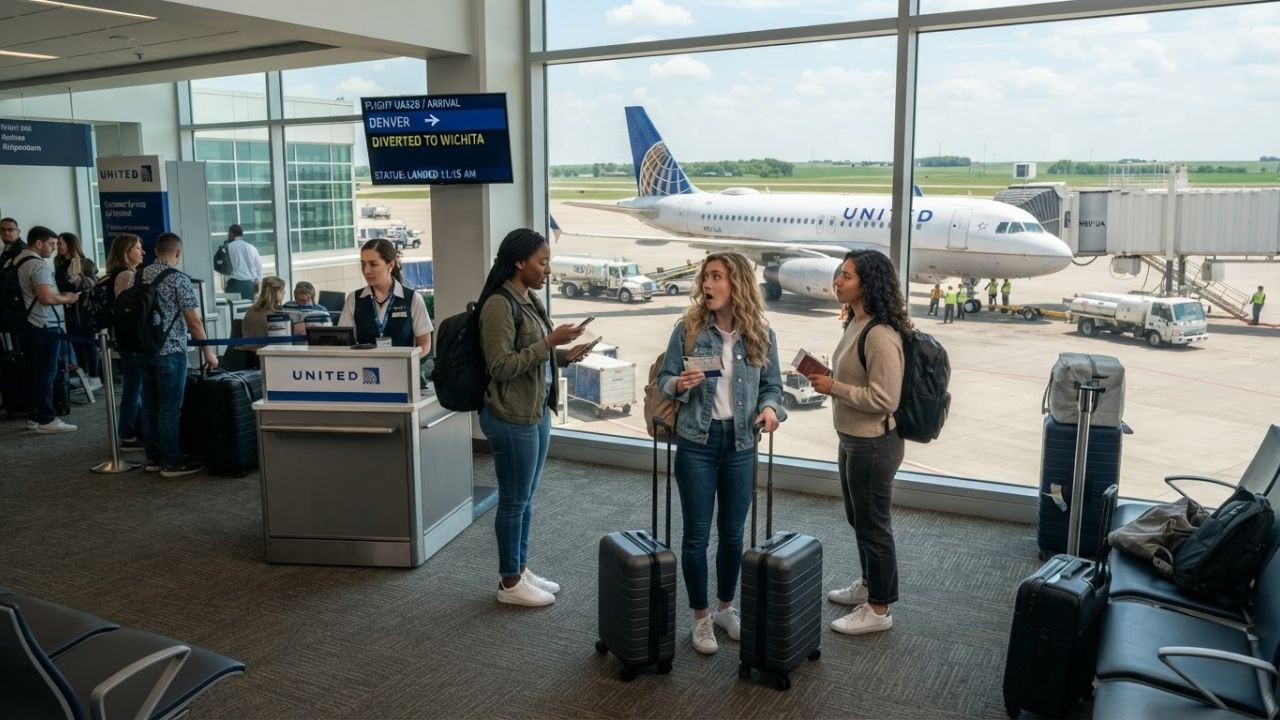
Image generated by AI
United Airlines Flight UA2834 from New York LaGuardia to Denver Diverted to Wichita Dwight D Eisenhower National Airport
SEO Title: United Airlines Flight UA2834 Diversion Wichita 2026 Meta Description: United Airlines Flight UA2834 from New York LaGuardia to Denver, operated by an Airbus A321neo (N14512), diverted to Wichita on July 7, 2026. Slug: /united-airlines-flight-2834-diversion-wichita-2026 Standfirst: United Airlines Flight UA2834, flying from New York LaGuardia to Denver on July 7, 2026, diverted to Wichita Dwight D. Eisenhower National Airport. The Airbus A321neo later resumed its journey to Denver after a temporary stop.
Article
[Wichita, July 9, 2026] — A domestic flight operating from the United States East Coast to the Rocky Mountain region experienced an unscheduled diversion on July 7, 2026. United Airlines Flight UA2834 was routing from New York LaGuardia Airport to Denver International Airport.
Flight tracking services, including FlightAware and Flightradar24, show that the aircraft diverted while transiting Midwestern airspace. The Airbus A321neo landed safely at Wichita Dwight D. Eisenhower National Airport in Kansas.
The carrier has not publicly confirmed the exact cause of the diversion. Flight tracking logs indicate that the flight path was altered while cruising, followed by a standard descent into Wichita.
Incident Flight Parameters and Route Interruption
The aircraft involved in the incident was an Airbus A321neo carrying registration N14512. Following the landing, the aircraft remained on the ground in Wichita for a brief servicing period.
United Airlines coordinated with local airport operations to prepare the aircraft for departure. The flight subsequently took off from Wichita to complete the remaining leg to Denver.
Passengers arrived at Denver International Airport later that evening. The airline managed the operational delay without requiring an aircraft swap or dispatching a replacement crew.
Post Diversion Operations and Passenger Recovery
Although the direct cause remains unverified, convective weather systems were active along the flight path. Thunderstorms and associated air traffic control restrictions caused widespread delays in the national airspace system.
During summer months, severe weather patterns regularly disrupt arrivals into Denver's high-altitude airfield. Air traffic controllers frequently implement holding patterns or route changes to manage arrival flows.
Wichita Dwight D. Eisenhower National Airport serves as a primary alternate airport for flights bound for Denver. The Kansas airfield has sufficient runway length and terminal facilities to accommodate mainline narrowbody aircraft.
Meteorological Conditions and Airspace Capacity Constraints
The diversion of Flight UA2834 demonstrates the operational flexibility built into domestic airline networks. Dispatchers and flight crews regularly assess fuel reserves and weather radar to choose safe alternate routes.
A decision to divert is a standard operating procedure designed to mitigate potential risks before they escalate. Airfields like Wichita provide ground handling services, refueling, and passenger support during irregular operations.
United Airlines maintains a significant presence at major midwestern transit points. This infrastructure allows the carrier to quickly resolve travel disruptions and return aircraft to scheduled rotations.
Data Table
United Airlines Flight UA2834 Diversion Profile
| Parameter | Operational Detail | Aircraft Specification |
|---|---|---|
| Flight Number | UA2834 / UAL2834 | Airbus A321neo |
| Registration Number | N14512 | Next-generation narrowbody |
| Origin Airport | New York LaGuardia (LGA) | Departed scheduled gate |
| Destination Airport | Denver International (DEN) | Scheduled arrival point |
| Diversion Airport | Wichita Dwight D. Eisenhower (ICT) | Safe unscheduled landing |
| Incident Date | July 7, 2026 | Summer operational season |
| Status | Completed to Denver | Delayed arrival |
Environmental and Airspace Factors
| Factor | Current Assessment | Operational Action |
|---|---|---|
| Weather Status | Active thunderstorms reported | Route adjustments required |
| Air Traffic Control | Traffic management program active | Arrival rate restrictions |
| Wichita Airport Facilities | Dwight D. Eisenhower National (ICT) | Alternate airport support |
| Passenger Impact | Temporary delay, travel completed | Normal customer assistance |
Why This Matters
This flight diversion highlights the growing reliance of US airlines on modern fleet types like the Airbus A321neo to manage schedule volatility. The A321neo has a longer range and better fuel efficiency than the older aircraft it replaces. This extra fuel margin gives flight crews more options when faced with Denver's notorious summer afternoon thunderstorms. Rather than holding in congested airspace and burning through critical fuel reserves, the crew could easily elect to divert to Wichita while maintaining sufficient fuel safety margins.
Our analysis of the flight path suggests that the diversion was likely a preemptive decision to avoid landing delays in Denver. Denver International Airport is a major hub where a delay on one flight can cause a chain reaction, affecting crew duty limits and subsequent flight connections across the country. Diverting to Wichita allows the airline to wait out the weather system in a controlled ground environment, which is often more efficient than holding in the air.
Additionally, this incident showcases the strategic importance of midwestern regional airports as safety valves for the national airspace. Without airports like Wichita that are capable of handling large mainline narrowbody jets on short notice, convective weather in the Midwest would cause far more severe disruptions, forcing flights to return to their East Coast origins.
Industry Outlook
Market trends suggest that airline dispatchers will increasingly utilize predictive weather modeling to plan flight routes during the summer storm season. Implementing these automated routing systems will help reduce the number of active diversions by routing flights around convective weather before departure.
Apart from routing improvements, airport operators in the Midwest are expanding their ground servicing capabilities to support diverted flights. Securing fast refueling services at alternate airports is essential to minimizing passenger delays during irregular operations.
Related Aviation News Guides
- Saudi Arabia Aviation Expansion Drives Massive Fleet Growth for Riyadh Air, flyadeal, and flynas
- Emirates to Deploy Second Daily Airbus A350 to Colombo Doubling Premium Economy Seat Capacity on Key South Asian Route in August 2026
- Thai Airways to Introduce Second Daily Paris to Bangkok Service Deploying Boeing 787-9 Dreamliner Starting December 2026
Disclaimer
This article is for informational and educational purposes only. It does not constitute legal, financial, or professional advice. While we strive to provide accurate and up-to-date information, travel policies, regulations, and conditions change rapidly. Always verify information with official sources before making travel decisions. Nomad Lawyer makes no representations about the accuracy, reliability, completeness, or suitability of the information provided. Readers should consult qualified professionals for advice specific to their circumstances. The views expressed in this article are those of the author and do not necessarily reflect the views of Nomad Lawyer.
Preeti Gunjan
Contributor & Community Manager
A passionate traveller and community builder. Preeti helps grow the Nomad Lawyer community, fostering engagement and bringing the reader experience to life.
Learn more about our team →