
United Airlines Flight UAL2027 Diverts to Salt Lake City Due to Severe Storms and Wind Shear in Denver Airspace
United Airlines Flight UAL2027, an Airbus A319-131 flying from Great Falls to Denver, diverted to Salt Lake City due to severe Front Range storms.

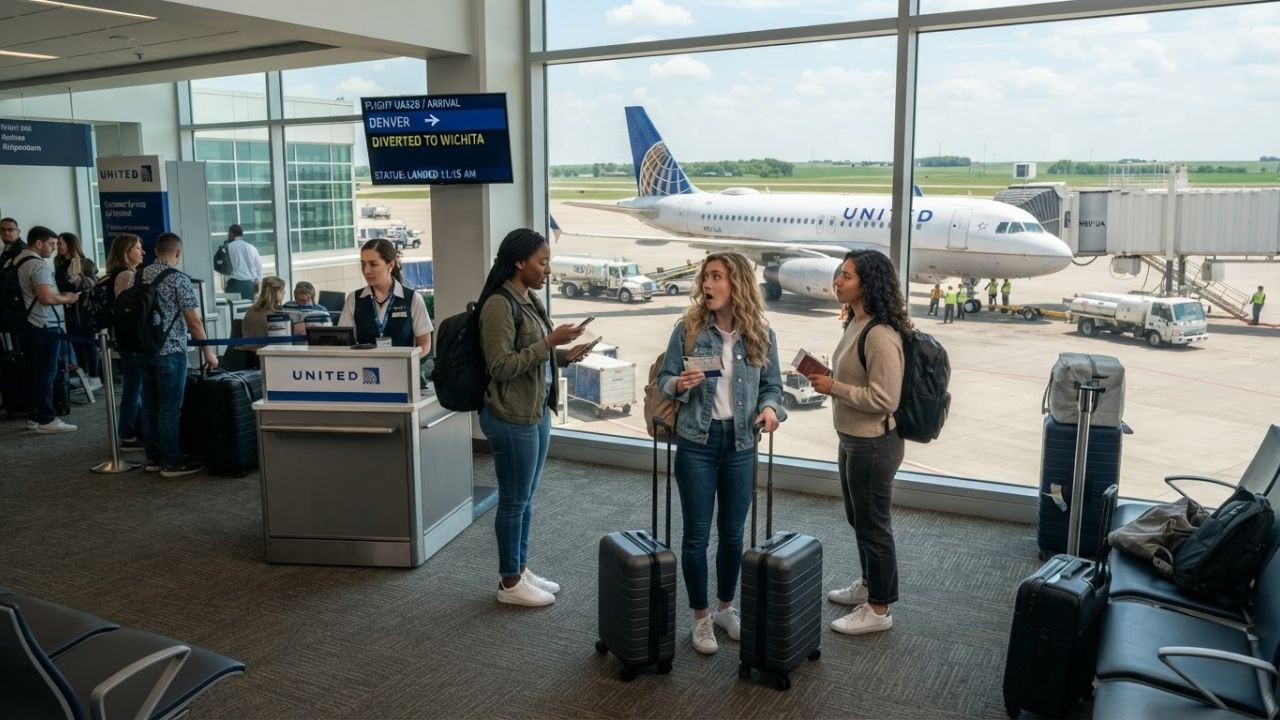
Image generated by AI
[Salt Lake City, July 9, 2026] — United Airlines flight UAL2027 executed an unscheduled diversion to Salt Lake City International Airport. The flight was operating from Great Falls International Airport in Montana to Denver International Airport.
The Airbus A319-131 entered a standard descent profile before encountering an active line of severe convective weather systems. Severe summer thunderstorms along the Colorado Front Range caused lightning and wind shear directly over the runways.
Faced with deteriorating weather trends, air traffic control instructed several commercial airframes to enter holding patterns. The crew determined that a prolonged hold would compromise the safety margins of the flight.
Operational Choice of Salt Lake City as diversion Hub
When weather prevents a landing, the flight deck coordinates with the airline's dispatch office to select a suitable alternate. Salt Lake City International Airport was chosen due to its favorable localized weather conditions and long runway capacity.
The twin-engine Airbus A319-131 touched down smoothly on the main runway without further operational incident. Ground handling teams immediately met the aircraft to perform safety checks and coordinate refueling.
Passengers experienced an unexpected delay while waiting for the thunderstorm cells over Denver to clear. The aircraft remained parked until conditions allowed for a safe departure to the original destination.
Technical Warning Systems and Macroburst Risk Mitigation
The decision to divert was triggered by a macroburst warning issued by Denver's low-level windshear alert system. A macroburst is a localized column of sinking air that can destabilize an aircraft during its approach phase.
Continuing a landing approach in these conditions poses a severe threat to aircraft control. The crew utilized onboard multi-scan radar to identify a clear path out of the convective storm cells.
Rerouting to Salt Lake City allowed the flight to bypass the severe turbulence entirely. Modern cockpit avionics systems allow flight crews to track meteorological shifts in real time to prevent low-fuel emergencies.
Precautionary Fuel Window Protocols
Aviation regulations require commercial flights to carry reserve fuel to reach their alternate destinations if a landing is aborted. These fuel margins are monitored by the flight crew throughout the journey.
Sticking to a holding pattern near storm cells rapidly depletes these reserve fuel levels. Executing a timely diversion ensures that the aircraft maintains sufficient fuel for a safe landing approach at the alternate airfield.
United Airlines prioritizes passenger safety over schedule recovery when dealing with unpredictable summer weather patterns. Rerouting represents a standard safety buffer rather than an emergency situation.
Other Regional Weather Reroutings
This incident occurred alongside other domestic flight diversions across the United States. Earlier, United Airlines flight UA1510 operating a Boeing 737-800 from Denver to Philadelphia was forced to reroute.
The flight diverted to Richmond International Airport after encountering arrival challenges across busy East Coast airspace. Severe summer weather patterns frequently cause cascading delays across the entire domestic route network.
Flight Parameters (UAL2027)
| Parameter | Details |
|---|---|
| Flight Number | UAL2027 (UA2027) |
| Aircraft Type | Airbus A319-131 |
| Departure Airport | Great Falls International Airport (GTF) |
| Original Destination | Denver International Airport (DEN) |
| Diversion Airport | Salt Lake City International Airport (SLC) |
| Primary Reason | Severe thunderstorms & low-level wind shear |
Secondary Flight Reference (UA1510)
| Flight Number | Aircraft Type | Route | Diversion Destination |
|---|---|---|---|
| UA1510 | Boeing 737-800 | Denver (DEN) to Philadelphia (PHL) | Richmond International Airport (RIC) |
Why This Matters
This incident highlights the operational challenge that summer convective weather presents to busy hub airports. Denver International Airport is highly vulnerable to rapid storm development along the Front Range, which can shut down runways within minutes.
Our analysis of the flight data indicates that modern low-level windshear alert systems are essential to preventing landing accidents. The macroburst alert prompted the crew to abort the approach immediately rather than waiting for conditions to improve.
Additionally, this event demonstrates the complex logistics involved in managing passenger traffic during widespread weather delays. Ground operations at alternate hubs like Salt Lake City must quickly accommodate diverted aircraft to prevent terminal gridlock.
Future Outlook
Market trends suggest that airlines will continue to face scheduling challenges as summer weather patterns become more volatile. Enhancing meteorological forecasting tools remains a key priority for safety boards.
Furthermore, airport operators must expand runway capacity at alternate diversion airports to handle unexpected arrivals. Improving coordination between municipal airports and regional air traffic control centers is necessary to minimize passenger delays.
Related Aviation News Guides
- United Airlines Flight 498 Diverts to Wichita Following Mechanical Issue on Boeing 737-900ER
- United Airlines Flight 1255 Diverts to Salt Lake City Due to Cabin Pressurization System Fault on Boeing 737-900
- SkyWest-Operated United Airlines Flight 5081 Diverts to Fargo After Hydraulic Failure Indication
Disclaimer
This article is for informational and educational purposes only. It does not constitute legal, financial, or professional advice. While we strive to provide accurate and up-to-date information, travel policies, regulations, and conditions change rapidly. Always verify information with official sources before making travel decisions. Nomad Lawyer makes no representations about the accuracy, reliability, completeness, or suitability of the information provided. Readers should consult qualified professionals for advice specific to their circumstances. The views expressed in this article are those of the author and do not necessarily reflect the views of Nomad Lawyer.
Preeti Gunjan
Contributor & Community Manager
A passionate traveller and community builder. Preeti helps grow the Nomad Lawyer community, fostering engagement and bringing the reader experience to life.
Learn more about our team →