
United Airlines Introduces Blocked Middle Seat Configuration on Airbus A321XLR Fleet to Enhance Premium Economy Cabin Options
United Airlines introduces an upgraded Economy Plus seat configuration on all 50 Airbus A321XLR aircraft. View layouts, legroom details, and travel guides.

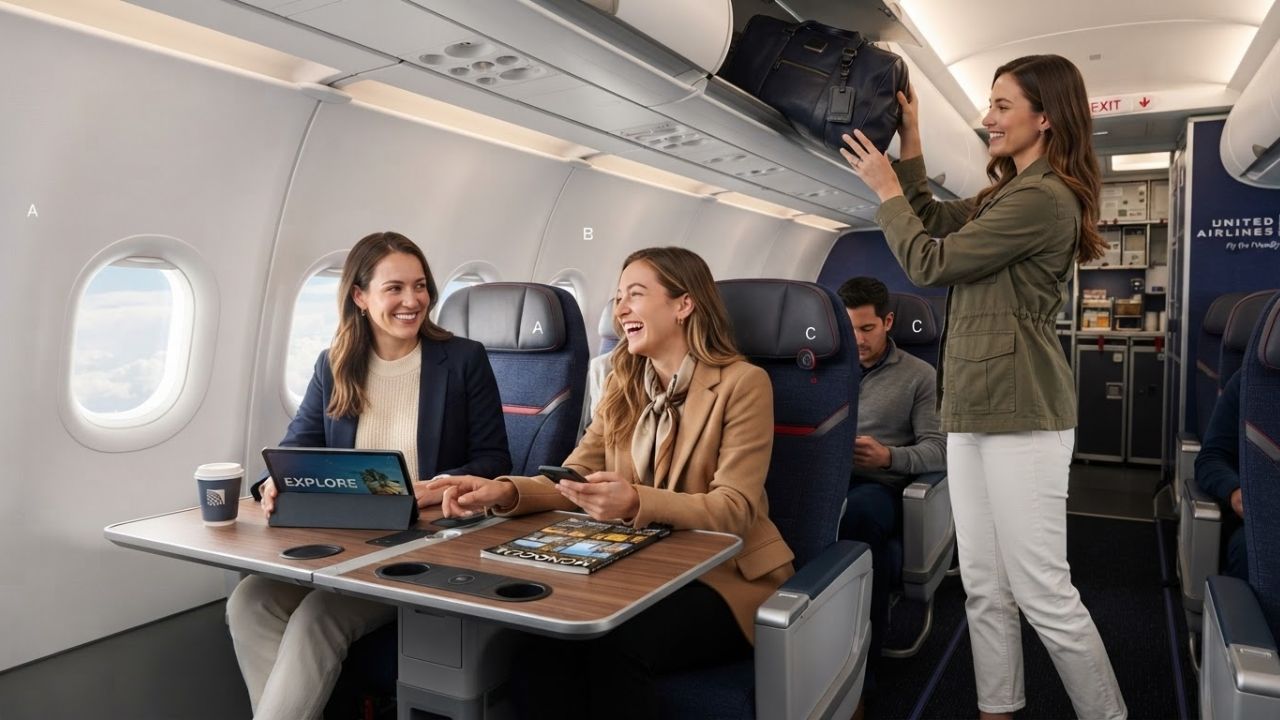
Image generated by AI
United Airlines has unveiled a new cabin layout that permanently blocks the middle seat in select Economy Plus rows on its upcoming Airbus A321XLR fleet. The configuration converts the center cushion into a shared table, providing passengers with increased personal space and three additional inches of legroom.
The Core Transit Update
[Chicago, Illinois – July 16, 2026] — United Airlines has announced plans to implement a new seating option in its Economy Plus cabins, featuring a permanently blocked middle seat. The configuration will debut on the carrier's incoming fleet of 50 Airbus A321XLR narrowbody aircraft, which are scheduled for delivery starting later this year. Under this design, the center seat in designated rows will be replaced by a custom-engineered, leather-like table equipped with dual molded cup holders, converting a standard three-seat row into a two-passenger premium space.
According to United Airlines' commercial planning division, the introduction of this tier aims to capture the premium leisure segment. Many travelers are willing to pay a surcharge to avoid the center seat, particularly on transcontinental routes like Newark (EWR) to San Francisco (SFO) or Los Angeles (LAX). The customized center console is designed to remain permanently fixed to the seat frame, preventing passengers from removing it. This ensures that the rows remain strictly configured for two travelers, maintaining cabin density standards certified by the Federal Aviation Administration (FAA).
This initiative represents a significant shift for major carriers in the domestic United States aviation market, borrowing a layout commonly used in European short-haul business class configurations by operators such as Lufthansa and Finnair. The new seat option will be marketed alongside the carrier's recently announced "Relax Rows" on Boeing 777 and 787 widebody aircraft, which allow travelers to convert three consecutive economy seats into a flat couch surface. Ticket sales for the new configuration are expected to open later this year.
Transit Schedule & Cabin Specifications
The cabin specifications and layout parameters of United's Airbus A321XLR are outlined in the table below:
| Operational Parameter | Airbus A321XLR Configuration Specs | Fleet Implementation Details | Regulatory & Cabin Standards |
|---|---|---|---|
| Middle-Seat Treatment | Fixed shared table over blocked middle seat | Installed on 50 incoming narrowbody jets | FAA Safety & Seating Certification |
| Row Configuration | Select rows in Economy Plus | Window and aisle passenger seating | Dual molded cup holders, leather-like table |
| Additional Legroom | 3 inches of extra pitch | Standard Economy Plus row spacing | Standard FAA pitch compliance |
| Total Passenger Capacity | Exactly 150 passenger seats | Reduced from original manufacturer capacity | Enables 4 flight attendants instead of 5 |
| Target Route Operations | Transcontinental domestic US / Transatlantic | Starting with domestic routes late 2026 | Meets US DOT passenger protection standards |
Traveler Logistics Guide (Information Gain)
Passengers planning to utilize United's new Airbus A321XLR Economy Plus seating should consider these operational guidelines:
- Navigating Single-Aisle Long-Haul Transit: The Airbus A321XLR is a long-range narrowbody aircraft, which features only a single aisle. Unlike widebody aircraft, single-aisle cabins can experience bottlenecking in the aisle during boarding, lavatory queues, and deplaning. Travelers are advised to book forward rows, such as the newly configured Economy Plus seats, to ensure faster exit times upon arrival.
- Baggage and Check-in Protocols: Since United's new configuration is designed to maximize cabin space, the Airbus A321XLR is equipped with extra-large overhead bins. Under airline luggage rules, rollaboard bags should be placed on their sides (wheels in first) to ensure all passengers can store their carry-on luggage. Checked bags should be registered online at least 24 hours prior to departure to expedite terminal drop-off.
- Digital Transit and Immigration Policies: For travelers booking transcontinental or transatlantic flights, understanding international transit requirements is essential. Passengers traveling to the United Kingdom or the European Schengen Area must prepare for biometric processing under the Entry/Exit System (EES) and, when active, pre-travel clearance via the European Travel Information and Authorisation System (ETIAS).
- Last-Minute Equipment Changes: Under the United States Department of Transportation (DOT) guidelines, if an airline changes the scheduled aircraft type at the last minute and is unable to provide a purchased seating upgrade (such as the blocked middle seat row), the traveler is entitled to a full refund of the upgrade fee. Passengers should monitor the airline's mobile app for real-time fleet assignments.
Infrastructure Impact Assessment
The deployment of the Airbus A321XLR with a 150-seat configuration represents a strategic approach to route development and resource management. By reducing the passenger capacity to exactly 150 seats, United Airlines complies with the Federal Aviation Administration (FAA) safety staffing ratio of one flight attendant for every 50 seats. This allows the airline to operate the long-range narrowbody with four crew members instead of five, significantly lowering operational and labor costs over long-haul domestic and transatlantic routes.
In addition, the range capabilities of the Airbus A321XLR allow the carrier to establish direct, point-to-point connections from secondary domestic airports to European destinations. This decentralization reduces the traffic load on major hub airports like Chicago O'Hare (ORD) and Newark Liberty (EWR), optimizing gates and runway slot utilization. While this strategy reduces connecting passenger volumes at major hubs, it increases direct connectivity, supporting regional tourism and business travel.
The introduction of this configuration highlights the ongoing segmentation of the commercial passenger cabin. Major carriers are moving away from standard three-class cabin divisions toward micro-cabins that target specific passenger preferences and price points. While this strategy increases complexity for booking systems and aircraft maintenance teams, it maximizes the revenue potential of the cabin floor plan. As other global carriers monitor the market response, similar blocked middle seat configurations could expand across domestic and international narrowbody fleets.
Related Travel Guides
Disclaimer
This article is for informational and educational purposes only. It does not constitute legal, financial, or professional advice. While we strive to provide accurate and up-to-date information, travel policies, regulations, and conditions change rapidly. Always verify information with official sources before making travel decisions. Nomad Lawyer makes no representations about the accuracy, reliability, completeness, or suitability of the information provided. Readers should consult qualified professionals for advice specific to their circumstances. The views expressed in this article are those of the author and do not necessarily reflect the views of Nomad Lawyer.
Kunal K Choudhary
Co-Founder & Contributor
A passionate traveller and tech enthusiast. Kunal contributes to the vision and growth of Nomad Lawyer, bringing fresh perspectives and driving the community forward.
Learn more about our team →