
UAE Reopens Airspace: Emirates Back to Full Ops at DXB
UAE airspace fully reopened on March 17 after brief closure amid Iran threats. Emirates and Etihad resume normal operations at Dubai (DXB) and Abu Dhabi airports, while international carriers remain suspended. Travelers should check flight status before heading to the airport in 2026.

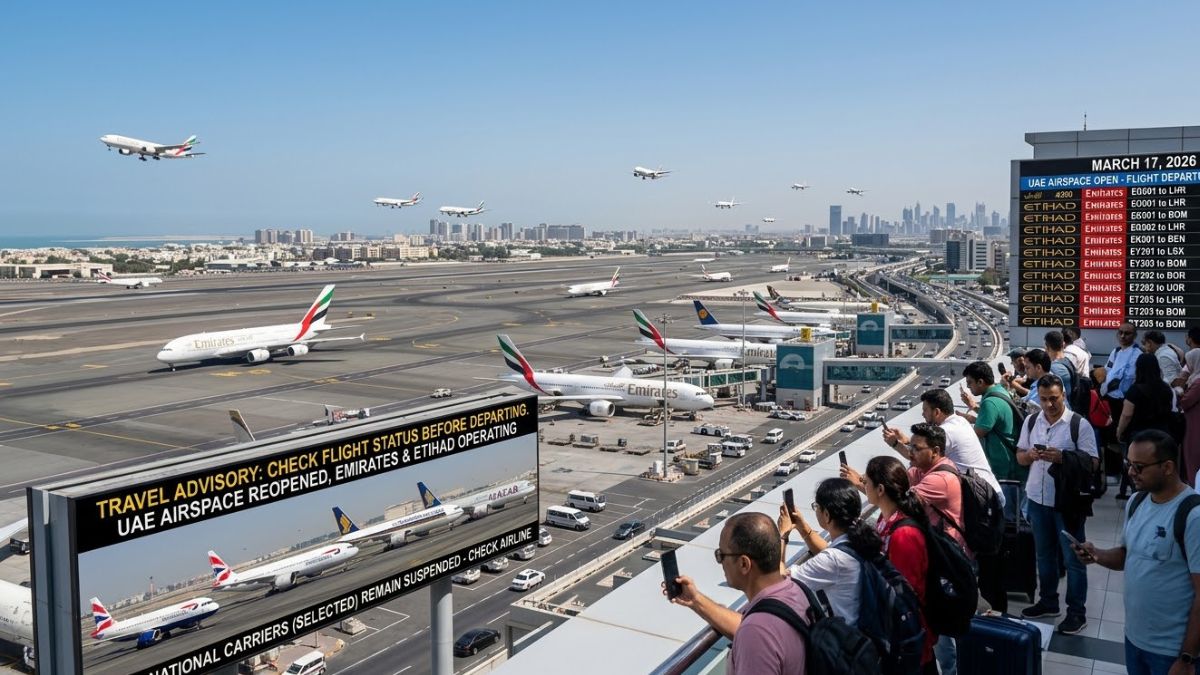
Image for illustrative purposes
Quick Summary
- UAE Airspace: Fully reopened March 17 at 5:05 AM local time after 2-hour closure due to Iran missile/drone threats.
- Key Airports: Dubai International (DXB/OMDB) and Abu Dhabi operations normal; Etihad and Emirates flying.
- Traveler Impact: Check airline apps now—international carriers like Lufthansa suspended through late March.
- What's Next: GCAA monitoring ongoing; EASA CZIB warning extended to March 18 across Middle East.
UAE Airspace Reopens After Iran Threats—Emirates Leads Recovery at Dubai
The United Arab Emirates (UAE) has lifted a temporary full closure of its airspace, restoring normal air navigation just hours after intercepting incoming missiles and drones from Iran. The General Civil Aviation Authority (GCAA) confirmed the reopening at 5:05 AM local time on Tuesday, March 17, 2026, following a comprehensive security assessment. Dubai International Airport (DXB/OMDB) and operations at Abu Dhabi are now running as usual, with Emirates and Etihad maintaining services amid the regional conflict.
This marks the first complete airspace shutdown in over two weeks of hostilities that began on February 28, 2026. The UAE Defense Ministry reported intercepting more than 300 ballistic missiles and over 1,600 drones since then. Airport operations resumed swiftly, signaling a push toward full capacity for UAE hubs in 2026.
Why This Matters for Global Travel
The brief closure disrupted already strained flights into Dubai International Airport (DXB/OMDB), the world's busiest long-haul hub. It followed a drone strike on March 16 that hit a fuel depot near DXB, causing a contained fire with no injuries—the fourth such incident this month. Despite these events, UAE aviation has shown resilience, reopening quickly each time.
For travelers, this reopening boosts confidence in Dubai and Abu Dhabi as key gateways. Emirates is operating flights, though passengers must verify status via official channels due to fast-changing conditions. The GCAA urged reliance on verified sources over social media.
Broader Middle East airspace remains volatile. EASA's Conflict Zone Information Bulletin (CZIB 2026-03), extended on March 11, advises against operations across Iran, Iraq, Israel, Jordan, Lebanon, Bahrain, Kuwait, Qatar, UAE, Oman, and Saudi Arabia due to missile and military risks—valid through March 18.
Emirates Operations at Dubai (DXB/OMDB)
Emirates continues flying into Dubai International Airport (DXB/OMDB) post-reopening, positioning itself for full capacity recovery. No specific flight cancellations were noted after the 5:05 AM all-clear, but the airline recommends checking emirat.es/flightstatus before travel. Dubai Airports offers support via WhatsApp at +971 4 224 5555 or live chat at dubaiairports.ae/contact-information.
The carrier has navigated four drone incidents near DXB since February 28 without major halts. This resilience underscores Dubai's role in global connectivity, even as conflicts persist.
Etihad and Abu Dhabi Airport Status
Etihad Airways at Abu Dhabi International Airport (AUH/OMAA) mirrors Emirates' approach, with operations ongoing despite the airspace event. The GCAA's nationwide clearance covers all UAE airports, including Al Maktoum International (DWC/OMDW), which saw minor disruptions. Local handlers confirm normal procedures, though No Objection Certificates (NOCs) from GCAA's Foreign Operators Affairs (foa@gcaa.gov.ae) aid recovery flights.
Suspended International Airlines
Major carriers remain cautious. Lufthansa Group, Air France, KLM, Cathay Pacific, Finnair, and Virgin Atlantic have suspended flights to the region through late March or longer. British Airways is also holding off. Qatar's Doha (DOH/OTHH) airspace allows limited arrivals/departures with approval, while Saudi Arabia (OEJD/Jeddah FIR) uses contingency routes.
Oman (OOMS/Muscat FIR) stays open but restricts some diversions. Operators should monitor NOTAMs for routings linking UAE-Saudi via Oman.
Key Facts at a Glance
| Detail | Data |
|---|---|
| Airspace Closure Date | Early March 17, 2026 (lifted 5:05 AM local) |
| Reason | Iran missile/drone threats; first full UAE shutdown in conflict |
| Interceptions Since Feb 28 | 300+ ballistic missiles, 1,600+ drones |
| Affected Airports | Dubai (DXB/OMDB), Al Maktoum (DWC/OMDW), Abu Dhabi (AUH/OMAA) |
| Operating Airlines | Emirates, Etihad |
| Suspended Carriers | Lufthansa Group, Air France/KLM, Cathay Pacific, Finnair, Virgin Atlantic, British Airways |
| EASA Warning Validity | Through March 18, 2026 |
| Prior Incident | Drone fuel depot strike near DXB on March 16 (4th this month) |
- UAE airspace open for all flights as of March 17 morning.
- Real-time GCAA monitoring in place.
- Evacuation/cargo via specific corridors with NOC.
What This Means for Travelers
Dubai and Abu Dhabi flights are stabilizing, with Emirates leading the return to prominence. Expect near-empty inbound planes as locals depart, but capacity builds quickly. Long-haul connections through DXB benefit first from this green light.
Check airline apps proactively— a morning all-clear doesn't guarantee midday status. Carry extra fuel for potential diversions in adjacent FIRs like Saudi or Oman.
Challenges and Risks Ahead
The conflict, now in its third week, shows no signs of abating. Rapid closures like March 17's 2-hour shutdown highlight unpredictability—even open FIRs can close abruptly. International suspensions limit options, stranding connecting passengers.
EASA's broad advisory persists, and drone strikes near DXB raise insurance and routing concerns. Travelers to UAE should prepare for waivers and alternatives.
Traveler Action Checklist
- Check your flight status via airline app or FlightAware before heading to the airport.
- Contact your airline directly to rebook—activate disruption waivers proactively via app.
- Know your rights—US DOT mandates full cash refunds on cancelled flights, not just vouchers; see US DOT Aviation Consumer Protection.
- Keep all receipts for meals, hotels, or alternative transport—may be reimbursable.
- Consider alternative airports—Muscat (OOMS) or Jeddah (OEJD) with NOTAM checks.
Frequently Asked Questions
Is Dubai International Airport (DXB) open on March 17, 2026?
Yes, Dubai Airport (DXB/OMDB) resumed normal operations after UAE airspace reopened at 5:05 AM local time on March 17. GCAA confirmed air navigation normal; check your airline for flight-specific updates.
Are Emirates flights operating to Dubai after the airspace closure?
Emirates continues services to DXB post-reopening, with no broad cancellations reported. Verify via emirat.es/flightstatus as conditions evolve quickly.
Which airlines have suspended flights to UAE amid Iran threats?
Lufthansa Group, Air France, KLM, Cathay Pacific, Finnair, Virgin Atlantic, and British Airways remain suspended through late March or longer. Emirates and Etihad are operating.
What should operators do for UAE recovery flights?
Obtain GCAA NOC via foa@gcaa.gov.ae with risk assessment; single NOC covers multiple flights. Response under 60 minutes.
Related Travel Guides
Middle East Airspace Restrictions Guide Emirates Flight Status and Tips Safe Travel to Dubai Amid Conflicts
Disclaimer
This article is for informational and educational purposes only. It does not constitute legal, financial, or professional advice. While we strive to provide accurate and up-to-date information, travel policies, regulations, and conditions change rapidly. Always verify information with official sources before making travel decisions. Nomad Lawyer makes no representations about the accuracy, reliability, completeness, or suitability of the information provided. Readers should consult qualified professionals for advice specific to their circumstances. The views expressed in this article are those of the author and do not necessarily reflect the views of Nomad Lawyer.
Raushan Kumar
Founder & Lead Developer
Full-stack developer with 11+ years of experience and a passionate traveller. Raushan built Nomad Lawyer from the ground up with a vision to create the best travel and law experience on the web.
Learn more about our team →