
US Airports May Allow Full Water Bottles as TSA Evaluates Heathrow-Style CT Security Modernization
The TSA is evaluating 3D CT scanner security upgrades that could allow full water bottles through US airport checkpoints, mirroring London Heathrow rules.

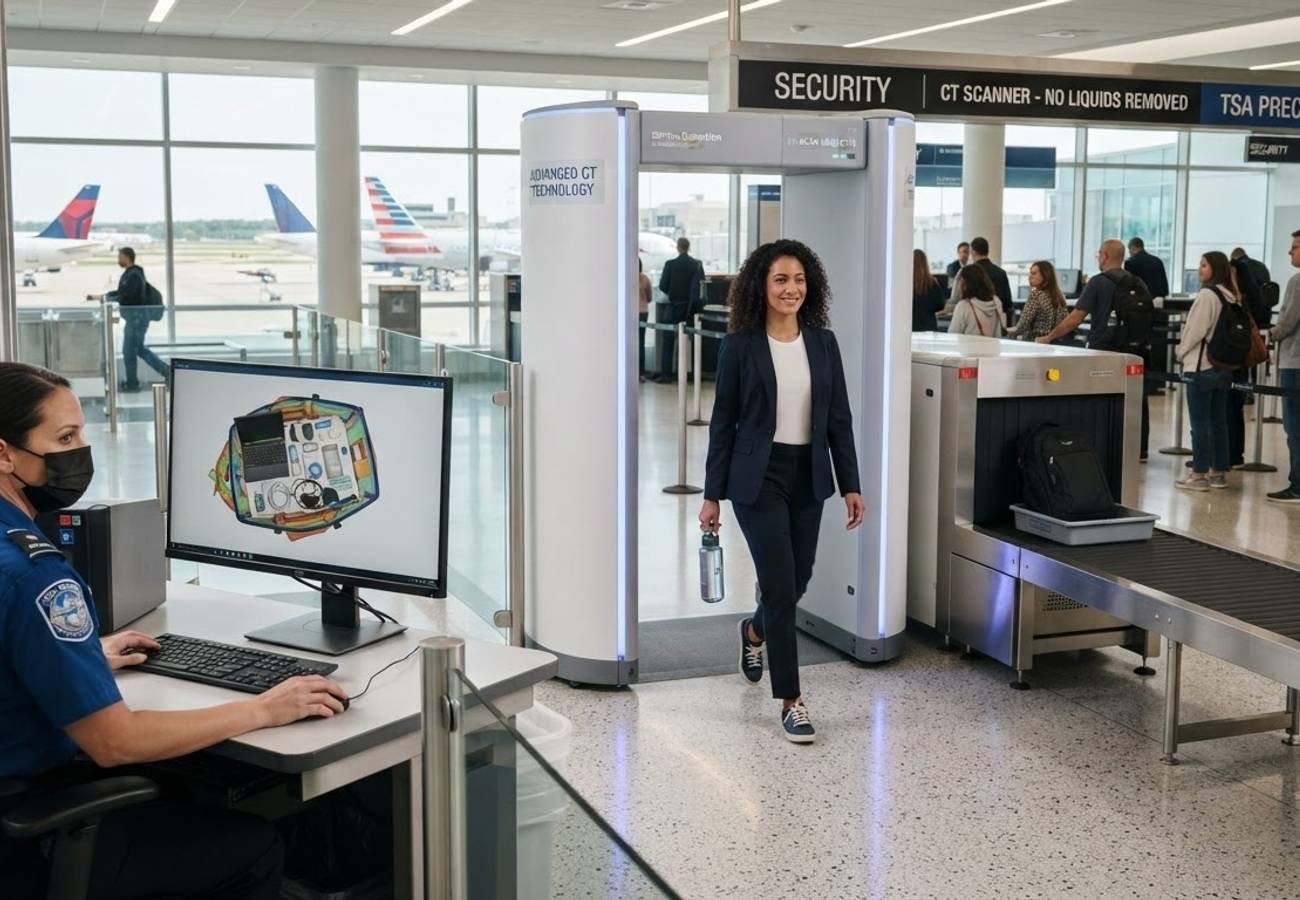
Image generated by AI
The Transportation Security Administration (TSA) is reviewing policy updates that could allow travelers to carry full water bottles through airport security checkpoints, supported by advanced 3D Computed Tomography (CT) screening technology.
WASHINGTON, D.C. — The Transportation Security Administration (TSA) is evaluating operational trials to modernize US airport security screening protocols. Under the proposed framework, passengers at select US airports equipped with high-resolution Computed Tomography (CT) baggage scanners may eventually be permitted to bring filled water bottles through security lanes, easing one of commercial aviation's longest-standing passenger restrictions.
While nationwide implementation has not been finalized, the initiative mirrors security upgrades already deployed at major UK airports, including London Heathrow (LHR). Any initial trial phase in the US is expected to focus on TSA PreCheck members at major domestic hubs.
Comparison: Existing TSA 3-1-1 Rule vs. Proposed Modernized Protocol
The potential policy change represents a major shift from the traditional 3-1-1 liquids rule enforced across US airports since 2006.
| Security Parameter | Existing TSA Liquids Rule | Proposed Modernized CT Protocol |
|---|---|---|
| Liquid Container Limit | Restricted to 3.4 oz (100ml) or smaller | Full water bottles permitted |
| Baggage Packing Requirement | Must fit in a single 1-quart clear plastic bag | Liquids remain inside carry-on luggage |
| Scanning Technology | Standard 2D X-Ray & manual inspection | High-resolution 3D Computed Tomography (CT) |
| Initial Target Passenger Group | Mandatory for all passengers nationwide | Potential pilot focus on TSA PreCheck lanes |
| Current Enforcement Status | Active nationwide standard | Under TSA operational review for pilot testing |
Advanced CT Scanning Technology and Security Capabilities
The driver behind the potential rule change is the deployment of Computed Tomography (CT) scanners at airport security checkpoints. Unlike legacy 2D X-ray systems, CT scanners generate 3D volumetric images of carry-on bags.
| Technology Capability | Operational Security & Passenger Advantage |
|---|---|
| 3D Volumetric Imaging | Rotates 360 degrees to analyze explosive compound densities from all angles |
| Automated Threat Detection | Software algorithms flag prohibited substances without requiring bag opening |
| Reduced Bag Unpacking | Passengers leave laptops, electronics, and liquids inside carry-on bags |
| Enhanced Throughput | Accelerates lane movement and reduces queue wait times at peak hours |
Origins of the 3-1-1 Rule and International Precedents
The current 3-1-1 liquid restriction was instituted globally following a foiled 2006 transatlantic terror plot involving liquid explosives. However, several international airports have leveraged advanced CT scanners to ease these limits.
| Airport Gateway | Country | Modernized Liquid Allowance | Security Technology |
|---|---|---|---|
| London Heathrow (LHR) | United Kingdom | Permits liquid containers up to 2 liters | 3D CT Baggage Scanners |
| London City Airport (LCY) | United Kingdom | Removed traditional 100ml container limits | 3D CT Baggage Scanners |
| Teesside International (MME) | United Kingdom | Removed traditional 100ml container limits | 3D CT Baggage Scanners |
| US Airports (Current) | United States | Enforces 3.4 oz (100ml) container limits | 2D & Expanding 3D CT |
Potential Candidate Airports for US Pilot Testing
Because scaling CT scanner hardware across thousands of US security lanes requires capital investment, initial testing is expected to target major airports with established CT infrastructure, such as San Francisco International Airport (SFO).
| Candidate Airport Hub | IATA Code | Operational Focus & Infrastructure |
|---|---|---|
| Hartsfield-Jackson Atlanta | ATL | World's busiest passenger hub & major Delta Air Lines operation |
| Dallas/Fort Worth International | DFW | Major international transfer hub & primary American Airlines gateway |
| Los Angeles International | LAX | High-volume West Coast international terminal complex |
| Denver International | DEN | Major mountain hub with high domestic connecting volume |
| Harry Reid International | LAS | Primary leisure destination airport with high passenger traffic |
| Salt Lake City International | SLC | Modernized terminal complex featuring dedicated CT scanner lanes |
Environmental and Sustainability Benefits
Allowing reusable water bottles through security checkpoints aligns with broader aviation sustainability goals by reducing single-use plastic waste at airport terminals.
- Plastic Waste Reduction: Travelers currently discard thousands of single-use plastic bottles before security lines. Allowing full reusable bottles reduces terminal plastic waste generation.
- Economic Savings for Travelers: Passengers can fill reusable bottles at home or hotel locations rather than purchasing overpriced single-use bottled beverages airside.
- Streamlined Checkpoint Cleanliness: Eliminating mass liquid disposal bins at checkpoint entrances reduces liquid spills and waste management bottlenecks.
Traveler Logistics Guide: Checkpoint Preparation During the Transition
While the TSA reviews modern liquid rules, passengers must continue adhering to active regulations to prevent delays.
1. Maintain Compliance with Active TSA Rules
- 3.4 oz (100ml) Rule Remains Active: Until TSA formally announces a rule change, liquids over 3.4 oz must be packed in checked luggage or emptied prior to security screening.
- Empty Reusable Bottles: Passengers carrying reusable stainless steel or plastic bottles should empty them prior to entering the queue and refill them at airside hydration stations.
2. TSA PreCheck Enrollment Benefits
- Expedited Lines: TSA PreCheck members currently retain shoes, light outerwear, and belts while leaving laptops in bags.
- First Access to Pilots: Approved PreCheck travelers will likely be the first group eligible for full liquid screening trials once pilot testing begins.
3. Navigating International Rule Discrepancies
- Check Connecting Airport Rules: When flying internationally, remember that liquid rules vary. Departing London Heathrow allows 2-liter containers, but transferring at a US airport still requires compliance with the 3.4 oz standard.
FAQ: TSA Water Bottle Security Modernization
Are full water bottles currently allowed through US airport security?
No. Current TSA regulations restrict liquids to containers of 3.4 ounces (100ml) or smaller, placed in a 1-quart clear plastic bag.
Has the TSA officially changed the water bottle rule nationwide?
No. The TSA is reviewing potential pilot programs and technology capabilities, but no nationwide policy change has been enacted.
Which international airports already allow larger liquids through security?
Airports in the UK, including London Heathrow (LHR), London City (LCY), and Teesside International (MME), permit larger liquid volumes up to 2 liters using advanced CT scanners.
Which passenger group is expected to test the water bottle rule first in the US?
Any initial pilot trials are expected to focus on TSA PreCheck travelers at select major airports equipped with 3D CT scanners.
Related Travel Guides
Disclaimer
This article is for informational and educational purposes only. It does not constitute legal, financial, or professional advice. While we strive to provide accurate and up-to-date information, travel policies, regulations, and conditions change rapidly. Always verify information with official sources before making travel decisions. Nomad Lawyer makes no representations about the accuracy, reliability, completeness, or suitability of the information provided. Readers should consult qualified professionals for advice specific to their circumstances. The views expressed in this article are those of the author and do not necessarily reflect the views of Nomad Lawyer.
Preeti Gunjan
Contributor & Community Manager
A passionate traveller and community builder. Preeti helps grow the Nomad Lawyer community, fostering engagement and bringing the reader experience to life.
Learn more about our team →