
Tongariro Northern Circuit Reopens as a Complete Loop This December: Insider Guide to New Zealand's Great Walk
New Zealand's Tongariro Northern Circuit restores its 44.9km alpine loop in December 2026 with the reopening of fire-repaired Mangatepopo Track and the new 28-bed Oturere Hut.

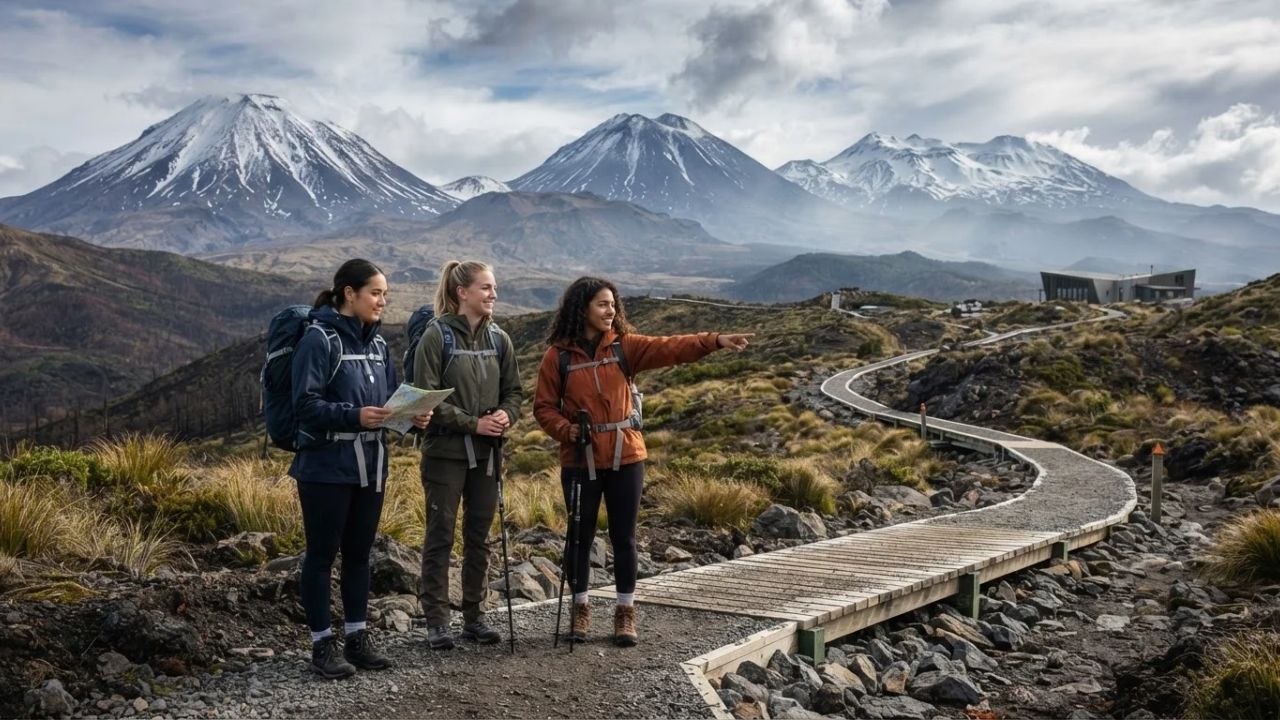
Image generated by AI
Trekkers holding bookings for New Zealand's legendary Tongariro Northern Circuit face two different reopening timetables this spring, as the fire-damaged Mangatepopo Track prepares for a mid-December return while the brand-new 28-bed Oturere Hut will not welcome hikers until 18 December 2026. Following catastrophic wildfires in November 2025 that scorched an estimated 2,935 hectares of delicate sub-alpine vegetation across Tongariro National Park, the Department of Conservation (DOC) initially trimmed the trail into a 35.5-kilometre end-to-end route running between Mangatepopo Carpark and Whakapapa Village. Now, backed by a five-year NZ$3.5 million ecological restoration fund drawn from the International Visitor Levy across more than 3,000 hectares, track crews are rebuilding bridges, laying resilient boardwalks, and completing the missing 9.4-kilometre Whakapapa–Mangatepopo segment to restore the full 44.9-kilometre circuit loop just in time for the peak summer tramping season.
The Dual-Clock Dilemma: Navigating the 18 December Reopening
For independent hikers and international tour operators, understanding the two separate operational dates is essential to avoid dangerous alpine miscalculations. While the physical Mangatepopo Track is tracking toward a mid-December reopening date, the replacement Oturere Hut—constructed in deep partnership with mana whenua iwi Ngāti Hikairo ki Tongariro to replace an aging 50-year-old shelter—faced weather-delayed helicopter supply drops that pushed its official opening to 18 December.
This construction timing creates a demanding challenge for early-season trampers holding reservations between 22 October and 17 December. On the traditional four-day circuit, Oturere provides a vital refuge between Mangatepopo Hut and Waihohonu Hut. Without Oturere available, traversing from Mangatepopo directly to Waihohonu turns into an arduous 20-kilometre alpine march demanding eight to ten hours of sustained trekking through exposed scree slopes, active volcanic craters, and sudden mountain weather shifts. During the official Great Walk season extending from 23 October to 30 April, hut fees are set at NZ$44 per night for New Zealand adults (NZ$22 for youth) and NZ$66 for international adults (NZ$33 for youth), while campsite rates are NZ$19 for domestic adults and NZ$28 for international visitors. With camping strictly banned within 500 meters of the Northern Circuit track outside designated campsites, hikers cannot simply pitch an unauthorized tent along the missing Oturere link.
What Makes Tongariro Different: Dual Heritage and Volcanic Fire
Tongariro National Park holds a revered place in global conservation as New Zealand’s oldest national park and a dual-inscribed sanctuary recognized by the UNESCO World Heritage Centre for both outstanding volcanic geology and profound Māori spiritual associations. In 1887, Ngāti Tūwharetoa Paramount Chief Horonuku Te Heuheu Tukino IV gifted the sacred volcanic peaks of Tongariro, Ngauruhoe, and Ruapehu to the nation to protect their sacred ancestral tapu (spiritual sanctity) from commercial exploitation.
Walking the Northern Circuit is an otherworldly journey across an active volcanic moonscape. Trampers ascend past steaming geothermal vents, cross the jagged black basalt flows of the Oturere Desert, and circle the vivid mineral-stained waters of the Emerald Lakes and Blue Lake (Te Wai-whakaata-o-te-Rangihiroa).
Yet what elevates this Great Walk beyond standard hiking trails is its deep cultural resonance. For centuries, the peaks have been revered as living ancestors (tūpuna). Hikers are instructed by tribal guardians and DOC never to step onto the summit peaks of Mount Ngauruhoe or Mount Tongariro, nor touch or swim in the sacred geothermal waters. By respecting these cultural boundaries, travelers transition from passive sightseers into mindful guests walking across sacred ground. These cultural values and regional wilderness updates are highlighted through Tourism New Zealand.
Visitor Insider Tips: Navigating Shuttles, Huts, and Gateway Towns
Mastering the logistical mechanics of the Central Plateau requires local coordination across transport, accommodation, and alpine safety:
- Bypass Carpark Fines with Whakapapa Shuttles: During the Great Walk season, parking at Mangatepopo Carpark is strictly enforced with a four-hour maximum parking limit. Do not attempt to leave your vehicle there overnight. Park your car at Whakapapa Village, where free long-term parking permits are issued at the Tongariro National Park Visitor Centre, and catch an authorized shuttle to your trailhead.
- Base Yourself in Gateway Enclaves: Avoid long morning drives by staying in one of the primary gateway towns located approximately 50 kilometres (a 40-minute drive) from Whakapapa. Choose Tūrangi near the southern tip of Lake Taupō for world-class fly fishing and hot springs, or base yourself in Ohakune or Waimarino (formerly National Park Village), which sit directly along the North Island Main Trunk railway line.
- Pack for Four Seasons in Two Hours: Tongariro's weather is notoriously volatile, where blistering sunshine can transform into gale-force sub-zero blizzards within minutes. Always carry a seam-sealed waterproof jacket, thermal merino wool underlayers, a wool beanie, sturdy hiking boots, and sun protection. Never begin a crossing if rangers advise that alpine wind chill warnings are active.
- Sample Local Central Plateau Flavors: After completing the circuit, celebrate in Ohakune with a world-famous gourmet meat pie from the local bakery, accompanied by a rich flat white coffee. In Tūrangi, dine on fresh river trout prepared at local lodges, or sample artisan feijoa-infused sodas and craft beers brewed with volcanic glacial water.
- Reconfirm Your Digital Booking vs Physical Alerts: DOC’s summer 2024/25 survey recorded 4,350 Northern Circuit visitors between December and February with an 85 per cent hut occupancy rate, drawn from an annual pool of 4,421 bookings (2,585 New Zealanders and 1,836 international visitors). Because website notices can lag behind field repairs, always check the active DOC alert board at the Whakapapa Visitor Centre on the morning of your tramp to confirm real-time track status.
Cultural and Environmental Context: Wildfire Recovery and Indigenous Partnership
The rebuilding of the Tongariro Northern Circuit is fundamentally an ecological and cultural restoration story. The November 2025 wildfires caused severe damage to native tussock lands, sub-alpine scrub, and fragile alpine bog habitats that take decades to recover in harsh volcanic climates.
The deployment of the NZ$3.5 million International Visitor Levy fund represents an essential reinvestment of foreign tourism expenditure directly into native biodiversity. Dedicated conservation teams are executing intensive weed eradication, non-native pest management (controlling stoats, rats, and possums), and continuous ecological monitoring to allow native alpine buttercups and rare mountain dacrydium shrubs to regenerate.
Simultaneously, the architectural design of the new 28-bed Oturere Hut marks a triumph of collaborative governance between DOC and Ngāti Hikairo ki Tongariro. Built with high-efficiency thermal insulation, modern water-catchment filtration, and solar-powered communication arrays, the structure minimizes physical impact while honoring Māori architectural aesthetics. By adhering strictly to the 500-meter no-camping corridor, packing out every scrap of rubbish, and staying on marked boardwalks, international trampers support a resilient conservation framework that ensures Tongariro remains sacred and pristine for generations to come.
FAQ: Hiking the Tongariro Northern Circuit 2026/27
When does the full Tongariro Northern Circuit loop reopen?
The Mangatepopo Track is scheduled to reopen in mid-December 2026 to restore the full 44.9-kilometer loop, while the newly rebuilt 28-bed Oturere Hut opens officially on 18 December 2026.
Can I camp anywhere along the Northern Circuit?
No. Camping is prohibited within 500 meters of the Northern Circuit track outside designated DOC campsites at Mangatepopo, Oturere, and Waihohonu. Campsites require advance bookings and paid permits during the Great Walk season.
How much do Northern Circuit huts cost during the 2026/27 season?
Hut passes cost NZ$44 per night for New Zealand adults (NZ$22 youth) and NZ$66 per night for international adults (NZ$33 youth) between 23 October and 30 April.
Where can I park my car overnight while walking the track?
Park your vehicle at Whakapapa Village after obtaining a free overnight parking permit at the Tongariro National Park Visitor Centre. Overnight parking at Mangatepopo Carpark is strictly prohibited during the Great Walk season.
Across ancient lava fields and windswept alpine ridges, Tongariro stands as a living sanctuary where every step honors the sacred breath of the earth.
Related Travel Guides
Disclaimer
This article is for informational and educational purposes only. It does not constitute legal, financial, or professional advice. While we strive to provide accurate and up-to-date information, travel policies, regulations, and conditions change rapidly. Always verify information with official sources before making travel decisions. Nomad Lawyer makes no representations about the accuracy, reliability, completeness, or suitability of the information provided. Readers should consult qualified professionals for advice specific to their circumstances. The views expressed in this article are those of the author and do not necessarily reflect the views of Nomad Lawyer.
Raushan Kumar
Founder & Lead Developer
Full-stack developer with 11+ years of experience and a passionate traveller. Raushan built Nomad Lawyer from the ground up with a vision to create the best travel and law experience on the web.
Learn more about our team →