
Thailand Launches Toll-Free Motorway Trials to Modernize Bangkok Road Travel
Thailand opens toll-free sections on the M6 and M82 motorways to reduce traffic congestion and improve road travel from Bangkok to regional gateways.

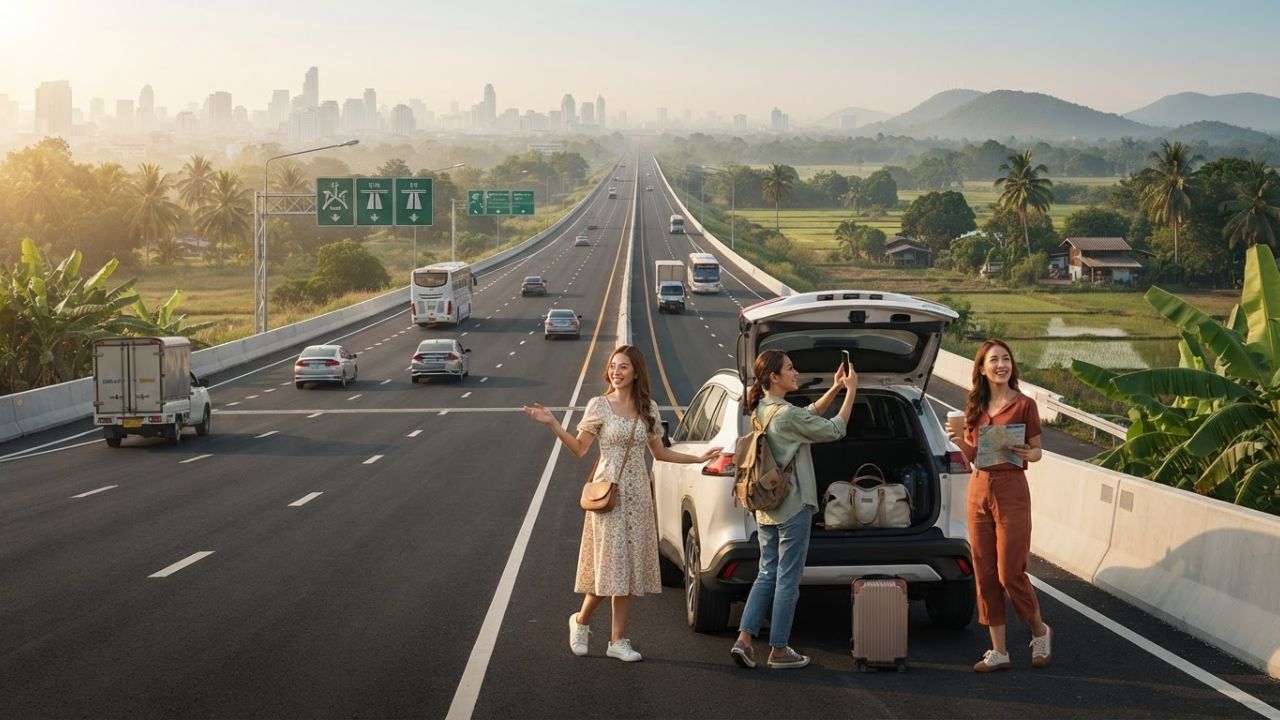
Image generated by AI
Thailand is opening toll-free trial runs on key sections of its M6 and M82 motorways, offering commuter alternatives to ease congestion on the nation's heavily packed road corridors. By providing direct detours around the busy Mittraphap and Rama II roads, the new routes will significantly reduce travel times from Bangkok to regional gateways.
Easing Traffic Congestion: The Toll-Free Motorway Policy
Thailand's Department of Highways has initiated toll-free trial operations to address severe traffic bottlenecks on major holiday corridors, continuing a transportation framework that began with initial trials in August 2022. By offering free transit during the testing phase, the government aims to evaluate traffic flow, test automatic barrier-free tolling systems, and improve transport efficiency along two critical road routes.
The new sections are designed to ease traffic on Mittraphap Road, which connects Bangkok with northeastern Thailand, and Rama II Road, a primary corridor heading toward Samut Sakhon and southern destinations. Although both motorway sections will initially be available without toll charges, motorists will experience different operating conditions, speed limits, and vehicle restrictions. Opening schedules, entry points, and local access routes vary because some parts of the projects are still undergoing final system preparations or construction work.
The M6 Bang Pa-in to Pak Chong Weekend Trial Details
The 110-kilometre Bang Pa-in–Pak Chong section of Motorway No. 6 (M6) will begin its toll-free trial operation on August 21. However, the route will initially operate only during weekends, opening from Friday afternoon until Sunday midnight. This weekend-only schedule will continue through the New Year holiday period in 2027, giving travelers an additional highway option during some of Thailand’s busiest holiday periods.
During the first phase of the trial, only four-wheel vehicles are permitted to use the motorway, with a maximum speed limit of 80 kilometers per hour enforced to ensure safety while authorities monitor traffic flow. Motorists using the M6 route can enter and exit through five interchanges: Bang Pa-in, Hin Kong, Kaeng Khoi, Muak Lek, and Pak Chong.
However, travelers heading from Pak Chong toward Bangkok should note that some parts of the Bangkok-bound carriageway are not yet fully completed. Drivers will need to leave the motorway and use Thanarat Road and Mittraphap Road before reconnecting with the M6 at the Muak Lek interchange. The motorway will provide basic roadside facilities, including toilets and drinking water at the Thap Kwang rest areas on both sides of the route. However, fuel stations and electric vehicle charging docks are not yet available, so motorists are advised to fill their tanks or charge their batteries before entering. The Pak Chong to Nakhon Ratchasima bypass section of the M6 will continue operating free of charge every day, providing unrestricted travel on this completed stretch.
The M82 Ekkachai to Ban Phaeo 24-Hour Route Operations
The second major motorway opening involves the Ekkachai–Ban Phaeo section of Motorway No. 82 (M82). The 16.4-kilometre elevated route will begin free trial operations on August 28. This new section connects with existing operational parts of the M82, creating a continuous motorway route stretching approximately 25 kilometers along the Bang Khun Thian–Ekkachai–Ban Phaeo corridor.
Unlike the M6, which operates only on weekends, the M82 section will be available 24 hours a day. The route supports a wider range of vehicles, allowing cars, trucks, and buses to use the elevated highway, expanding transport options for both private travelers and commercial logistics operators. Different speed limits will apply depending on vehicle type: cars are limited to a maximum speed of 80 kilometers per hour, while trucks and buses have a maximum speed limit of 65 kilometers per hour.
Four interchanges will be available for motorists during the trial phase: Phanthai Norasing, Mahachai 1, Mahachai 2, and Ban Phaeo. The Samut Sakhon 1 and Samut Sakhon 2 interchanges will remain closed as development work continues. For safety reasons, certain vehicles are prohibited from accessing the elevated motorway, including motorcycles, bicycles, pedestrians, three-wheel vehicles, and all types of local carts.
Regional Connectivity and the National Transit Corridor Improvements
The opening of these two motorway sections represents a major step in Thailand’s efforts to modernize its national road network and create more efficient transport links. The M6 expansion is expected to reduce traffic pressure on Mittraphap Road, one of the country’s busiest routes connecting Bangkok with the northeastern provinces, which often experiences severe congestion during major holidays.
Similarly, the M82 opening is designed to support smoother traffic flow along the Rama II Road corridor, which plays a critical role for commuters, freight operators, and travelers moving between Bangkok and Samut Sakhon. This elevated highway bypasses busy local intersections and industrial zones, allowing seafood transport trucks and passenger buses to move more efficiently. The motorway will become an increasingly important part of Thailand’s regional transport network as additional sections are completed and connected in the coming years.
Visitor Guide: Local Dining, Road Trip Safety, and Eco-Transit Rules
Exploring Thailand's highway corridors safely during these trial openings involves understanding route restrictions, preparing your vehicle, and experiencing local culture. By planning ahead, travelers can ensure a smooth road trip.
When driving along the M82 toward Samut Sakhon, stop at local markets to try regional culinary specialties. Sample Mae Klong Mackerel (Pla Tu Mae Klong), a famous local fish celebrated for its sweet taste and quality, traditionally sold in small bamboo baskets with the fish positioned in a bent-neck shape. Enjoy it deep-fried and served with spicy chili paste (Nam Prik). Visit local dessert stalls in Samut Sakhon to try Lort Chong, a traditional Thai sweet dessert of pandan-flavored rice flour droplets served in sweet coconut milk.
Ensure your vehicle is fully prepared before entering the motorways. Adhere strictly to the speed limits of 80 kilometers per hour on the M6 and M82, and 65 kilometers per hour for heavy vehicles on the M82. If using the weekend-only M6, fill your fuel tank or charge your vehicle before entering the route, as the Thap Kwang rest areas do not provide refueling or EV charging services. If you utilize the barrier-free M-Flow toll lanes on connected highways, ensure your vehicle is registered or pay the toll online within two days to avoid penalties.
Observe eco-friendly travel practices by disposing of trash at designated rest stops and avoiding littering along the motorways. When traveling within Bangkok, utilize the MRT Blue Line or BTS Skytrain networks to reduce carbon emissions and urban traffic before renting a vehicle for regional road trips.
Future Outlook: Smart Infrastructure and Green Highways
The long-term development of Thailand's motorway network focuses on integrating smart infrastructure with environmental awareness. The expansion of barrier-free tolling systems like M-Flow, which uses artificial intelligence and camera sensors to scan license plates at highway speeds, is reducing vehicle idling times and carbon emissions at toll gates.
By integrating EV charging plazas, solar-powered lighting systems, and green corridors along motorway routes, the Department of Highways is building a sustainable transit model. This forward-looking infrastructure planning ensures that Thailand's road network remains competitive, safe, and environmentally responsible, showing that transport efficiency and green development can progress together.
Related Travel Guides
Disclaimer
This article is for informational and educational purposes only. It does not constitute legal, financial, or professional advice. While we strive to provide accurate and up-to-date information, travel policies, regulations, and conditions change rapidly. Always verify information with official sources before making travel decisions. Nomad Lawyer makes no representations about the accuracy, reliability, completeness, or suitability of the information provided. Readers should consult qualified professionals for advice specific to their circumstances. The views expressed in this article are those of the author and do not necessarily reflect the views of Nomad Lawyer.
Raushan Kumar
Founder & Lead Developer
Full-stack developer with 11+ years of experience and a passionate traveller. Raushan built Nomad Lawyer from the ground up with a vision to create the best travel and law experience on the web.
Learn more about our team →