
Thailand Rescues 40,000 Stranded Tourists as Middle East Airspace Shuts Down
An estimated 40,000 international tourists were stranded across Thailand after Middle East airspace closures on February 28, 2026 cut off major flight routes. Here's how the rescue unfolded — and what travelers need to know.

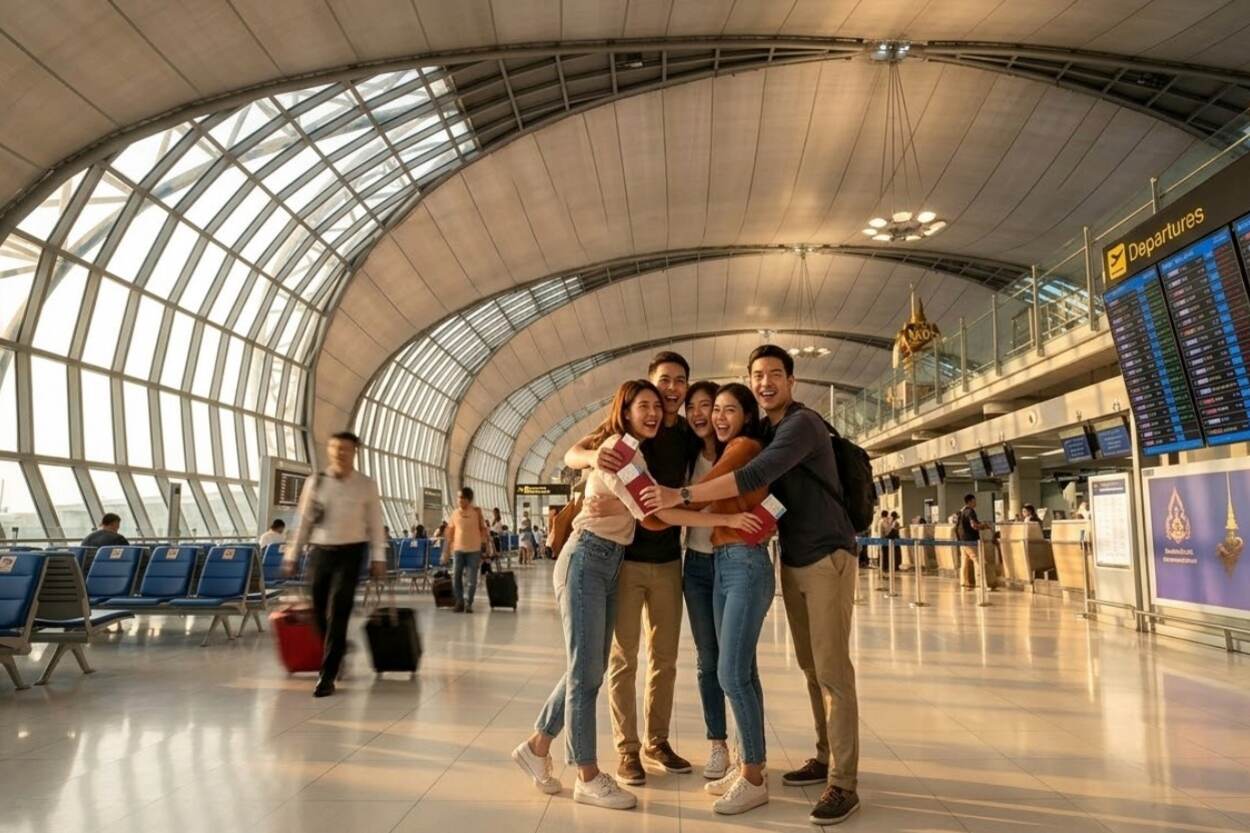
Image generated with AI
Quick Summary
- 40,000 international tourists stranded across Thailand after Middle East airspace closed on February 28, 2026
- Thailand's Civil Aviation Authority (CAAT) granted emergency approval for empty charter flights to evacuate travelers
- 315 Nordic tourists were successfully flown home to Copenhagen on March 9, 2026 aboard a Sunclass Airlines charter
- Independent travelers not linked to tour groups are urged to contact their embassies immediately
An estimated 40,000 international tourists found themselves stranded across Thailand after the sudden closure of Middle East airspace on February 28, 2026, triggered by the outbreak of regional conflict. Within hours of the announcement, departure halls at Bangkok's Suvarnabhumi Airport and Phuket International Airport transformed from busy travel hubs into holding areas for confused and anxious visitors with nowhere to go. Thailand's government, airlines, and tourism industry have since launched a coordinated rescue operation — one that is now being described as a landmark response to a modern travel crisis.
What Triggered the Crisis
The closure of Middle East airspace on February 28, 2026 immediately severed some of the world's most heavily trafficked long-haul flight corridors. Hundreds of scheduled commercial flights traveling between Asia, Europe, and beyond were either cancelled outright or unable to reroute their fleets in time.
For tourists already on the ground in Thailand, the situation deteriorated rapidly. A series of initial delays cascaded into full cancellations within the first 24 hours, leaving tens of thousands of travelers without confirmed routes home.
Thailand Opens Skies for Emergency Charters
The most critical logistical breakthrough came from Thailand's aviation authority. The Civil Aviation Authority of Thailand (CAAT) issued emergency temporary approvals allowing airlines to operate "empty leg" charter flights — meaning aircraft could fly into Thailand without passengers solely to collect and repatriate stranded tourists.
This was an unprecedented move in Thai aviation policy. Without it, airlines like Sunclass Airlines (operating under the Spies Group) and TUI would have had no legal mechanism to quickly position rescue aircraft into Thai airspace.
The decision effectively cracked open the bottleneck that had formed at both major international airports and allowed evacuation operations to begin in earnest.
Key Facts: By the Numbers
- 40,000 — estimated international tourists stranded in Thailand
- February 28, 2026 — date Middle East airspace was closed following conflict outbreak
- 315 — Nordic tourists evacuated on a single Sunclass Airlines charter flight
- March 8, 2026 — date the Nordic charter departed Thailand
- March 9, 2026 — date the flight landed in Copenhagen
- 2 — primary airports affected: Suvarnabhumi (Bangkok) and Phuket International
The Nordic Rescue: 315 Travelers Fly Home
Among the most visible successes of the evacuation effort was the repatriation of 315 Nordic travelers who had been stranded for over a week. Scattered across multiple destinations in Southeast Asia and the Indian Ocean region, the group was consolidated and placed aboard a Sunclass Airlines charter flight that departed Thailand on March 8, 2026.
The flight landed in Copenhagen on March 9, reuniting passengers with their families after a prolonged and stressful delay. For many of the Nordic travelers, the landing marked the end of an unexpected ordeal that had stretched a holiday into a week-long waiting game.
Hotels Step Up: Emergency Rates and Flexible Stays
While government agencies worked to secure flight paths, Thailand's hospitality sector responded with its own form of relief. The Thai Ministry of Tourism and Sports coordinated with hotel associations in Bangkok, Phuket, and Koh Samui to implement emergency support measures for affected tourists.
Hotels in key tourism hubs introduced:
- Deeply discounted "Emergency Stay" rates for travelers presenting proof of a cancelled flight
- Flexible check-out policies, allowing guests to leave at short notice once a charter seat became available
- Complimentary Wi-Fi and communication amenities to help travelers stay in contact with their embassies and airlines
The response drew widespread praise from stranded visitors on social media, with many noting that Thai hospitality remained intact even under the pressure of a global emergency.
Independent Travelers Still at Risk
Despite the scale of the operation, officials acknowledge that the job is not complete. A significant population of independent travelers — those who booked outside of tour operators or large airline group packages — has yet to make contact with their embassies or the CAAT.
Unlike package tourists, independent travelers are harder to locate and account for. Thai tourism authorities issued a direct appeal for any remaining stranded visitors to register with their nearest embassy and report their location.
"The more data we have on where people are, the more effectively we can plan the next wave of charter operations," a senior tourism official stated publicly.
What This Means for Travelers
The 2026 Middle East airspace crisis has underscored just how quickly global travel can be upended by geopolitical events. Travel experts and aviation analysts are already calling it a defining case study in crisis-era tourism management. For anyone currently in Thailand or planning travel to Asia during this period, the following precautions are strongly recommended:
- Register with your embassy: Ensure your country's government has your location and contact details before departure
- Get force majeure travel insurance: Confirm your policy covers flight disruptions caused by military conflict or airspace closures — standard policies often do not
- Maintain direct contact with your airline: Don't rely solely on apps or third-party notifications; speak directly with airline ground staff at the airport for the most current information on charter and rerouted flights
Thailand's Response Sets a Global Benchmark
As the evacuation effort continues, Thailand's handling of the crisis has attracted attention beyond the tourism industry. The combination of fast regulatory action by the CAAT, private sector cooperation from airlines and hotels, and government coordination from the Ministry of Tourism and Sports has been cited as a model response to large-scale traveler displacement.
The speed at which emergency charter approvals were granted — and the sector-wide hospitality measures introduced — ensured that tens of thousands of tourists, despite being stranded, were cared for rather than abandoned.
For those who experienced it, the defining memory of Thailand in 2026 may not be the crisis itself, but the country's response to it.
Related News
- Thailand Tourism Hit Hard as UK, China, India Reroute Flights Now — Airlines from the UK, China, and India are scrambling to reroute Asia-bound services as Thailand's tourism sector absorbs the impact of sustained flight disruptions.
- Middle East Tourism Collapses — $56B Loss, 38M Fewer Visitors Now — The Middle East conflict has triggered an estimated $56 billion loss in tourism revenue across the UAE, Qatar, and Saudi Arabia, with 38 million fewer visitor arrivals projected for 2026.
- UAE Waives Overstay Fines for Stranded Travelers Caught in Middle East Crisis — The UAE has announced a waiver on overstay fines for travelers who could not depart due to regional airspace closures, offering relief to thousands still unable to fly home.
FAQ: Thailand Stranded Tourists 2026
How many tourists were stranded in Thailand during the Middle East airspace closure? An estimated 40,000 international tourists were stranded across Thailand following the closure of Middle East airspace on February 28, 2026.
How did airlines bring stranded tourists home from Thailand? The Civil Aviation Authority of Thailand (CAAT) granted emergency approval for "empty leg" charter flights, allowing airlines like Sunclass Airlines and TUI to fly aircraft into Thailand without passengers and depart with stranded tourists.
When did the first major evacuation charter flight leave Thailand? A Sunclass Airlines charter carrying 315 Nordic tourists departed Thailand on March 8, 2026, landing in Copenhagen on March 9.
What should independent travelers stranded in Thailand do right now? Travelers not part of a tour group should immediately contact their country's embassy in Thailand and report their location to the Civil Aviation Authority of Thailand to be included in the next wave of coordinated charter evacuations.
Disclaimer
This article is for informational and educational purposes only. It does not constitute legal, financial, or professional advice. While we strive to provide accurate and up-to-date information, travel policies, regulations, and conditions change rapidly. Always verify information with official sources before making travel decisions. Nomad Lawyer makes no representations about the accuracy, reliability, completeness, or suitability of the information provided. Readers should consult qualified professionals for advice specific to their circumstances. The views expressed in this article are those of the author and do not necessarily reflect the views of Nomad Lawyer.
Raushan Kumar
Founder & Lead Developer
Full-stack developer with 11+ years of experience and a passionate traveller. Raushan built Nomad Lawyer from the ground up with a vision to create the best travel and law experience on the web.
Learn more about our team →