
Travel Passengers Face Massive Texas Airport Disruptions: 463 Delays Hit Dallas, Houston, Austin
Travel passengers face chaos as Texas airports report 463 flight delays and 6 cancellations in March 2026, affecting Delta, United, Mesa Airlines across Dallas, Houston, Austin hubs.

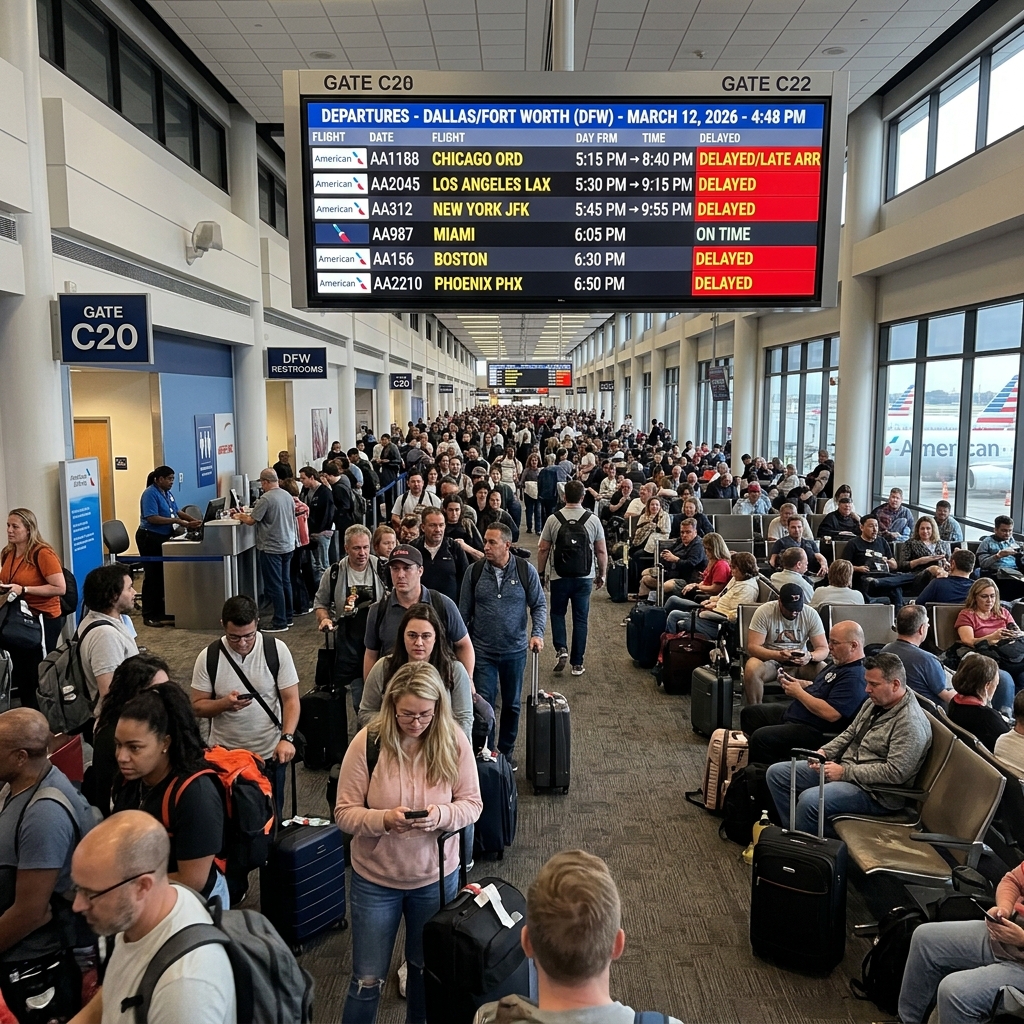
Image generated by AI
Quick Summary • Texas's three busiest airports—Dallas-Fort Worth (DFW), Houston's George Bush Intercontinental (IAH), and Austin-Bergstrom (AUS)—recorded 463 combined flight delays and 6 cancellations on March 28, 2026 • Delta Air Lines, United Airlines, and Mesa Airlines led carriers experiencing operational disruptions across multiple departure gates • The synchronized breakdown created ripple effects throughout Southwest and Central U.S. travel corridors, stranding thousands mid-journey • Passengers retain rebooking rights and potential compensation depending on delay duration and disruption cause
Nearly 500 flights ground to a crawl across Texas on Friday as Dallas, Houston, and Austin airports became bottlenecks in the nation's air travel network, leaving passengers scrambling for alternatives. The Texas delays echo similar disruptions that paralyzed Doha routes earlier this month, highlighting vulnerability in hub-dependent networks.
The simultaneous operational strain across DFW, IAH, and AUS exposed the fragility of interconnected flight schedules. Texas serves as a critical junction point connecting East and West Coast routes while anchoring Southwest Airlines' largest operational base. When all three hubs stumble together, the nationwide impact multiplies exponentially.
Texas Airport Disruptions by the Numbers
Flight tracking data reveals the scale of Friday's interference. Dallas-Fort Worth International logged the highest disruption count with over 200 delayed departures between morning and evening banking periods. Houston's George Bush Intercontinental followed with approximately 150 delays concentrated on afternoon connections. Austin-Bergstrom contributed roughly 113 delays primarily affecting Southwest and United regional services.
The six cancellations—while numerically small—forced complete rerouting for hundreds of connecting passengers. Travelers can monitor their flight status through FlightAware's live delay tracking to receive up-to-the-minute notifications.
DFW's position as the fourth-busiest airport globally amplifies any operational hiccup. The facility handles approximately 2,100 daily operations under normal conditions. Friday's delays represented a 9.5% disruption rate—enough to cascade into Saturday morning schedules as aircraft and crews fell out of position.
Houston's IAH serves as United Airlines' second-largest hub after Chicago O'Hare, processing over 500 United flights daily. The airport's dual role as an international gateway compounds domestic delays, since long-haul aircraft arriving late from overseas create domino effects on outbound domestic sectors.
Austin-Bergstrom has experienced explosive growth in recent years, now managing over 20 million annual passengers. The airport's limited terminal infrastructure leaves little buffer capacity when weather or air traffic control constraints tighten throughput.
Which Airlines and Routes Were Most Affected
Delta Air Lines encountered significant disruptions on its Atlanta-Dallas-Los Angeles triangle—a critical transcontinental corridor accounting for roughly 30 daily frequencies. Passengers booked on morning DL flights faced average delays exceeding 90 minutes, forcing missed connections at West Coast endpoints.
United Airlines struggled particularly with Houston operations. The carrier's IAH hub connects Texas to over 180 destinations worldwide. Friday's interference impacted Newark-Houston-Denver routes most severely, with regional jets operated by United Express partners experiencing gate holds averaging 75 minutes.
Mesa Airlines, a prominent regional carrier operating under United Express and American Eagle brands, saw dispatch reliability plummet. The airline flies Bombardier CRJ-900s and Embraer E175s on spoke routes from all three Texas hubs. Smaller regional aircraft prove more vulnerable to air traffic management constraints since controllers prioritize sequencing larger mainline jets during congestion periods.
Southwest Airlines—which bases over 200 aircraft in Dallas and operates point-to-point networks through all three Texas airports—reported proportionally fewer delays but higher passenger impact numbers due to its high-frequency schedule density. Combined with recent airline operational incidents, the Texas delays raise questions about infrastructure readiness heading into peak travel season.
American Airlines maintained relatively better performance despite operating a massive hub at DFW. Industry observers credit the carrier's sophisticated operations control center in Fort Worth, which coordinates real-time aircraft swaps and crew reaccommodations faster than competitors.
What Caused the Widespread Texas Flight Delays
Multiple contributing factors converged Friday to create the perfect operational storm. Air traffic control flow restrictions topped the list. The FAA air traffic control system coordinates operations across regional hubs, and disruptions in one state can ripple nationwide.
Fort Worth Air Route Traffic Control Center—which manages high-altitude airspace over North Texas—implemented ground delay programs throughout the afternoon. These programs hold departing aircraft at gates rather than allowing them to taxi and queue for takeoff, preventing airborne congestion but creating visible gate delays.
Weather played a secondary but meaningful role. While no severe thunderstorms materialized, scattered cloud layers and gusty southerly winds reduced arrival rates at DFW's four parallel runways. The airport can process 120 arrivals hourly in visual conditions but drops to 88 per hour when instrument approach procedures become necessary.
Houston faced similar meteorological constraints with low ceilings requiring wider aircraft spacing on final approach. IAH's five-runway configuration normally provides operational flexibility, but when weather forces single-direction operations, capacity shrinks dramatically.
Staffing considerations at regional carriers added complexity. Mesa Airlines and other contract operators have faced pilot availability constraints throughout 2026's first quarter. When delays force crews to exceed federally mandated duty limits, airlines must cancel flights rather than operate illegally—explaining some of the six total cancellations.
Technology infrastructure also deserves scrutiny. Airlines rely on interconnected systems for crew scheduling, maintenance tracking, and passenger rebooking. When hundreds of flights fall behind schedule simultaneously, these systems can become overwhelmed, slowing recovery efforts.
Passenger Rights and Rebooking Options
Travelers caught in Friday's disruptions possess specific protections depending on disruption cause. Understanding passenger rights under DOT regulations becomes critical when delays extend beyond carrier control.
For delays caused by air traffic control flow restrictions or weather, airlines maintain no compensation obligation beyond rebooking. However, carriers must provide meal vouchers once delays exceed three hours and hotel accommodations for overnight disruptions requiring next-day rebooking.
When delays stem from airline controllable factors—maintenance issues, crew unavailability, or operational decisions—passenger entitlements expand. Department of Transportation rules require airlines to rebook travelers on the next available flight at no additional charge, including flights on competing carriers if that provides faster resolution.
Delta, United, and Southwest all maintain same-day standby policies allowing flexible travelers to switch to earlier or later flights within the original travel date. Friday's widespread delays meant standby lists filled quickly, but persistence at ticket counters often yielded results.
Credit card travel insurance provides another recourse layer. Premium cards from Chase, American Express, and Capital One typically include trip delay coverage reimbursing meals, hotels, and essential purchases when flights experience qualifying delays—usually six hours or more.
Passengers should document everything: photograph delay information screens, save all communications from airlines, retain receipts for expenses incurred. This documentation becomes essential when filing compensation claims or disputing credit card charges.
The EU261 regulation does not apply to flights within the United States, but passengers on international itineraries connecting through Texas may qualify for European compensation if their journey originated or terminated in EU member states.
What Affected Passengers Should Do Now
Step 1: Check current flight status immediately using airline apps or FlightAware. Don't rely solely on departure boards—gate agents receive updates faster through internal systems.
Step 2: Contact airlines through multiple channels simultaneously. Call reservations while using Twitter/X to message airline customer service accounts. Phone hold times exceeded 90 minutes Friday evening, but social media teams often respond within 15 minutes.
Step 3: Download airline mobile apps if not already installed. Most carriers now allow full rebooking through apps without agent assistance. United's app particularly excels at offering alternative routing options with a few taps.
Step 4: Consider nearby airport alternatives. San Antonio International sits 80 miles south of Austin, while Dallas Love Field provides options beyond DFW. Ground transportation costs may prove worthwhile compared to 24-hour delays.
Step 5: Document all expenses related to the delay. Meals, ground transportation, phone calls, and accommodations may qualify for reimbursement depending on delay cause and your credit card benefits.
Step 6: File compensation claims within airline-specified timeframes. Delta requires submission within 45 days, United within 90 days, Southwest within six months. Missing deadlines forfeits recovery rights.
Step 7: Monitor rebooking for schedule changes. Airlines frequently adjust recovered flights multiple times as operations normalize. Set up text alerts to catch changes before arriving at the airport.
These incidents align with broader March travel disruption patterns affecting multiple regions simultaneously. Industry analysts suggest travelers book morning flights when possible, since delayed aircraft from prior days typically get repositioned overnight, making early departures more reliable.
The Texas disruptions underscore the interconnected vulnerability of hub-and-spoke airline networks. When major connecting points stumble, effects propagate nationwide within hours. Passengers should consider travel insurance for non-refundable bookings and maintain flexible plans during peak travel periods.
Airlines face mounting pressure to invest in operational resilience as climate change increases weather variability and air traffic control infrastructure ages. Friday's events may accelerate conversations about capacity expansion at Texas's three major gateways.
FAQ: Texas Flight Delays and Cancellations
Why did all three Texas airports experience delays simultaneously? Air traffic flow restrictions affected the entire regional airspace managed by Fort Worth Center. When controllers implement ground delay programs, all airports in the affected region experience ripple effects. Combined with weather reducing arrival rates, the three hubs couldn't absorb normal traffic volumes.
Can I get compensation for my delayed Texas flight? Compensation depends on delay cause. Weather and air traffic control delays don't trigger automatic payments, but airlines must rebook you and provide meals for long delays. If your delay stemmed from airline-caused issues like maintenance, you have stronger compensation grounds, especially on international itineraries.
Which airlines handled the Texas disruptions best? American Airlines demonstrated better operational resilience at DFW due to its sophisticated operations center and crew base proximity. Southwest maintained higher on-time percentages than legacy carriers at Austin and Houston, though total passenger impact was significant due to Southwest's schedule density.
Should I avoid connecting through Texas airports? Texas hubs remain critical network connectors with generally strong operational records. Friday's disruptions were exceptional. However, travelers with inflexible schedules should consider nonstop options when available or build longer connection buffers during spring weather season.
How long will recovery take from Friday's delays? Most airlines restored normal operations by Saturday morning as aircraft and crews repositioned overnight. However, some passengers on Friday's six cancelled flights may face weekend disruptions if rebooking placed them on fully-booked flights. Full network recovery typically requires 24-48 hours.
Related Articles:
Disclaimer
This article is for informational and educational purposes only. It does not constitute legal, financial, or professional advice. While we strive to provide accurate and up-to-date information, travel policies, regulations, and conditions change rapidly. Always verify information with official sources before making travel decisions. Nomad Lawyer makes no representations about the accuracy, reliability, completeness, or suitability of the information provided. Readers should consult qualified professionals for advice specific to their circumstances. The views expressed in this article are those of the author and do not necessarily reflect the views of Nomad Lawyer.
Preeti Gunjan
Contributor & Community Manager
A passionate traveller and community builder. Preeti helps grow the Nomad Lawyer community, fostering engagement and bringing the reader experience to life.
Learn more about our team →