
Takuma Fujisaki Transforms Tokyo’s Ginza District With 18-Year Pipe Cleaner Retrospective
Artist Takuma Fujisaki unveils MOLnarrative in Tokyo, showcasing 18 years of pipe cleaner art and a high-profile COMME des GARÇONS HOMME collaboration.

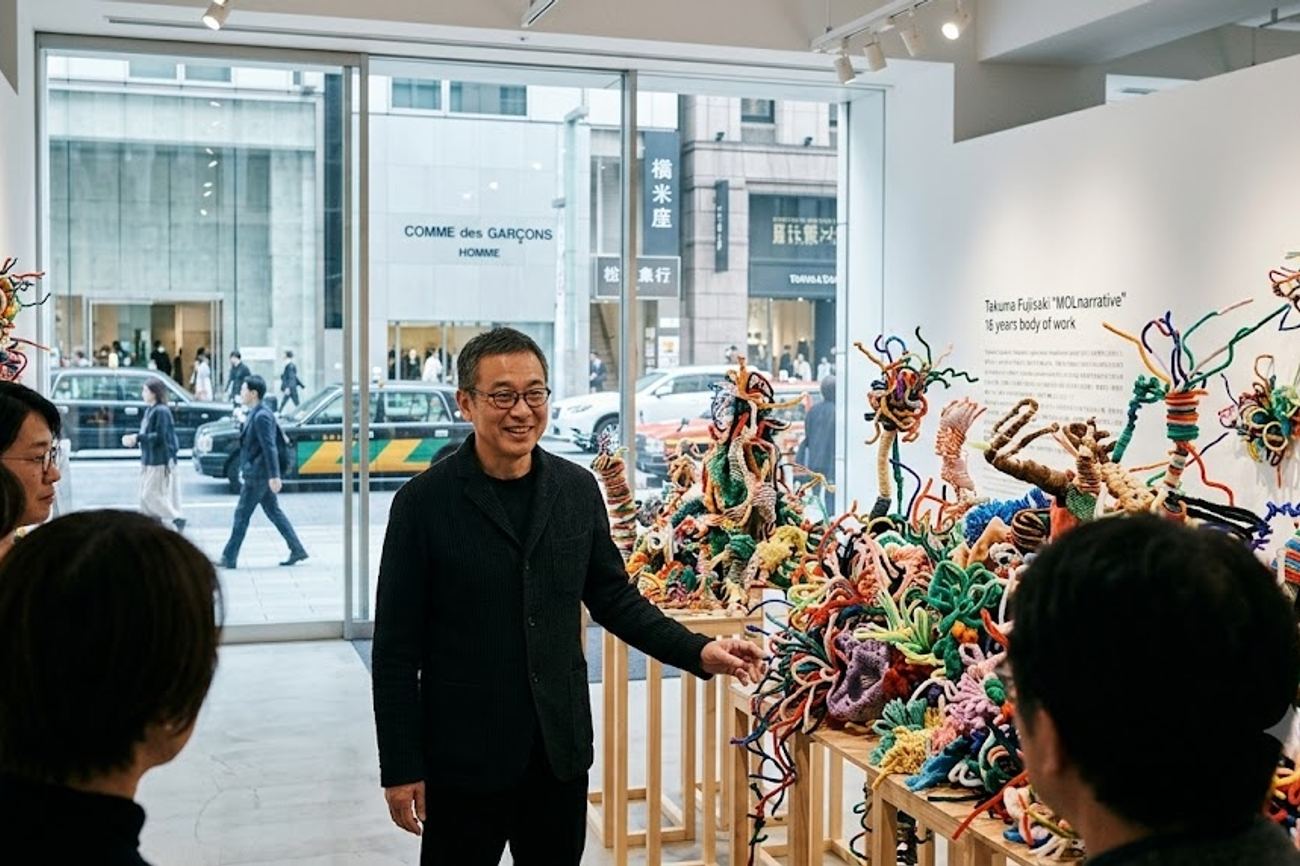
Image generated by AI
Tokyo Hosts Rare Retrospective of Pipe Cleaner Sculpture
[Tokyo, September 5, 2026] — A unique intersection of childhood craft and high-concept contemporary art has arrived in the heart of Tokyo. Takuma Fujisaki, an artist represented by the ARTOX GROUP, has opened his solo exhibition titled “MOLnarrative” at the GINZA ATRIUM, located within the Ginza Tsutaya Books complex. The showcase, which debuted on 29 August 2026 and runs through 15 September 2026, documents an 18-year trajectory of creative experimentation with pipe cleaners.
The installation serves as more than a simple gallery showing; it is a chronological mapping of Fujisaki's growth as a creator. By utilizing a medium typically associated with elementary school projects, Fujisaki challenges the boundaries between toy culture, professional design, and fine art. Beyond the main gallery, the exhibition incorporates limited-time pop-up events and specialized displays throughout Ginza Tsutaya Books, featuring MOGOLS art toys and exclusive merchandise.
The Evolution of the MOLnarrative Visual Timeline
The "MOLnarrative" exhibition is structured as a visual history, guiding visitors through the various stages of Fujisaki’s professional life. Each three-dimensional piece on display is treated as a fragment of a larger story, encapsulating the artist's personal memories, specific emotional states, and the broader cultural climate of the time in which it was created.
Rather than focusing solely on the refinement of technical skill, the exhibition emphasizes the shift in Fujisaki’s conceptual perspective. By placing early works alongside recent sculptures, the display highlights how the artist's interpretation of the world has matured. This approach transforms the gallery into a narrative space where the pipe cleaner becomes a vehicle for exploring nostalgia and the passage of time.
Fujisaki’s work deliberately blurs the lines between various creative sectors. His sculptures do not fit neatly into a single category, instead existing in a hybrid space where pop culture meets sculptural design. This multidisciplinary approach allows the exhibition to function as both a professional retrospective and a study on the endless versatility of unconventional materials.
Two Decades of Mastery Over Unconventional Materials
Since 2010, Takuma Fujisaki has been a fixture in the Tokyo art scene, hosting a series of workshops and exhibitions that have slowly defined his artistic identity. For nearly 18 years, he has focused on the transformative potential of the pipe cleaner, elevating a common craft item into a sophisticated medium for expression.
In the hands of Fujisaki, the inherent properties of pipe cleaners—their flexibility, vivid saturation, and organic irregularities—are leveraged to create personality-driven characters. The resulting sculptures often evoke a paradoxical sensation for the viewer: a feeling of deep familiarity coupled with an underlying sense of mystery. These figures feel as though they belong to a known world, yet they remain elusive and original.
The tactile, handmade nature of the work is central to its appeal. Because each piece is shaped by hand, subtle variations in texture and structure ensure that no two characters are identical. This individuality allows his work to transition smoothly between the worlds of collectible designer toys and high-end contemporary art.
From Fine Art to High Fashion Collaborations
The influence of Fujisaki’s aesthetic has recently extended beyond the gallery walls and into the global fashion industry. His ability to merge playful forms with sophisticated design has attracted the attention of major Japanese labels.
In August 2026, this trend culminated in a high-profile partnership with the fashion house COMME des GARÇONS HOMME. The project, titled “COMME des GARÇONS HOMME × TAKUMA FUJISAKI MOGOLS,” was integrated into the brand’s 2026 Autumn/Winter collection.
This collaboration saw the creation of handmade art charms crafted exclusively from black pipe cleaners. By stripping away the bright colors typical of his other work, Fujisaki emphasized the raw texture and sculptural silhouette of the material. These pieces, designed to be worn on clothing or attached to bags, function as miniature, wearable sculptures. This partnership underscores the versatility of Fujisaki's vision, proving that his "toy-like" medium can align with the avant-garde minimalism of a world-renowned fashion house.
The MOGOLS Universe and Collectible Culture
The culmination of Fujisaki's long-term experimentation is the creation of "MOGOLS," an expansive artistic universe populated by his signature pipe cleaner characters. MOGOLS is not merely a series of characters but a cohesive world that blends imagination with the modern appetite for collectible art.
By developing a consistent set of characters and lore, Fujisaki has moved from creating isolated sculptures to building a comprehensive intellectual property. This expansion into the "art toy" sector reflects a broader trend in Tokyo's creative economy, where the distinction between "low" art (toys/collectibles) and "high" art (gallery sculptures) continues to vanish.
Why This Matters: The Shift in Material Value
For the modern art observer and traveler visiting Tokyo, the "MOLnarrative" exhibition represents a significant shift in how we perceive material value. When an artist spends 18 years mastering a material as humble as a pipe cleaner, the value of the artwork shifts from the cost of the medium to the depth of the labor and the history of the vision.
From a logistical and cultural standpoint, this exhibition demonstrates the power of "Hyper-Niche" mastery. In an era of digital art and AI-generated imagery, there is a growing premium on the "handmade irregularity" that Fujisaki champions. For the visitor, the experience is a reminder that creativity is not limited by the tools available, but by the persistence of the artist's perspective. The transition of these works from a craft store material to a COMME des GARÇONS runway piece illustrates a complete cycle of artistic validation.
Related Travel Guides
Disclaimer
This article is for informational and educational purposes only. It does not constitute legal, financial, or professional advice. While we strive to provide accurate and up-to-date information, travel policies, regulations, and conditions change rapidly. Always verify information with official sources before making travel decisions. Nomad Lawyer makes no representations about the accuracy, reliability, completeness, or suitability of the information provided. Readers should consult qualified professionals for advice specific to their circumstances. The views expressed in this article are those of the author and do not necessarily reflect the views of Nomad Lawyer.
Preeti Gunjan
Contributor & Community Manager
A passionate traveller and community builder. Preeti helps grow the Nomad Lawyer community, fostering engagement and bringing the reader experience to life.
Learn more about our team →