
Taiwan High Speed Rail Deploys 176 Extra Trains for 2026 Mid-Autumn and Teachers' Day Rush
Taiwan High Speed Rail (THSRC) expands capacity with 176 additional services to manage millions of passengers during the rare combined Mid-Autumn Festival and Teachers' Day holiday window in September 2026.

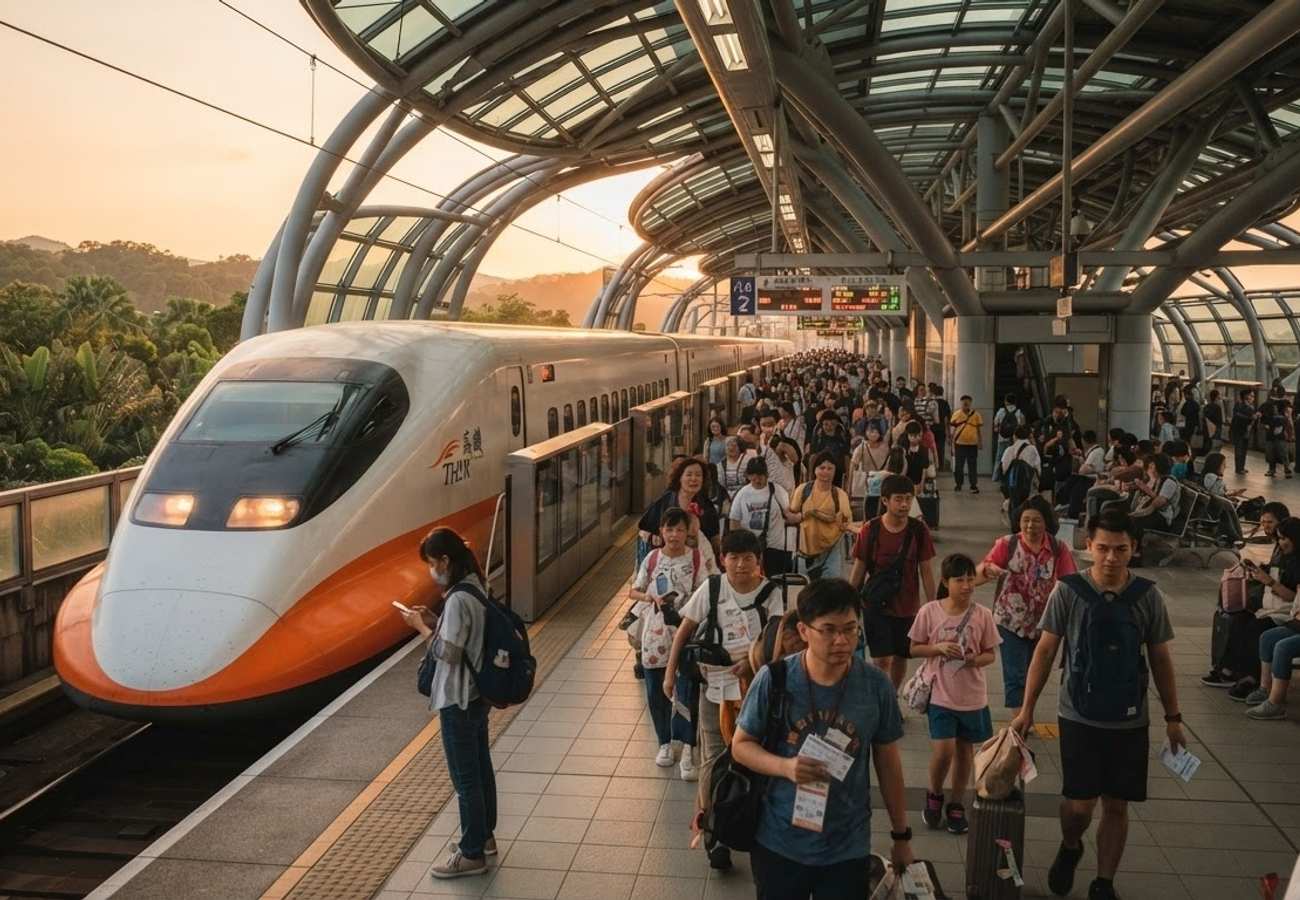
Image generated by AI
Millions of passengers will swarm Taiwan's western corridor this September, prompting Taiwan High Speed Rail (THSRC) to deploy 176 additional trains to prevent gridlock during a rare holiday overlap.
The 2026 Holiday Convergence
A unique calendar alignment in 2026 has created a high-intensity travel window. The Mid-Autumn Festival falls on 25 September, while Teachers' Day is observed on 28 September. This clustering transforms a standard break into a six-day transit surge from 24 to 29 September.
To combat the anticipated chaos, THSRC is scaling operations to 1,150 total services. The 176 extra trains are strategically weighted toward the return leg: 70 southbound services will facilitate the initial exodus, while 106 northbound trains will handle the massive return flow to Taipei and other northern hubs.
This expansion is a direct response to traffic forecasts. During similar long weekends, Taiwan's highways typically see volumes jump to 1.3 or 1.4 times their usual weekday levels. By shifting millions from private cars to high-capacity rail, the region reduces the environmental footprint of the holiday rush.
Cultural Value and Environmental Impact
For the visitor, the real impact of this surge is the visible manifestation of Taiwan's "Moon Festival" traditions. This is not merely a logistical challenge but a cultural pilgrimage. The drive toward family reunions, outdoor barbecues, and moon-gazing drives a massive migration from urban centers like Taipei to ancestral homes in Taichung, Tainan, and Kaohsiung.
From a sustainability perspective, the reliance on the 345-kilometer high-speed corridor is a victory for eco-tourism. Government data suggests that during peak long weekends, national freeway traffic can exceed 110 million vehicle-kilometers per day. Every passenger who opts for the THSR over a private vehicle significantly lowers the carbon intensity of the holiday. This shift supports regional goals managed by local transportation authorities to decrease highway congestion and urban smog during peak cultural events.
Navigating the Rush: Logistics and Crowd Control
THSRC is leaning heavily on a digital-first strategy to manage the millions on the move. Tickets for the 176 extra services are available via the T-EX mobile app, official websites, and widespread convenience store networks, which act as decentralized booking hubs to keep station queues manageable.
The seating strategy remains a hybrid model:
- Reserved Cars: Guaranteed seating for those who book in advance.
- Unreserved Cars: Each train features between two and nine unreserved carriages. While these offer flexibility, they do not guarantee a seat, making early arrival essential.
To prevent station bottlenecks, THSRC uses color-coded graphical indicators via the T-EX app. These tools provide estimated waiting times in 20-minute increments, allowing travelers to time their arrival based on real-time congestion levels.
Visitor Insider Tips
Traveling during a Taiwanese "mega-holiday" requires a different strategy than standard tourism. To avoid the stress of the 2026 rush, keep these local insights in mind:
- The "Golden Window" for Tickets: Set alerts for the T-EX app the moment the reservation window opens. Tickets for northbound returns on the final two days of the break sell out almost instantly.
- Timing the Flow: Avoid southbound travel in the late afternoon of the first holiday day. For the return trip, look for "ghost hours"—very early morning or late-night departures on the final day—where crowds are marginally thinner.
- Station Logistics: Major hubs like Nangang, Taipei, and Zuoying often extend hours, with some first departures starting before 6 a.m. Factor in an extra 45 minutes for taxi queues and local transfers, as intracity transport near riverfronts and night markets becomes heavily congested.
- The Unreserved Gamble: If you must use unreserved cars, check the station information boards immediately upon arrival to identify exactly which carriages are designated as unreserved for your specific train.
Tourism Outlook
The deployment of 176 extra trains is more than a temporary fix; it is part of a long-term evolution in Taiwan's mobility. Since 2007, the high-speed rail has transitioned from a luxury convenience to the backbone of national holiday logistics.
As Taiwan continues to integrate its transport networks, the ability to absorb millions of passengers over a six-day window without systemic collapse demonstrates a mature infrastructure. The long-term trend suggests a permanent shift away from private vehicle reliance for intercity travel, reinforcing the role of rail as the primary driver of sustainable domestic tourism.
Efficient rail is the heartbeat of the Mid-Autumn reunion.
Related Travel Guides
Disclaimer
This article is for informational and educational purposes only. It does not constitute legal, financial, or professional advice. While we strive to provide accurate and up-to-date information, travel policies, regulations, and conditions change rapidly. Always verify information with official sources before making travel decisions. Nomad Lawyer makes no representations about the accuracy, reliability, completeness, or suitability of the information provided. Readers should consult qualified professionals for advice specific to their circumstances. The views expressed in this article are those of the author and do not necessarily reflect the views of Nomad Lawyer.
Naina Thakur
Contributor & Travel Specialist
Travel enthusiast and legal writer covering visa regulations, responsible tourism, and cultural journeys across global destinations.
Learn more about our team →