
Vietnam Airlines Boeing 787-9 Suffers Tail Strike and Severe Tire Damage During Munich Departure in 2026
A Vietnam Airlines Boeing 787-9 flight from Munich to Hanoi was forced to make an emergency return after a suspected tail strike and significant landing gear damage.

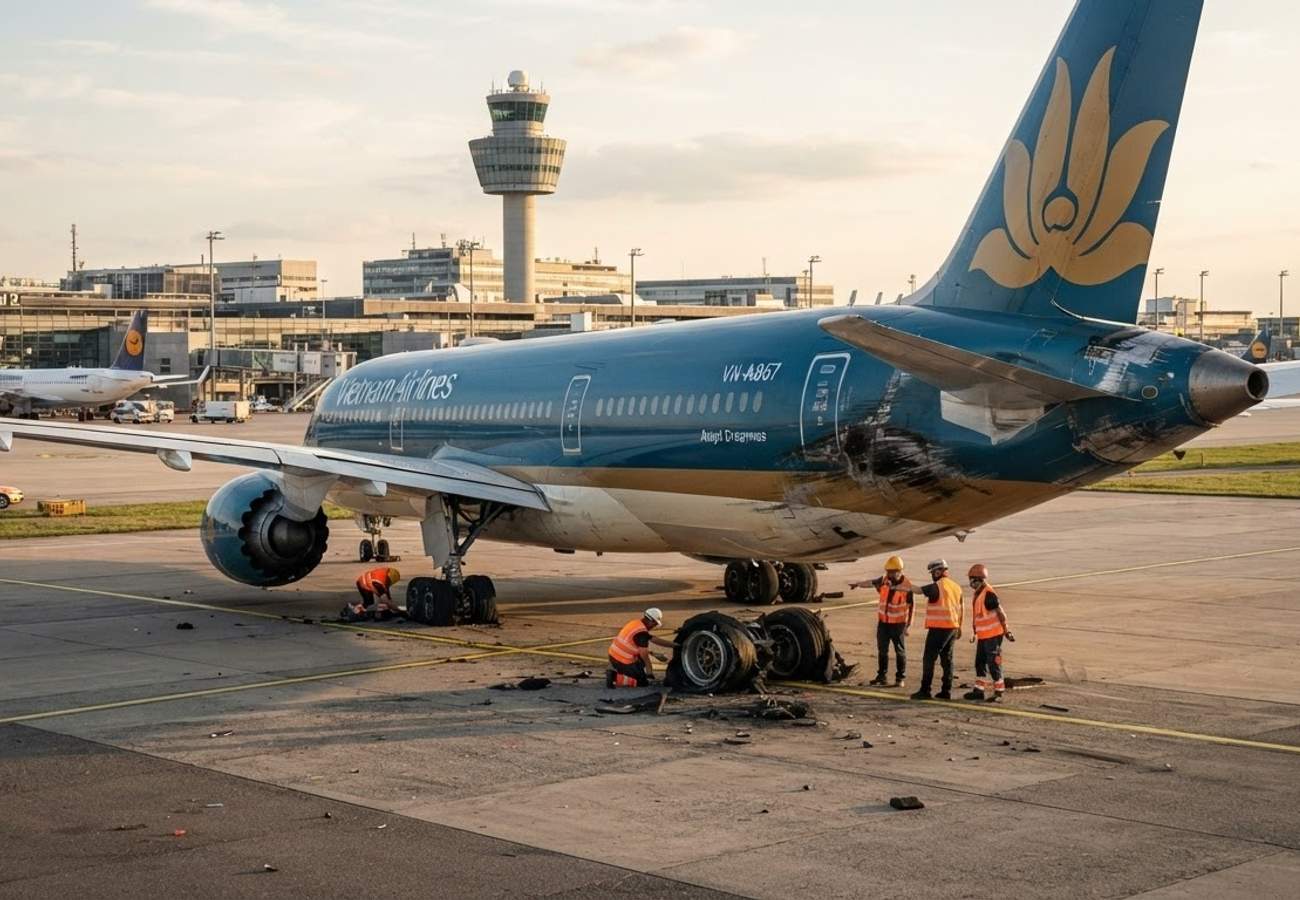
Image generated by AI
A Vietnam Airlines Boeing 787-9 was forced to abort its long-haul journey to Hanoi on August 15, 2026, returning to Munich Airport following a suspected tail strike and catastrophic tire failure. The incident, involving flight VN34, caused significant disruption to German hub operations and left the aircraft with visible structural and mechanical damage.
The emergency return occurred after a problematic takeoff from Munich’s southern runway. According to flight tracking data and eyewitness reports, the widebody aircraft, registered as VN-A867, utilized nearly the entire length of the runway before rotating. This late liftoff is believed to have resulted in the rear of the fuselage contacting the pavement, a phenomenon known in the industry as a tail strike.
Late Rotation Triggers Emergency Return at Munich Airport
The sequence of events began during the departure roll of flight VN34. Visual evidence from terminal observers and social media footage indicates that the Boeing 787-9 accelerated deep into the runway, rotating much later than standard operating procedures dictate. As the aircraft finally ascended, witnesses reported seeing a plume of smoke and dust emanating from the aft section of the jet, suggesting immediate contact between the tail cone and the runway surface.
Almost immediately after becoming airborne, the flight crew was alerted to critical issues regarding tire pressure and landing gear status. These onboard warnings indicated that the gear assembly may have struck runway lighting or other ground equipment during the late rotation. Faced with the dual threat of structural tail damage and compromised tires, the pilots opted to discontinue the flight to Hanoi and entered a holding pattern over the Bavarian region.
To ensure a safe landing, the aircraft spent an extended period flying racetrack patterns to burn off fuel and reduce its overall weight. This maneuvering not only delayed the aircraft's return but also created a ripple effect of delays for other flights operating within the Munich airspace.
Fuel Dumping and Visual Inspections of VN-A867
Before attempting to land, the crew performed fuel dumping over designated zones to reach a safe landing weight. Industry observers and aircraft spotters noted that the 787 conducted one or more low-altitude passes. These maneuvers allowed ground controllers and technical teams to visually inspect the condition of the undercarriage and the lower fuselage while the plane was still in the air.
Upon touchdown, the extent of the mechanical failure became apparent. Images shared within aviation communities show that multiple main landing gear tires were shredded, with some worn down to the metal wheel rims. The presence of rubber debris on the runway suggests that the tires were already severely compromised before the aircraft touched back down.
Furthermore, photographs of the lower aft fuselage reveal clear scraping and deformation. The damage pattern—stretching along the underside of the rear section—is consistent with a high-pitch rotation where the tail strikes the ground as the pilot attempts to force the aircraft into the air near the end of the runway.
Analysis of Takeoff Performance and Procedural Failures
While official reports from aviation regulators are pending, aviation engineers and pilots have highlighted several potential contributing factors. One theory suggests a discrepancy in performance calculations, where a combination of high aircraft weight and reduced thrust settings may have left the crew with an insufficient margin for takeoff.
Another possibility is that the crew passed the decision speed (V1) and attempted to rotate, but the aircraft did not lift off at the expected rate. This may have prompted a more aggressive pitch input to avoid overrunning the runway, which frequently leads to tail strikes on long-fuselage aircraft like the Boeing 787-9.
A formal investigation by German and Vietnamese authorities is expected to analyze the following data points:
- Flight Data Recorder (FDR) and Cockpit Voice Recorder (CVR) telemetry.
- Accurate load sheets and weight-and-balance calculations.
- Runway surface conditions and the status of ground-based lighting equipment.
- The specific timing of the tire pressure alerts relative to the rotation point.
Structural Implications for the Boeing 787-9 Composite Frame
The aircraft involved, VN-A867, now faces a lengthy grounding. The Boeing 787-9 utilizes a carbon-fiber reinforced polymer composite for its fuselage, which requires specialized repair techniques compared to traditional aluminum aircraft. Tail strikes on composite structures often necessitate the removal of large sections of the skin and precision bonding performed by manufacturer-approved teams.
Industry experts note that such repairs can take several months due to the limited global capacity for heavy composite work. The visible deformation of the tail cone suggests that the damage may extend beyond superficial scraping, requiring a deep structural integrity audit before the aircraft can be certified for flight again.
Additionally, the landing gear assembly will require a total overhaul. With shredded tires and potential damage to the rims and braking systems, significant components must be replaced. Munich Airport officials also had to conduct thorough inspections of the southern runway to clear rubber debris and repair surface gouging caused by the damaged gear.
Operational Fallout for Passengers and Airport Logistics
The incident caused immediate logistical chaos at Munich Airport. The southern runway was partially closed while the damaged 787 was secured and towed, forcing air traffic controllers to reroute flights to the northern runway. This led to a series of diversions to other German airports and significant departure delays during the evening peak.
For Vietnam Airlines, the cancellation of flight VN34 represents a loss of long-haul capacity during the high-demand summer season. The airline has had to adjust its fleet planning, substituting aircraft or rescheduling services to maintain its connection between Germany and Vietnam.
The event highlights the razor-thin margins of error involved in heavy-aircraft departures from European hubs, where a few seconds of delayed rotation can lead to months of costly repairs.
Related Travel Guides
Disclaimer
This article is for informational and educational purposes only. It does not constitute legal, financial, or professional advice. While we strive to provide accurate and up-to-date information, travel policies, regulations, and conditions change rapidly. Always verify information with official sources before making travel decisions. Nomad Lawyer makes no representations about the accuracy, reliability, completeness, or suitability of the information provided. Readers should consult qualified professionals for advice specific to their circumstances. The views expressed in this article are those of the author and do not necessarily reflect the views of Nomad Lawyer.
Kunal K Choudhary
Co-Founder & Contributor
A passionate traveller and tech enthusiast. Kunal contributes to the vision and growth of Nomad Lawyer, bringing fresh perspectives and driving the community forward.
Learn more about our team →