
Sydney Airport Overnight Tower Shutdown Plan: Controller Shortages Threaten Australia’s Peak Travel Surge

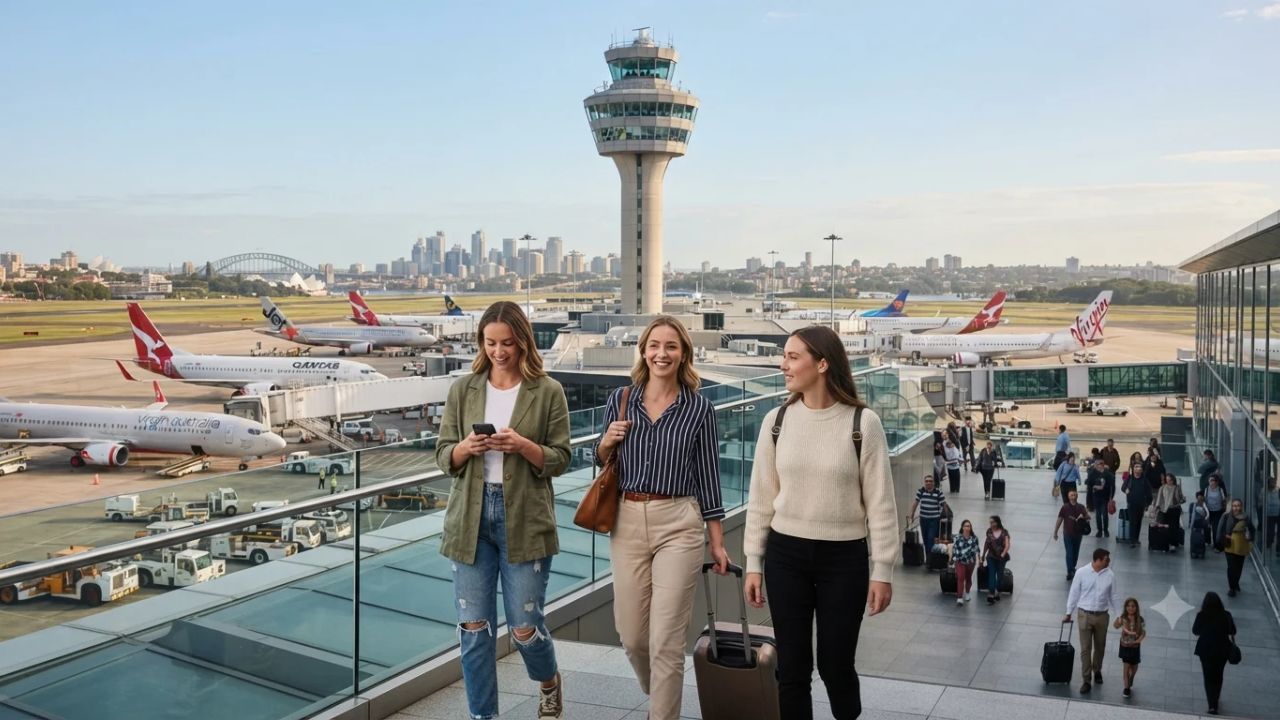
Image generated by AI
With an estimated 2.67 million holiday travelers scheduled to pass through terminal gates between 21 September and 11 October 2026, a reported proposal to shutter Sydney Kingsford Smith Airport’s air traffic control tower overnight exposes the fragile staffing margins anchoring Australia’s premier gateway. Endorsed in principle by major domestic airlines seeking to redeploy specialized controllers onto daytime flight banks, the plan highlights how workforce shortages within air navigation provider Airservices Australia threaten national schedule reliability right as international passenger arrivals hit record highs.
Regulatory Caps and Curfew Realities: Decoding the Overnight Tower Proposal
The proposal to close the Sydney Airport control tower overnight, reported on 17 September 2026, has ignited widespread industry debate over infrastructure resilience. However, contrary to consumer alarm, the measure does not signal an unexpected shutdown of commercial passenger aviation. Sydney Kingsford Smith operates under a strict statutory framework governed by the Sydney Airport Curfew Act, which mandates a blanket prohibition on standard passenger jet operations between 11:00 PM and 6:00 AM, permitting only emergency medical transfers, police flights, and designated low-noise prop freight exemptions.
The strategic rationale driving airline support centers on workforce allocation. Airservices Australia, the government-owned corporation responsible for airspace safety, faces an ongoing deficit of certified terminal controllers. When sick leave or roster gaps occur, safety protocols require supervisors to immediately throttle ground and approach traffic flow rates to maintain separation standards. Airservices Australia Chief Executive Rob Sharp acknowledged on 10 August 2026 that staffing constraints have caused frustrating delays for airlines and travelers, emphasizing that reducing movement rates is mandatory to uphold uncompromised aviation safety.
The vulnerability of this system became painfully apparent on 11 September 2026, when unexpected controller shortages forced flow restrictions that triggered 14 inbound flight cancellations and delays exceeding one hour. By temporarily halting overnight tower operations during the existing curfew window, air navigation managers can concentrate scarce personnel on daytime and evening departure rosters when runways process maximum passenger volumes.
Capacity Ceilings, Disruption Spirals, and Economic Exposure: The Hard Data
The operational stability of Sydney Airport carries immediate macroeconomic implications for the Australian economy. In 2025, the gateway handled more than 42.54 million passengers, representing a 2.7 percent increase over 2024. International passenger traffic set an all-time record of 17.17 million travelers, capped by a phenomenal fourth quarter where 11.41 million total passengers and 4.62 million international flyers crossed the tarmac. Inbound momentum surged across critical bilateral markets, led by double-digit jumps in Chinese passport holders (up 12.2 percent) and South Korean travelers (up 15.3 percent), alongside solid growth from Japan (8.3 percent) and the United Kingdom (7.4 percent).
According to Destination NSW and Tourism Research Australia data for the year ending March 2026, Sydney welcomed 67.5 million total visitors who generated $34.7 billion in economic expenditure. Domestic tourism contributed 63.6 million visitors and $20.8 billion in spending, while 3.9 million international visitors stayed 89.9 million nights and injected $13.9 billion into the state economy. Across New South Wales as a whole, visitor numbers climbed 6.3 percent to 129.3 million, with total visitor spending expanding 16 percent to $61.9 billion.
At the national level, data from the Australian Bureau of Statistics demonstrates that direct tourism GDP reached $81.1 billion in 2024–25, representing 2.9 percent of national GDP. The visitor economy supported 696,000 jobs—accounting for 4.4 percent of Australia's entire workforce—while domestic consumption generated $168.8 billion and international consumption reached $42.3 billion.
| Operating Parameter / Metric | Statutory Rule / Observed Performance | Aviation Operational Impact | Economic & Traveler Exposure |
|---|---|---|---|
| Standard Movement Cap | 80 movements per regulated hour | Strictly caps hourly runway capacity | Prevents airlines from adding extra recovery flights |
| Daily Runway Ceiling | 1,360 total movements per day | Absolute ceiling under federal law | Delays cannot be cleared by extending night ops |
| Harris Review Recovery Window | Up to 85 movements/hour (max 2 hours) | Temporary post-disruption surge tool | Cannot operate during the 11:00 PM to 6:00 AM curfew |
| Holiday Peak Forecast (Sep 21 – Oct 11) | 2.67M passengers (Oct 1 Intl, Oct 2 Dom peaks) | Terminal and apron facilities operating at saturation | Single-point ATC delays trigger systemwide cancellations |
| Controller Recruitment Pipeline | 8 tower additions (18 mos); 109 national (FY2026) | Simulators and training pipelines accelerating | Roster gaps remain exposed to short-term absenteeism |
Under policy administration directed by the Department of Infrastructure, Transport, Regional Development, Communications and the Arts, Sydney is designated a Level 3 coordinated airport under International Air Transport Association guidelines. While recent reforms under the Sydney Airport Demand Management Regulations 2025 permit an hourly surge up to 85 movements for two consecutive hours after qualifying disruptions, this mechanism cannot breach the 11:00 PM curfew or the daily 1,360 movement cap, leaving zero structural cushion when afternoon thunderstorms or staffing shortages strike.
Expert Analysis: Rotational Fragility, Western Sydney Transition, and Missed Connection Cascades
From an airline operations perspective, air traffic control bottlenecks at Sydney Airport generate cascading domestic and trans-Pacific network failure.
The pricing pressure this creates means carrier seat inventory during peak school-holiday periods becomes hyper-inelastic. When ground delay programs reduce hourly arrivals from 80 aircraft down to 50 or 60, domestic jetliners entering the Sydney terminal area are placed into extended holding patterns or diverted to regional alternates like Canberra or Newcastle. For travelers booking this route, the direct consequence is severe itinerary breakdown: an aircraft delayed departing Sydney in the morning arrives late into Melbourne, Brisbane, or Adelaide, pushing secondary delays through multiple subsequent domestic sectors before breaching crew duty-time limits.
Passengers traveling on self-connected separate tickets or transferring to long-haul international flights face the greatest financial jeopardy. Missing an evening long-haul departure to London, Singapore, or Los Angeles frequently strands passengers for 24 to 48 hours because outbound international flights operate near 100 percent load factors during the October holiday peak.
Relief is on the horizon, but not in time for the current seasonal surge. Western Sydney International (Nancy-Bird Walton) Airport (WSI) is scheduled to open for passenger operations on 25 October 2026. Designed as a 24-hour, curfew-free facility with an initial capacity of 10 million passengers annually, WSI will see Jetstar launch opening-day domestic flights to the Gold Coast, Melbourne, and Brisbane, followed by Air New Zealand's Auckland route on 26 October and Singapore Airlines daily services in November. Furthermore, overnight air freight operations will permanently transfer from Kingsford Smith to Western Sydney starting 1 November 2026 under curfew regulations.
Until Western Sydney absorbs overnight freight and low-cost passenger volume, Kingsford Smith remains the indispensable economic aorta of Australian tourism. Managing controller rosters through pragmatic overnight tower consolidations represents an imperfect but necessary operational compromise to safeguard daytime passenger movement.
Key Takeaways
- Targeted Overnight Proposal: The plan to close Sydney Airport’s control tower overnight is an operational measure to redeploy controllers to daytime peaks, not an airport shutdown.
- Severe Staffing Deficit: Airservices Australia faces persistent air traffic controller shortages, requiring flow restrictions that caused 14 flight cancellations on 11 September.
- Massive Holiday Passenger Surge: Sydney Airport anticipates 2.67 million travelers between 21 September and 11 October 2026, with traffic peaking on 1 and 2 October.
- High Economic Stakes: Sydney tourism accounts for $34.7 billion in visitor spending and 67.5 million visitors annually, linking runway reliability directly to national GDP.
- Western Sydney Relief Imminent: Western Sydney International Airport opens on 25 October 2026 as a curfew-free 24/7 gateway, transferring overnight freight on 1 November.
FAQ: Sydney Airport Tower Proposal and Travel Disruptions 2026
Is Sydney Airport closing down overnight?
No. The proposal only considers closing the air traffic control tower during the existing 11:00 PM to 6:00 AM statutory curfew, when regular commercial passenger flights are already prohibited by federal law.
Why do airlines support closing the Sydney Airport control tower overnight?
Airlines support the measure because it allows Airservices Australia to shift rostered air traffic controllers from quiet nighttime shifts to high-density daytime and evening periods, reducing peak-hour flight delays.
How do air traffic control shortages cause passenger flight delays?
When staffing falls below required levels, air traffic management limits hourly runway arrivals and departures to maintain strict safety buffers, forcing aircraft into holding patterns or causing cancellations.
When will Western Sydney Airport open to relieve flight congestion?
Western Sydney International Airport opens for passenger flights on 25 October 2026, operating without a curfew and taking over dedicated overnight freight operations from 1 November 2026.
In an island continent defined by distance, keeping runway gates turning is not merely an operational ambition—it is the foundational pillar of national economic connectivity.
Related Travel Guides
Air New Zealand Expands Hobart-Auckland Flights: 170 Rotations and 33,000 Seats for 2026–27
Hundreds of Travelers Impacted as 3,744 Delays Hit Asian Aviation Hubs
Middle East Airports Face Severe Travel Disruptions With 895 Flight Delays
Disclaimer
This article is for informational and educational purposes only. It does not constitute legal, financial, or professional advice. While we strive to provide accurate and up-to-date information, travel policies, regulations, and conditions change rapidly. Always verify information with official sources before making travel decisions. Nomad Lawyer makes no representations about the accuracy, reliability, completeness, or suitability of the information provided. Readers should consult qualified professionals for advice specific to their circumstances. The views expressed in this article are those of the author and do not necessarily reflect the views of Nomad Lawyer.
Preeti Gunjan
Contributor & Community Manager
A passionate traveller and community builder. Preeti helps grow the Nomad Lawyer community, fostering engagement and bringing the reader experience to life.
Learn more about our team →