
Southwest Airlines Flight SWA1788 Executed Precautionary U-Turn to Kansas City
Southwest Airlines flight SWA1788 returned to Kansas City International Airport on July 5, 2026, after a cockpit technical alert interrupted its flight.

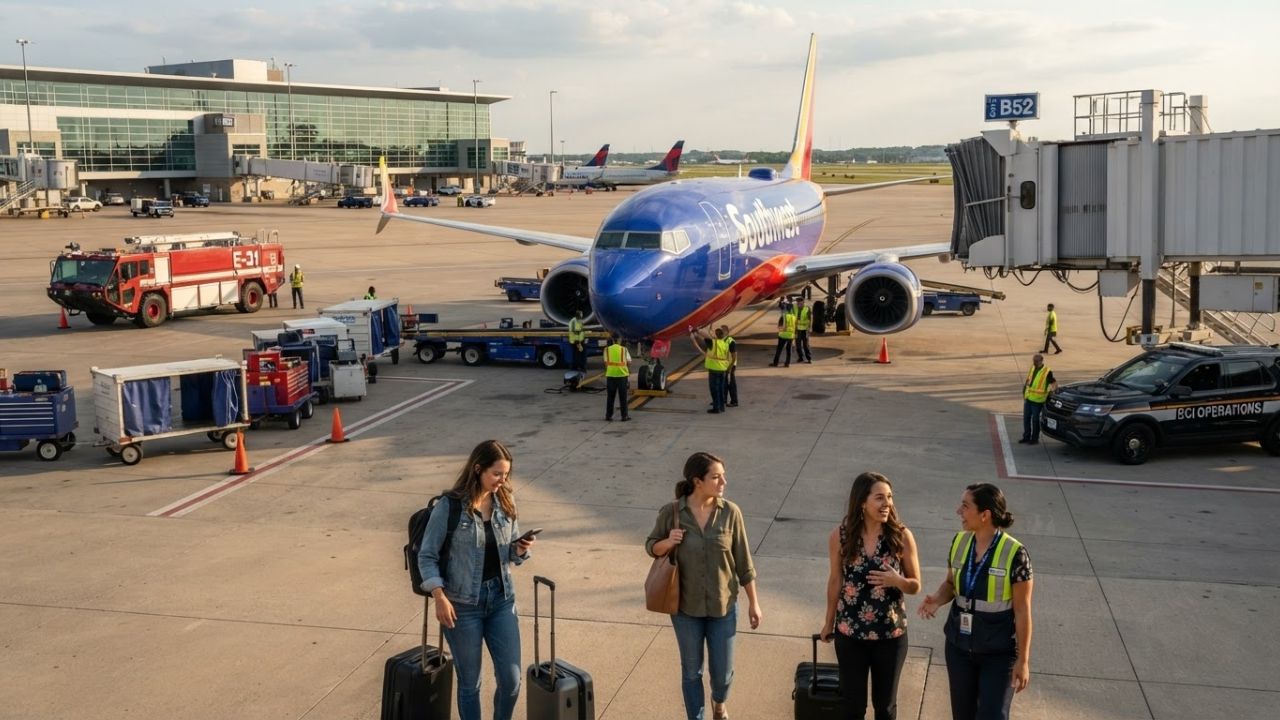
Image generated by AI
An unexpected Southwest Airlines SWA1788 U-turn occurred on July 5, 2026, when a Boeing 737 MAX 8 flying from Kansas City to St. Louis was forced to return to Kansas City International Airport (MCI). The flight crew executed the precautionary return after a cockpit technical alert was triggered.
Maintenance Base Efficiency and Pilot Decision-Making
The aircraft operating the route, registered as N8903H, climbed for several minutes before leveling off and initiating a banking turn back to the west. Air traffic controllers cleared a dedicated corridor to prioritize the plane's descent.
The flight landed safely at MCI without further incident. Emergency services vehicles stood by along the taxiway as a standard safety precaution, and the aircraft taxied normally to the passenger gate.
Returning to a primary maintenance base like Kansas City International Airport (MCI) allowed the airline to access specialized engineering teams and spare parts immediately. Pilots routinely prioritize returning to established bases rather than landing at secondary fields.
Southwest Airlines customer service teams arranged a replacement Boeing 737 MAX 8 to transfer the delayed travelers. Passengers resumed their journey to St. Louis later that afternoon.
Technicians initiated comprehensive diagnostic reviews to examine the sensor anomaly. System logs and digital flight data recorders were reviewed to confirm the airframe met federal airworthiness standards under Federal Aviation Administration regulations.
Mid-Flight Alert Response and Regional Airspace Traffic
The Missouri airspace requires coordination between regional radar sectors. Controllers guided SWA1788 to ensure the detour did not disrupt adjacent flight paths.
Flight tracking logs indicate the aircraft leveled off at its cruise altitude before returning. The pilot's prompt response allowed ground crews at the gate to prepare the arrival area.
Once diagnostic sign-offs are completed by the airline's engineering division, the aircraft will return to scheduled commercial service. Southwest's proactive handling ensured passenger safety during the minor schedule disruption.
Why This Matters
Our analysis of the flight data indicates that executing a precautionary return to a primary maintenance hub is a highly cost-efficient strategy for narrowbody aircraft operators. When a cockpit alert occurs, diversion to a non-base airport often results in extended aircraft ground time due to a lack of certified mechanics and specific spare parts. By returning to Kansas City, the carrier had immediate access to maintenance facilities and a spare Boeing 737 MAX 8 aircraft, minimizing passenger delay times. This operational choice reflects how airlines balance safety regulations with fleet utilization metrics during unexpected technical disruptions.
Industry Outlook
Market trends suggest that airlines will increasingly integrate predictive diagnostic software to detect minor component anomalies before takeoff, reducing the frequency of in-flight turnbacks. Long-term projections indicate that carriers will expand regional spare parts inventories to secondary airports to mitigate passenger delays caused by unexpected diversions. Expect regulatory agencies to continue auditing narrowbody sensor systems to maintain fleet safety standards during peak summer operations.
Frequently Asked Questions: Southwest Flight SWA1788 U-Turn
Why did Southwest Airlines flight SWA1788 return to Kansas City?
The flight returned to Kansas City International Airport due to a cockpit technical alert triggered shortly after takeoff.
Which aircraft operated flight SWA1788?
The flight was operated by a Boeing 737 MAX 8 regional passenger aircraft, registered as N8903H.
How did the airline accommodate the delayed passengers?
Passengers were transferred to a replacement Boeing 737 MAX 8 aircraft to complete their journey to St. Louis.
Related Travel Guides
Disclaimer
This article is for informational and educational purposes only. It does not constitute legal, financial, or professional advice. While we strive to provide accurate and up-to-date information, travel policies, regulations, and conditions change rapidly. Always verify information with official sources before making travel decisions. Nomad Lawyer makes no representations about the accuracy, reliability, completeness, or suitability of the information provided. Readers should consult qualified professionals for advice specific to their circumstances. The views expressed in this article are those of the author and do not necessarily reflect the views of Nomad Lawyer.
Kunal K Choudhary
Co-Founder & Contributor
A passionate traveller and tech enthusiast. Kunal contributes to the vision and growth of Nomad Lawyer, bringing fresh perspectives and driving the community forward.
Learn more about our team →