
Southwest Airlines Flight WN1682 Diverts to Tucson International Airport from Denver in August 2026
Southwest Airlines Flight WN1682 experienced a significant diversion to Tucson International Airport on August 3, 2026, resulting in a five-hour delay for passengers traveling from Denver to Phoenix.

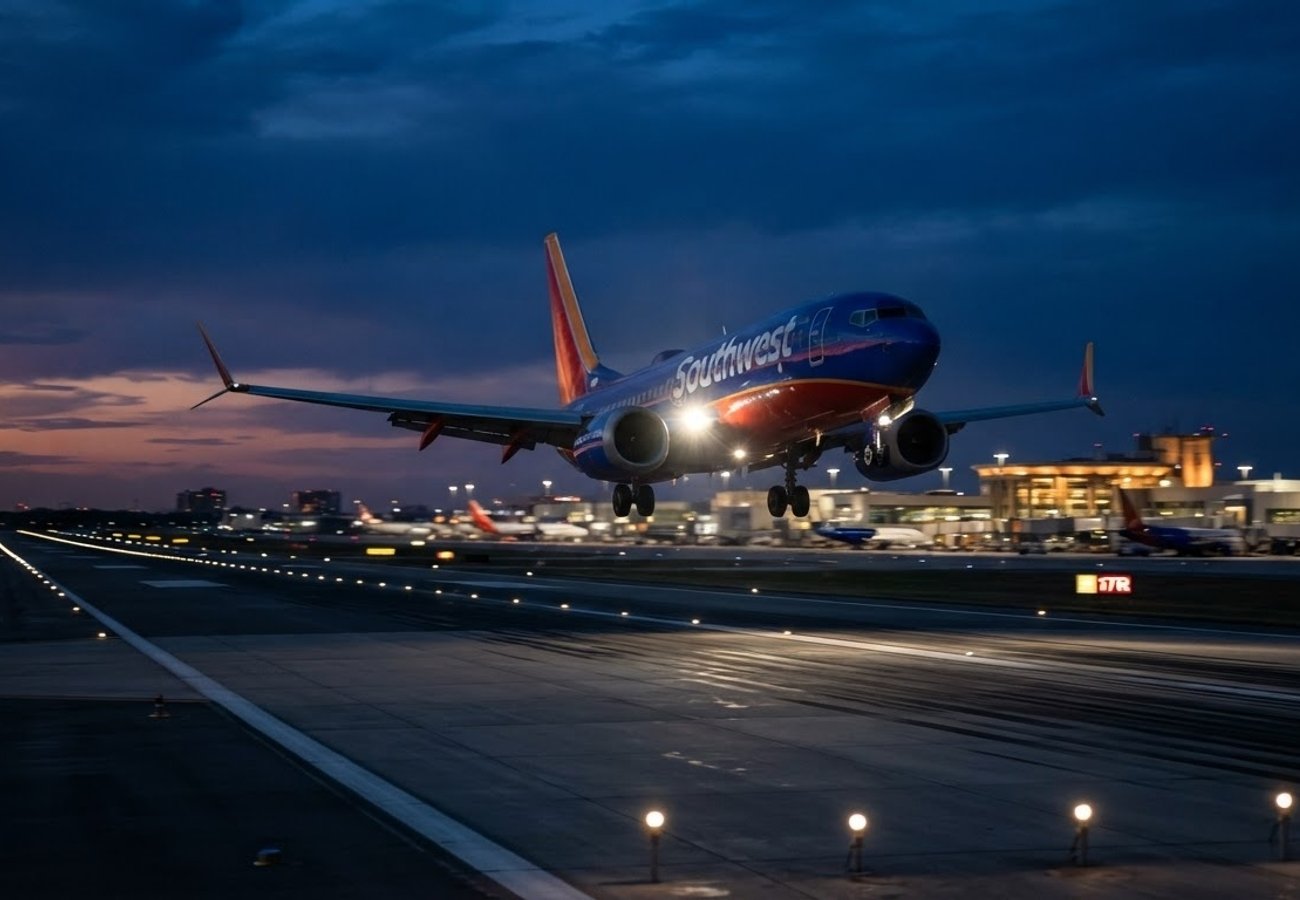
Image generated by AI
Flight WN1682, operating from Denver to Phoenix, was diverted to Tucson International Airport on August 3, 2026. Passengers faced a total delay of approximately five hours and thirty-five minutes.
Diversion Incident Details
On Monday, August 3, 2026, Southwest Airlines Flight WN1682 (also identified as SWA1682) departed from Gate C50 at Denver International Airport (DEN) bound for Phoenix Sky Harbor International Airport (PHX). The flight was operated by a Boeing 737 MAX 8, registration N8762Q.
During the transit, the aircraft was diverted from its original flight path and rerouted to Tucson International Airport (TUS) in Arizona. Flight tracking data indicates the aircraft touched down in Tucson at approximately 11:20 PM MST.
While the landing was completed safely, the diversion resulted in a substantial disruption to the scheduled arrival time. The aircraft reached its alternate destination roughly 5 hours and 35 minutes later than the original scheduled arrival in Phoenix.
Flight and Airport Impact Breakdown
- Flight Number: WN1682 / SWA1682
- Aircraft Model: Boeing 737 MAX 8 (Registration: N8762Q)
- Origin: Denver International Airport (DEN)
- Intended Destination: Phoenix Sky Harbor International Airport (PHX)
- Diversion Point: Tucson International Airport (TUS)
- Actual Arrival Time: 11:20 PM MST (August 3, 2026)
- Total Delay: ~5 hours 35 minutes
Passenger Rights & Advisory
For the affected passengers on WN1682, a diversion of this magnitude triggers specific obligations from the carrier. Because this flight operated within the United States, it falls under the jurisdiction of the U.S. Department of Transportation (DOT) guidelines rather than EU261.
Rebooking and Transport Our analysis of DOT policy suggests that when a flight is diverted to an alternate airport, the airline is responsible for coordinating the final leg of the journey. For passengers on WN1682, this meant Southwest was required to either provide ground transportation from Tucson to Phoenix or arrange a subsequent flight.
Duty of Care Given the 5+ hour delay and the late-night arrival (11:20 PM MST), passengers may have been entitled to amenities. For the affected traveler, this means:
- Meal Vouchers: Standard industry practice for delays exceeding three hours.
- Accommodation: If the diversion forced an overnight stay in Tucson, the airline is typically expected to provide or reimburse reasonable hotel costs.
Compensation Claims Unlike European regulations, U.S. law does not mandate fixed cash compensation for delays or diversions. However, if the diversion was caused by a "controllable" event (such as a mechanical failure of the Boeing 737 MAX 8) rather than "uncontrollable" factors (such as severe weather), passengers have stronger leverage to request travel vouchers or refunds for the unused portion of their ticket.
Industry Analyst View
This incident underscores the critical role of regional hubs like Tucson International Airport in the U.S. aviation safety net. The ability to seamlessly transition a Boeing 737 MAX 8 to an alternate runway ensures safety but places a high operational burden on the airline to manage "last-mile" logistics.
The lack of an immediate official reason for the diversion is common in early-stage reports. However, the significant time gap between the scheduled arrival and the actual landing in Tucson suggests a complex operational decision, likely involving either a technical malfunction or a sudden change in air traffic control restrictions.
Safe landings are the priority, but the operational recovery from a diversion remains a primary pain point for passenger satisfaction.
Related Travel Guides
Disclaimer
This article is for informational and educational purposes only. It does not constitute legal, financial, or professional advice. While we strive to provide accurate and up-to-date information, travel policies, regulations, and conditions change rapidly. Always verify information with official sources before making travel decisions. Nomad Lawyer makes no representations about the accuracy, reliability, completeness, or suitability of the information provided. Readers should consult qualified professionals for advice specific to their circumstances. The views expressed in this article are those of the author and do not necessarily reflect the views of Nomad Lawyer.
Preeti Gunjan
Contributor & Community Manager
A passionate traveller and community builder. Preeti helps grow the Nomad Lawyer community, fostering engagement and bringing the reader experience to life.
Learn more about our team →