
Singapore Tourism Update 2026 As China Leads Visitor Growth While Shorter Trips Impact Recovery
Singapore Tourism Update 2026 As China Leads Visitor Growth While Shorter Trips Impact Recovery

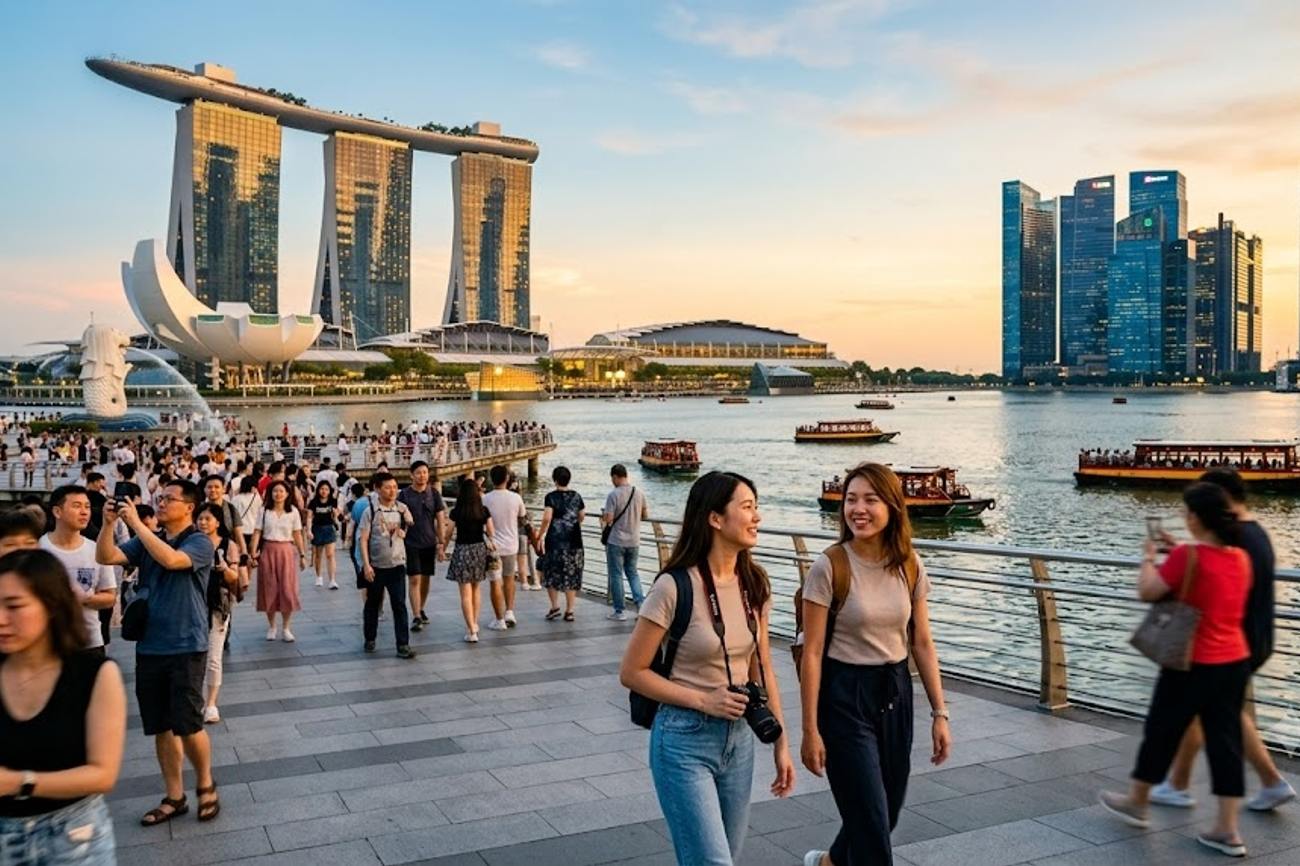
Image generated by AI
A traveler arriving at Changi Airport this August likely noticed a shift in the terminal atmosphere: while the crowds remain, the duration of their stay is shrinking. For those planning multi-city Asian itineraries, the recent data suggests Singapore is increasingly being treated as a short-term transit hub rather than a primary destination, a trend that directly impacts how you should book your flights and hotels to avoid unnecessary costs.
August 2026 Tourism Contraction and Visitor Trends
The Singapore Tourism Board (STB) has released data for August 2026 indicating a cooling period for the city-state's tourism sector. While the total volume of international arrivals remains high, there is a measurable decline in the "depth" of these visits. In August, Singapore recorded 1.61 million international visitors. While this number appears robust, it actually represents a marginal decrease of 0.3 percent compared to the same month in the previous year and a 1.2 percent drop from July 2026.
The more concerning metric for the local economy is the decline in overnight stays. The number of visitors staying at least one night fell by 2.2 percent year-on-year, totaling 1.24 million people. This shift is mirrored in the average length of stay, which plummeted by 4.2 percent year-on-year to just 3.46 days.
For the first eight months of 2026, the cumulative data shows a downward trend. Singapore welcomed 11.43 million international visitors from January through August, a 1.7 percent decrease compared to the same window in 2025. Overnight visitors for this period reached 8.37 million—representing 73.2 percent of all arrivals—but this figure is down 3.2 percent year-on-year. Furthermore, the average stay for the first eight months of the year dropped 2.8 percent to 3.43 days.
Despite these headwinds, the STB maintains an ambitious target for the full year of 2026, aiming for 17 million to 18 million international visitors, which would exceed the 16.9 million recorded in 2025. Financially, the board expects tourism receipts to land between SG$31 billion and SG$32.5 billion (approximately US$24.4 billion to US$25.5 billion).
Affected Routes and Visitor Demographics
The disruption in tourism patterns is not uniform across all nationalities. Certain markets are driving growth while others are retreating.
- Mainland China: The primary engine of recovery. August saw 435,440 arrivals, a 9.4 percent increase over August 2025. Chinese travelers are staying an average of 3.71 days.
- Indonesia: The second-largest source market with 161,680 arrivals.
- Malaysia: The second-fastest growing market among the top five, with 94,200 visitors (a 6.2 percent increase year-on-year).
- Japan: Remained stable with 92,960 arrivals.
- India: Recorded 87,770 arrivals, representing a 3.7 percent decline. However, Indian travelers provide the highest value per visit, with the longest average stay of 5.95 days.
- Australia: The sixth-largest market with 86,570 arrivals.
- Other Key Markets: South Korea, the United States, the Philippines, Taiwan, and the United Kingdom each contributed over 50,000 visitors in August.
Your Rights as a Passenger
While the STB data tracks tourism volume, the practical reality for passengers traveling to Singapore involves navigating the flights that facilitate these movements. If your travel to Singapore is disrupted by cancellations or significant delays, your legal protections depend on the airline's origin and the jurisdiction of the flight.
EU and UK Regulations (EU261/2004 & UK261) If you are flying to Singapore from an airport within the EU or UK, or flying into the EU/UK on a carrier licensed in those regions, you are protected by strict compensation laws. For flights exceeding 3,500 km (which applies to almost all flights to Singapore), you are entitled to €600 (or £520) in compensation if your flight is cancelled with less than 14 days' notice, or delayed by more than three hours, provided the cause was not "extraordinary circumstances." You can verify your eligibility through the UK Civil Aviation Authority or specialized platforms like AirHelp.
US Department of Transportation (DOT) Rules For passengers flying from the US, the DOT recently strengthened refund mandates. If your flight to Singapore is significantly changed or cancelled by the airline, you are entitled to a full refund to your original form of payment—not just a travel voucher—regardless of whether the ticket was "non-refundable." You can file a formal complaint or check current consumer protections via the US DOT Air Consumer portal.
DGCA India Regulations Given that India remains a top-five market for Singapore, many travelers fall under DGCA guidelines. Indian passengers are entitled to "duty of care" (meals and hotel accommodation) during long delays. While cash compensation is less standardized than in the EU, passengers are entitled to a full refund if the airline cancels the flight and cannot provide an alternative that meets the traveler's needs.
Rebooking Strategy and Alternatives
With the average stay in Singapore dropping to 3.46 days, many travelers are now using the city as a "stopover" rather than a destination. If your flight is cancelled or you are looking to optimize a shorter trip, consider these strategies:
1. The Stopover Pivot If your primary destination is further east (e.g., Australia or Japan) and your Singapore flight is disrupted, check for alternative routings through Bangkok (BKK) or Kuala Lumpur (KUL). Since Malaysia is seeing a 6.2 percent growth in visitors, connectivity between KUL and SIN is typically high. Use FlightRadar24 to monitor real-time aircraft movements and identify which airlines have the most available hulls on the route.
2. Refund vs. Rebooking Trade-off With the current trend toward shorter stays, you may find that a full refund (under US DOT or EU261 rules) allows you to book a more flexible "multi-city" ticket. Instead of a round-trip to Singapore, consider an open-jaw ticket (e.g., fly into Singapore, fly out of Kuala Lumpur) to maximize your time in the region without backtracking.
3. Monitoring Flight Status To avoid being stranded during this period of fluctuating demand, always check the official airline status page. For example, those flying British Airways should utilize the BA Flight Status tool 24 hours before departure to confirm that their flight is not among the casualties of shifting capacity.
FAQ: Singapore Tourism Trends 2026
Am I entitled to compensation for a cancelled flight to Singapore? Yes, if you are departing from the EU/UK or flying with an EU/UK carrier, you may be eligible for up to €600. US passengers are entitled to full refunds for significant cancellations. Indian passengers are entitled to a refund or re-routing under DGCA rules.
Why is the average stay in Singapore decreasing? The STB data indicates a shift toward shorter trips due to changing travel patterns and economic considerations. Visitors are increasingly opting for brief stays (averaging 3.46 days) rather than extended vacations.
Which nationality stays the longest in Singapore? Indian travelers currently record the longest average stay among major markets, spending approximately 5.95 days in the destination, significantly higher than the overall international average.
Can I get a refund if I choose to shorten my trip? Refunds for voluntary changes depend on your ticket fare class. However, if the airline changes your flight schedule significantly, you are legally entitled to a refund under US and EU laws, regardless of the ticket type.
Stay agile with your bookings as Singapore transitions from a long-stay destination to a high-velocity transit hub.
Related Travel Guides
Disclaimer
This article is for informational and educational purposes only. It does not constitute legal, financial, or professional advice. While we strive to provide accurate and up-to-date information, travel policies, regulations, and conditions change rapidly. Always verify information with official sources before making travel decisions. Nomad Lawyer makes no representations about the accuracy, reliability, completeness, or suitability of the information provided. Readers should consult qualified professionals for advice specific to their circumstances. The views expressed in this article are those of the author and do not necessarily reflect the views of Nomad Lawyer.
Raushan Kumar
Founder & Lead Developer
Full-stack developer with 11+ years of experience and a passionate traveller. Raushan built Nomad Lawyer from the ground up with a vision to create the best travel and law experience on the web.
Learn more about our team →