
Singapore Airlines and Southwest Defeat Severe Travel Chaos and Global Airport Disruptions With Massive 130-Destination Interline Partnership: Latest Airline News
As severe flight cancellations and disconnected itinerary failures paralyze global transit, Singapore Airlines and Southwest launch a massive single-ticket partnership to eradicate travel chaos.

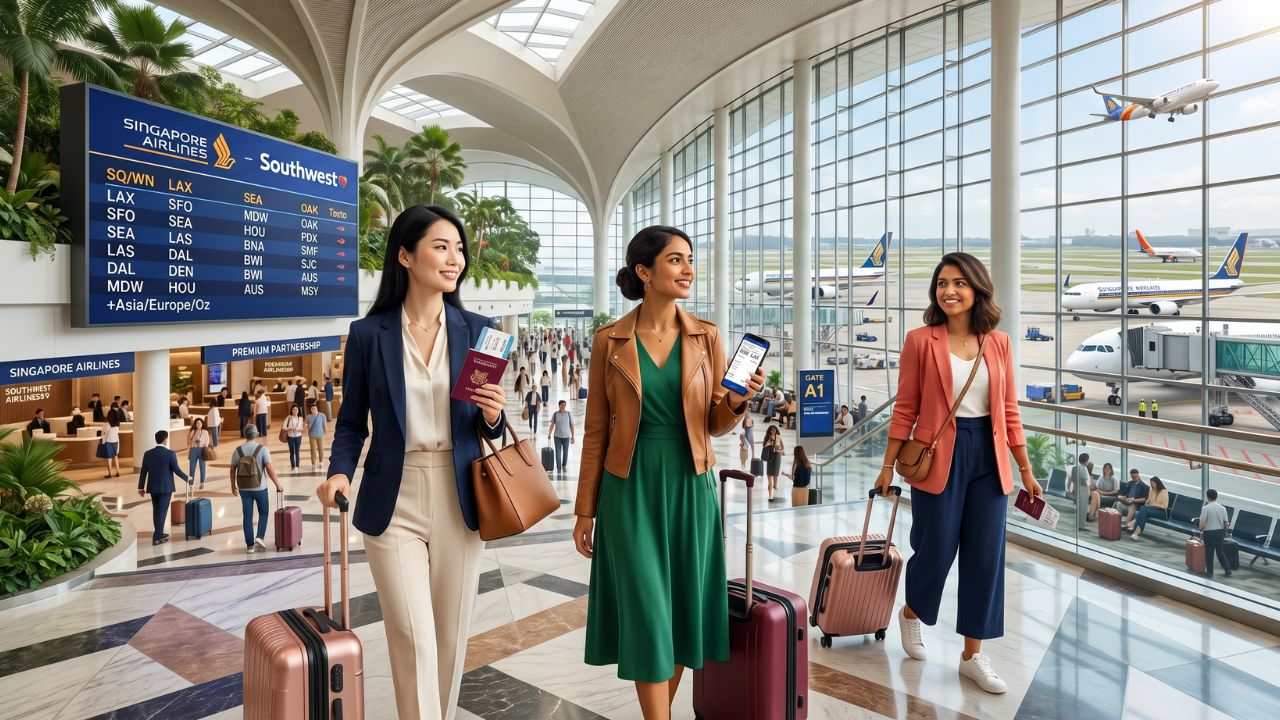
Image generated by AI
In a massive, highly coordinated operational strike designed to permanently eradicate the severe travel chaos and catastrophic flight cancellations currently plaguing unlinked international itineraries, Singapore Airlines and Southwest Airlines have officially announced a game-changing global partnership. As chronic airport disruptions and archaic booking complexities continue to paralyze passengers attempting to self-connect between North America and Asia, this newly formed alliance offers the ultimate disruption bypass. Announced in June 2026, the historic agreement allows passengers to seamlessly book single-ticket itineraries combining Southwest's massive domestic US grid with the Singapore Airlines Group's sprawling international reach. By entirely insulating travelers from the massive luggage losses and missed connections associated with fragmented booking, this single-ticket fortress connecting over 130 destinations across 35 countries represents the premier headline in today's breaking airline news and essential global aviation updates.
By introducing direct passenger coordination and dynamic scheduling backups, the regional aviation hubs target growing passenger demand across vital commerce sectors. The choice to coordinate flight departures in phases helps to manage gate capacity, supporting the country's broader regional transportation network.
Context: Eradicating the Fragmented Itinerary Meltdown
For the millions of global tourists and corporate professionals relying on multi-airline journeys between secondary US cities and the Asia-Pacific, the established reality of "self-connecting" has degenerated into an absolute nightmare of travel chaos.
Historically, passengers flying from a smaller US city like Omaha to a global destination like Jakarta were forced to book separate tickets on domestic and international carriers. In the modern era of tight connection windows, this fragmented approach is highly susceptible to cascading flight cancellations. If a domestic flight is delayed by weather, the entirely separate international ticket is rendered void, leaving the traveler stranded at the gateway airport facing total financial ruin. The Southwest Airlines and Singapore Airlines partnership explicitly destroys this vulnerability. By utilizing single-ticket, interline-style connectivity, passengers are mathematically protected. If rolling airport disruptions delay the Southwest leg, Singapore Airlines is structurally bound to accommodate the passenger, entirely removing the travel anxiety that defines modern self-transfers.
To view live flight schedules, specific route integration updates, or alternative connection options, travelers must consult official US and Singaporean aviation directories. For direct booking access to these heavily protected, single-ticket transit routes, travelers should check the official Singapore Airlines or Southwest Airlines booking portals. To explore live flight tracking and monitor the exact severity of the global airspace bottlenecks they are actively avoiding, passengers can consult the official FlightAware tracking service.
Section-Wise Breakdown of the Global Bypass Strategy
The Asian Fortress: Singapore Changi Airport
At the center of this massive network integration is Singapore Changi Airport. Functioning as the ultimate global connecting hub, Changi processed an astonishing 67.7 million passengers in 2025. By routing international traffic through this hyper-efficient gateway, the Singapore Airlines Group (including Scoot) offers unparalleled access across Southeast Asia, East Asia, South Asia, Australia, and New Zealand. Passengers transferring here are entirely insulated from the severe terminal gridlock plaguing older, less advanced Asian hubs.
The US Gateways: Los Angeles, San Francisco, Seattle-Tacoma
The partnership heavily relies on three primary gateway airports to filter passengers from the US interior directly into the international network. Los Angeles offers strong access to Southern California, San Francisco dominates the Northern technology corridors, and Seattle-Tacoma provides vital links for Pacific Northwest traffic. By utilizing these specific, high-capacity transfer points, the airlines distribute the passenger load efficiently, avoiding the extreme bottlenecking that frequently triggers flight cancellations at other coastal mega-hubs.
The Domestic Connector: The Southwest Transformation
The partnership arrives as Southwest Airlines undergoes a massive, passenger-focused transformation. Moving away from its traditional operating model, Southwest is aggressively rolling out assigned seating options, extra legroom products, and enhanced boarding experiences. These upgrades ensure that premium international travelers stepping off a Singapore Airlines long-haul flight receive a consistent, high-quality domestic connection to nearly 120 US airports.
Technical Roster: SIA-Southwest Connectivity and Disruption Bypass Matrix
To ensure absolute factual accuracy regarding the specific network reach and operational metrics defining this massive partnership, the following table details the exact integration data:
| Operational Metric / Connectivity Feature | Exact Integration Data | Global Aviation Market Impact |
|---|---|---|
| Partnership Structure | Single-ticket interline-style | Mathematically protects passengers from unlinked flight cancellations |
| Primary Asian Hub | Singapore Changi Airport | Hyper-efficient mega-hub processes 67.7 million annual passengers |
| US Gateway Airports | Los Angeles, San Francisco, Seattle | Strategic coastal filtering entirely bypasses interior travel chaos |
| Southwest Network Access | Nearly 120 US airports | Connects secondary US cities directly to the global pipeline |
| SIA Group Network Reach | More than 130 destinations | Spans across Southeast Asia, China, Japan, India, and Australia |
| Global Footprint | 35 Countries and Territories | Massive, unified network eliminates the need for fragmented booking |
| Airlines Included | Singapore Airlines, Scoot, Southwest | Combines premium long-haul luxury with expansive domestic reach |
Passenger Impact: Reclaiming the Multi-Leg Journey
For the everyday passenger and high-yield corporate traveler moving between regional America and the Asia-Pacific, this partnership represents the ultimate logistical victory against travel anxiety.
The immediate passenger impact is the absolute elimination of connection stress. Under the previous self-connecting model, travelers had to retrieve their baggage at the gateway airport, drag it to a new terminal, and re-check it with the international carrier, a process highly vulnerable to severe airport disruptions. With this new single-ticket agreement, luggage is seamlessly checked all the way from a secondary city like Boise, Idaho, straight through to Sydney or Bali. Furthermore, this connectivity drastically improves business travel efficiency by reducing administrative complexity, allowing corporate travel managers to book a single, fully protected itinerary rather than gambling on multiple, disconnected reservations.
Industry Analysis: Expansion Without the Capital Risk
Aviation industry analysts view the Southwest Airlines and Singapore Airlines partnership as a masterclass in aggressive, low-risk network expansion.
Analysts note that as international demand continues to strengthen across the Pacific, carriers are under intense pressure to capture long-haul traffic flows. However, launching new intercontinental routes requires billions of dollars in aircraft purchases and extreme exposure to fluctuating fuel costs and route unprofitability. By executing this interline partnership, Singapore Airlines instantly gains deeper penetration into the US interior market without launching a single new aircraft. Conversely, Southwest Airlines instantly becomes a major player in international long-haul distribution without the risk of operating widebody jets. Analysts agree that as global passenger traffic continues its upward trajectory according to the International Air Transport Association (IATA), domestic carriers with massive partnership networks will absolutely crush legacy airlines relying solely on organic expansion.
Actionable Advice for Bypassing Fragmented Travel Chaos
If you are an international traveler seeking to leverage this massive network integration to avoid the severe travel chaos currently plaguing self-connecting itineraries, execute this strategic planning checklist immediately:
- Demand Single-Ticket Itineraries: Never manually piece together a Southwest domestic flight with a separate Singapore Airlines international flight again. Use the official airline portals to book the integrated, single-ticket option to ensure full legal protection against missed connections.
- Select the Correct US Gateway: Optimize your transit by choosing the right gateway. If flying from the Pacific Northwest, route through Seattle-Tacoma to minimize domestic flight time and avoid the heavier airspace congestion frequently found down in Los Angeles.
- Leverage the Southwest Upgrades: Take advantage of Southwest's recent passenger-focused enhancements. Opt for the newly introduced assigned seating options and extra legroom products to ensure a comfortable transition after stepping off your premium Singapore Airlines flight.
- Explore Secondary Asian Markets: Utilize Scoot, the low-cost arm of the SIA Group included in this partnership, to efficiently reach secondary leisure destinations in Southeast Asia straight from your local US airport, entirely bypassing major Asian mega-hubs.
FAQ: Singapore Airlines & Southwest Partnership 2026
What exactly is the Southwest and Singapore Airlines partnership?
Announced in June 2026, it is a massive single-ticket interline agreement that allows passengers to seamlessly connect Southwest's vast US domestic network (nearly 120 airports) with Singapore Airlines' extensive global reach (over 130 destinations).
How does this partnership combat travel chaos and flight cancellations?
By utilizing single-ticket bookings, passengers are legally protected if a flight is delayed or canceled. The airlines are responsible for rebooking and handling luggage transfers, entirely eliminating the risk of being stranded on unlinked itineraries.
Which US gateway airports are being utilized for this partnership?
The partnership specifically filters passengers through Los Angeles (LAX), San Francisco (SFO), and Seattle-Tacoma (SEA), directly linking them to the massive global hub at Singapore Changi Airport.
The Breaking Point of Self-Connecting Travel
The monumental launch of the Southwest Airlines and Singapore Airlines partnership proves definitively that the era of risky, fragmented self-connecting travel is dead. By offering corporate and leisure passengers a highly capitalized, single-ticket bypass around the severe travel chaos crippling unlinked itineraries, these two titans have fundamentally shifted the balance of power in trans-Pacific transit. As legacy alliances desperately attempt to defend their market share against this massive, 130-destination network integration, passengers must accept a critical new reality: avoiding brutal airport disruptions requires booking with airlines that legally guarantee your connection, and the Singapore-Southwest alliance has officially emerged as the ultimate armor for the modern global traveler.
Key Takeaways
- Massive Network Integration: Singapore Airlines and Southwest launched a historic interline agreement connecting nearly 120 US airports to over 130 global destinations.
- Single-Ticket Protection: The partnership completely eliminates the travel chaos of "self-connecting" by providing single-ticket protection against flight cancellations and missed connections.
- Strategic US Gateways: Passengers are efficiently filtered through Los Angeles, San Francisco, and Seattle-Tacoma, bypassing the terminal gridlock of interior US mega-hubs.
- Singapore Changi Dominance: The partnership leverages the hyper-efficient Singapore Changi Airport, which processed 67.7 million passengers in 2025, as the ultimate Asian transfer node.
- Southwest Passenger Upgrades: The deal perfectly aligns with Southwest's massive transformation, which includes the rollout of assigned seating and extra legroom for premium connecting travelers.
Related Travel Guides
Global Airlines Expand Secondary Hubs to Defeat Travel Chaos
Qantas Defeats Travel Chaos With Project Sunrise Direct Flights
Singapore-Southwest Partnership and Luggage Transfer Strategies on Reddit
Disclaimer: Interline ticketing availability, specific gateway connections, and baggage transfer protocols for the Southwest and Singapore Airlines partnership are subject to ongoing integration updates. Travelers are legally advised to constantly verify their exact single-ticket protections and connection times directly via their operating carrier's official booking portal prior to finalizing any complex trans-Pacific itineraries.
Kunal K Choudhary
Co-Founder & Contributor
A passionate traveller and tech enthusiast. Kunal contributes to the vision and growth of Nomad Lawyer, bringing fresh perspectives and driving the community forward.
Learn more about our team →