
SFO Runway 1R Closure and FAA Arrival Caps Trigger Systemic Flight Delays Through October 2026
San Francisco International Airport faces severe congestion as a $180 million runway overhaul and FAA-mandated arrival caps reduce hourly aircraft throughput through October 2026.

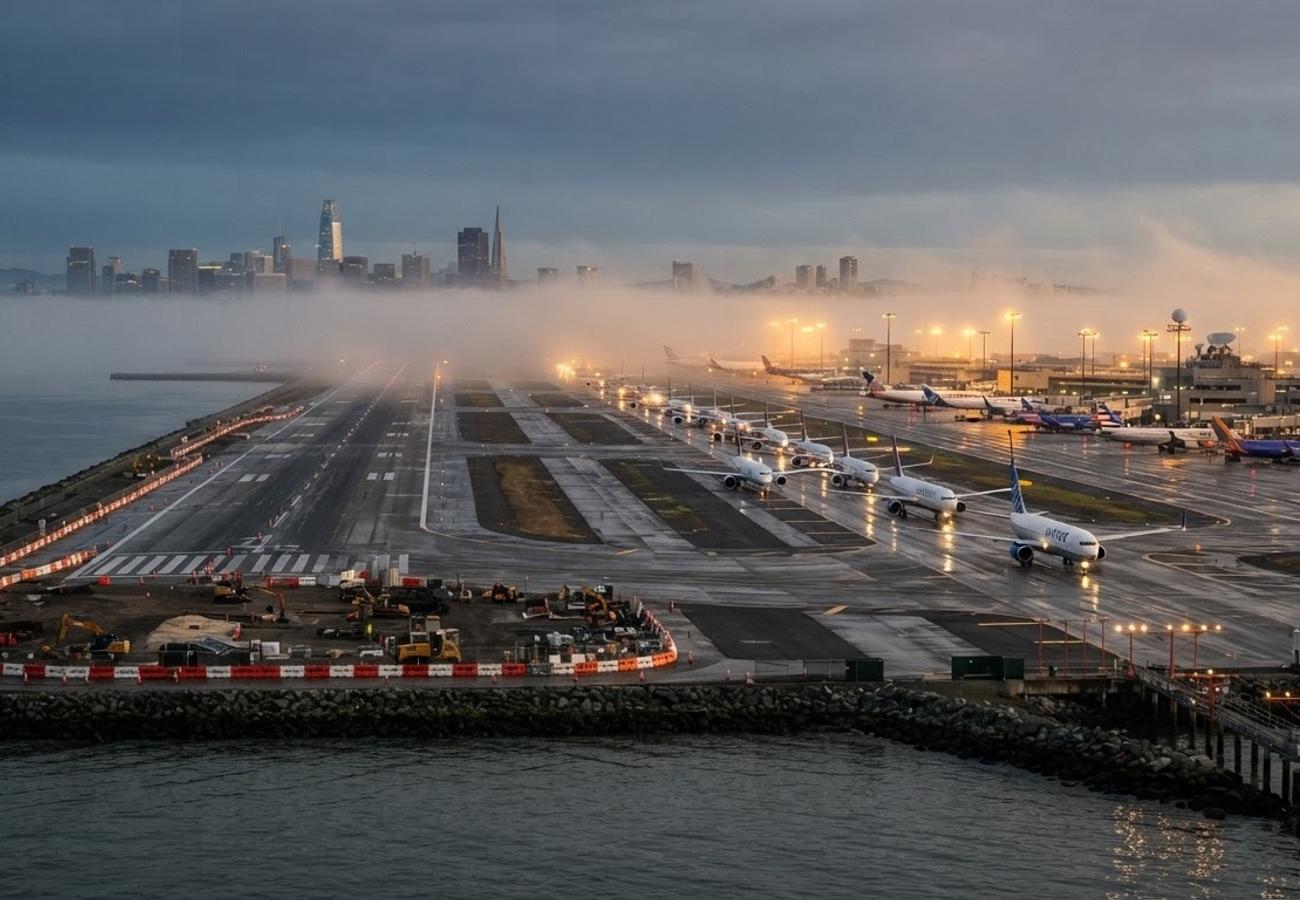
Image generated by AI
Federal arrival limits and a major runway repaving project at San Francisco International Airport (SFO) are compounding to create systemic flight delays through early October 2026.
Infrastructure Constraints and Federal Mandates
San Francisco International Airport is currently operating under significant capacity constraints due to the closure of Runway 1 Right (1R), which began on March 30, 2026. This six-month project involves a comprehensive pavement and lighting overhaul and taxiway improvements. The project carries a total cost of 180 million dollars, supported by more than 92 million dollars in grants from the Federal Aviation Administration (FAA).
According to FAA construction notices, Runway 01R/19L and its associated taxiway segments are scheduled to remain out of service until at least October 2, 2026. This closure forces the airport to funnel nearly all arrivals and departures through Runways 28 Left and 28 Right. While this configuration is standard during specific wind conditions, it lacks the flexibility required to handle peak traffic volumes.
The operational impact is further exacerbated by FAA-imposed restrictions on closely spaced parallel landings. Safety reviews have led to a reduction in hourly throughput; arrival rates that previously peaked at approximately 54 aircraft per hour during visual side-by-side approaches have been reduced to roughly 36 aircraft per hour.
SFO Operational Capacity and Schedule Impact
The intersection of physical runway closures and regulatory arrival caps has led to a measurable decline in on-time performance. Transportation Department statistics from 2026 indicate that SFO has seen some of the lowest punctuality rates among major U.S. hubs, with some months showing only slightly more than 50% of flights arriving within 15 minutes of their scheduled time.
SFO Capacity and Constraint Parameters
| Parameter | Pre-Construction/Standard | Current Constraint (2026) | Impact/Status |
|---|---|---|---|
| Primary Runway Status | All Runways Operational | Runway 1R Closed | Out of service until Oct 2, 2026 |
| Peak Arrival Rate | ~54 aircraft per hour | ~36 aircraft per hour | 33% reduction in throughput |
| Project Budget | N/A | $180 Million | $92M+ via FAA grants |
| On-Time Performance | Standard Hub Baseline | ~50% (certain months) | Significant punctuality drop |
| Primary Flow | Distributed | Runways 28L and 28R | High congestion during peaks |
Traveler Logistics Guide: Navigating SFO Congestion
From a ground-level perspective, the best way to navigate the current SFO environment is to assume a "buffer-first" approach to all scheduling. The combination of low ceilings (coastal fog) and reduced runway capacity creates a compounding effect that triggers Ground Delay Programs (GDPs) frequently.
Booking and Connection Strategy If connecting through SFO, avoid "tight" connections (under 2 hours). Because airlines are required to hold departures at origin airports when SFO arrival slots are full, your delay may begin before you even leave your first city. For international arrivals connecting to domestic flights, allow additional time for customs and terminal transfers, as gate holds often result in rushed boarding processes once the aircraft finally lands.
Digital Transit and Monitoring Travelers should rely on real-time FAA Air Traffic Control System Command Center advisories rather than just airline apps, as the former provides a clearer picture of systemwide Ground Delay Programs. If you see "Low Ceiling" or "Arrival Delay" flags for SFO in the morning, expect mid-morning and late-evening congestion to peak.
Ground Transport Given the likelihood of extended gate holds and airborne holding patterns, coordinate airport pickups for 60 to 90 minutes after the scheduled landing time to avoid excessive parking or waiting fees.
Regional Connectivity and Infrastructure Outlook
The current disruptions are part of a larger, multiyear infrastructure pipeline. FAA federal construction outlook reports indicate that SFO will continue a sequence of airfield projects—including taxiway realignments and runway rehabilitation—through at least 2027.
Because SFO is geographically constrained by the bay, any single runway closure has a disproportionate impact on regional connectivity. While the reopening of Runway 1R in early October will restore some flexibility, the FAA’s restrictive parallel landing configurations are expected to remain in place pending further safety reviews. This suggests that the "new normal" for SFO will involve a higher baseline of delay risk and potentially padded flight schedules from carriers to compensate for reduced peak arrival rates.
Expect continued volatility in Bay Area flight schedules until the full restoration of airfield capacity in late 2026.
Related Travel Guides
Disclaimer
This article is for informational and educational purposes only. It does not constitute legal, financial, or professional advice. While we strive to provide accurate and up-to-date information, travel policies, regulations, and conditions change rapidly. Always verify information with official sources before making travel decisions. Nomad Lawyer makes no representations about the accuracy, reliability, completeness, or suitability of the information provided. Readers should consult qualified professionals for advice specific to their circumstances. The views expressed in this article are those of the author and do not necessarily reflect the views of Nomad Lawyer.
Raushan Kumar
Founder & Lead Developer
Full-stack developer with 11+ years of experience and a passionate traveller. Raushan built Nomad Lawyer from the ground up with a vision to create the best travel and law experience on the web.
Learn more about our team →