
Schengen Travel Crisis 2026: EES Biometric Queues and Internal Border Checks Double Wait Times
European travel is facing severe disruptions as the new EES biometric system and reinstated internal border checks double passport control wait times at major hubs like Frankfurt and Amsterdam.

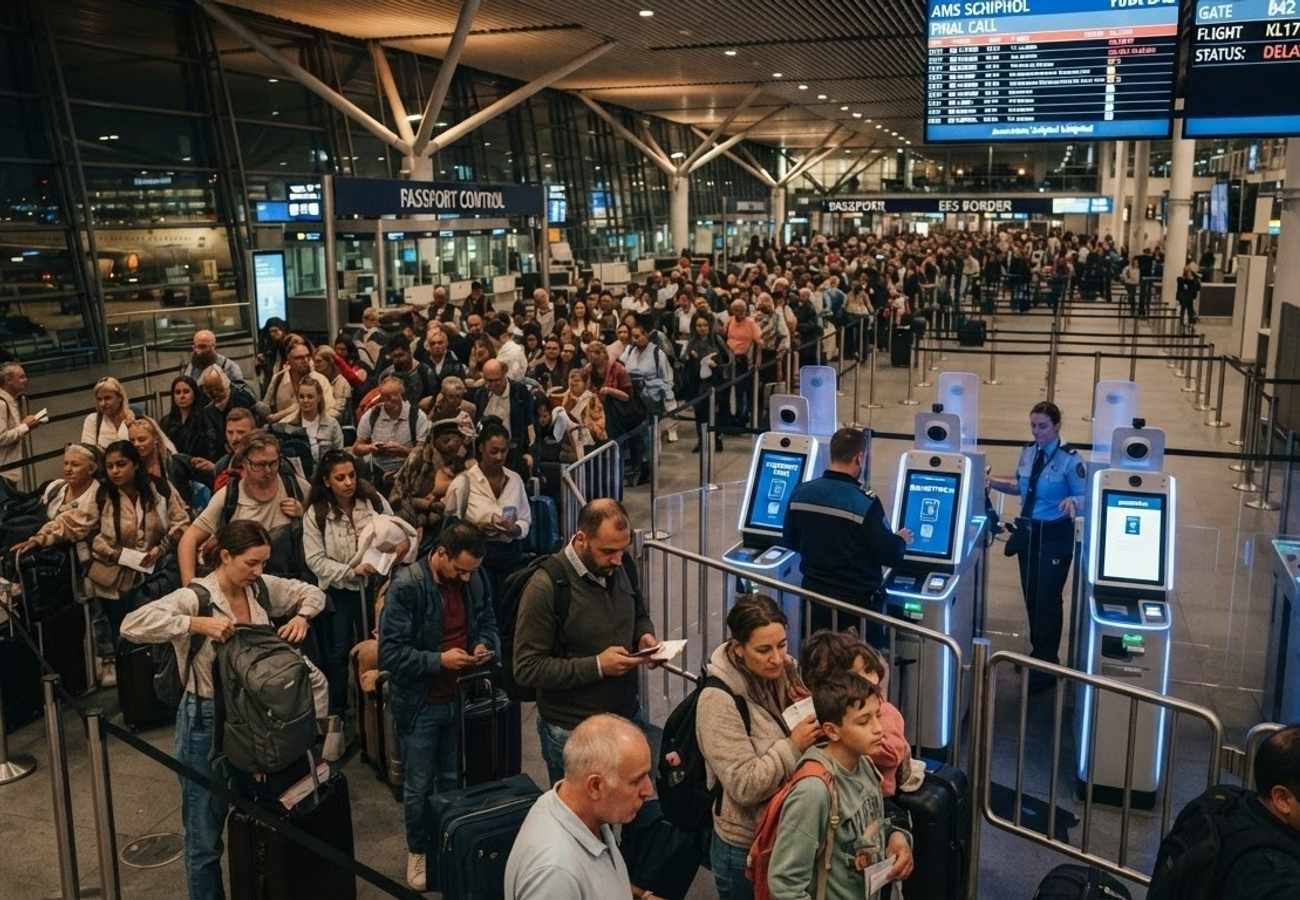
Image generated by AI
Passport control wait times at Frankfurt and Amsterdam airports have surged to 120 minutes in July 2026, marking a doubling of delays compared to the previous year. This systemic friction is the result of a "perfect storm": the full implementation of the EU Entry/Exit System (EES) coinciding with the reinstatement of internal border checks by ten Schengen member states.
The European summer travel season is currently navigating one of its most volatile border-control periods in recent history. For the modern traveler, the experience is no longer about a single point of friction but a cumulative series of delays. Passengers are now facing a dual-layered gauntlet: first, the biometric registration required to enter the Schengen Area, and subsequently, unexpected identity checks when moving between member nations.
Biometric Bottlenecks at Frankfurt and Major EU Hubs
The strain on Europe’s aviation gateways has reached a critical threshold. Frankfurt Airport serves as a primary barometer for this crisis; in July 2026, peak passport-control queues hit 120 minutes, a sharp increase from the 60-minute maximum recorded just one year prior.
Because Frankfurt is a cornerstone of international transit, these delays trigger a domino effect. A two-hour hold at immigration often leaves passengers with insufficient time to navigate terminal transfers, clear secondary security checkpoints, or reach distant departure gates, leading to a spike in missed connections and emergency rebookings.
The congestion is not limited to Germany. Amsterdam Schiphol and Munich Airport have reported similar upward trends in processing times.
Peak Passport Control Wait Times: July 2026 Comparison
| Airport | Earlier Maximum | July 2026 Maximum | Increase |
|---|---|---|---|
| Frankfurt | 60 minutes | 120 minutes | 60 minutes |
| Amsterdam Schiphol | 80 minutes | 120 minutes | 40 minutes |
| Munich | 31 minutes | 60 minutes | 29 minutes |
Industry data suggests these peaks occur when multiple long-haul flights land simultaneously, overwhelming the control zones. While the technology used for individual processing may be efficient, the overall airport throughput is failing to keep pace with peak summer volumes.
How the EES Digital Border Shifts Entry Requirements
The EU Entry/Exit System (EES), which became fully operational across external Schengen borders on 10 April 2026, has fundamentally changed how non-EU short-stay visitors enter the continent. By replacing traditional manual passport stamping with a digital record, the system aims to tighten security and eliminate overstays.
Under the EES framework, eligible travelers must now provide:
- Comprehensive passport and travel document data
- Digital entry and exit timestamps
- Facial imagery and fingerprints (where applicable)
- Records of any previous entry refusals
While the European Commission maintains that this system is vital for combating document fraud and enhancing border security, the operational reality for the passenger is an additional layer of bureaucracy. The transition proves that high-tech security measures do not inherently translate to faster passenger flow; in many cases, they create new bottlenecks when volume exceeds capacity.
Infrastructure Investments in Amsterdam and Munich
To mitigate these delays, Europe's largest hubs are aggressively expanding their biometric infrastructure. Amsterdam Schiphol has deployed 161 EES self-service kiosks to expedite registration, while Munich has installed 119 similar units.
Beyond hardware, these airports have redesigned waiting zones, expanded processing areas, and increased the presence of ground assistance staff. However, these investments highlight a core logistical challenge: the "burst" nature of aviation. Even with self-service technology, the arrival of several wide-body aircraft within a narrow window can create queues that outpace the capacity of the kiosks.
Germany Reinstates Land Border Checks Across Nine Nations
Adding to the complexity of external entry is the return of internal checkpoints. Germany has implemented temporary border controls along its land borders with nine neighboring countries: France, Luxembourg, Belgium, the Netherlands, Denmark, Austria, Switzerland, Czechia, and Poland.
These measures, which are currently slated to remain in place until 15 September 2026, are driven by concerns over irregular migration, human smuggling, and pressures on the national asylum system. For the traveler, this means the "invisible border" of the Schengen Area has effectively reappeared. A visitor who enters through Frankfurt via EES may find themselves stopped for an identity check again while crossing into France or Austria by rail or road.
The Wider Trend of Internal Schengen Controls
Germany is not alone in this shift. Currently, ten Schengen countries have notified the EU of temporary internal border controls, utilizing powers granted under the Schengen Borders Code.
| Country | Current Control Scope |
|---|---|
| Germany | Nine neighbouring land borders |
| France | Land, air and sea borders with six neighbours |
| Netherlands | Belgium, Germany and intra-Schengen air borders |
| Austria | Czechia, Slovakia, Hungary and Slovenia |
| Poland | Germany and Lithuania |
| Denmark | German land and sea borders |
| Sweden | All internal land, air and sea borders |
| Norway | Ports linked by Schengen ferry routes |
| Italy | Spain air and sea routes plus Slovenia land border |
| Spain | Air and sea borders with Italy |
France has established one of the most extensive zones, maintaining controls across land, air, and sea borders with Belgium, Germany, Luxembourg, Switzerland, Spain, and Italy through 31 October 2026. Given Paris's role as a central hub for both long-haul flights and high-speed rail (TGV), any friction here can disrupt itineraries across the entire Western European region.
Summer Tourism Risks in Spain and Italy
The situation is further complicated by seasonal controls in Southern Europe. Italy implemented temporary checks on air and sea routes with Spain from 1 August to 1 September 2026, with Spain mirroring these controls from 8 August to 7 September.
For tourists visiting both countries, this creates a "double-risk" itinerary. A traveler flying from London to Madrid and then to Rome will first undergo the EES process in Madrid. Despite being "inside" the Schengen zone, the subsequent flight to Rome may be subject to a second identity check due to the active bilateral controls.
Why This Matters: The New Reality for European Travel
From a logistical standpoint, the "Schengen experience" has shifted from seamless movement to a calculated risk. For the traveler, this means the margin for error in scheduling has vanished.
Previously, a three-hour layover in Frankfurt or Amsterdam was considered ample. In the current climate, that window could be entirely consumed by a single passport queue, leaving no time for security or boarding. Furthermore, the return of internal checks means that road trips and rail journeys—once the hallmark of European ease—now require the same level of document readiness as international flights.
The integration of EES and internal checks creates a fragmented travel landscape. Travelers must now treat every border crossing, whether external or internal, as a potential delay point. The lesson of 2026 is clear: digital transformation in border security provides data for the state, but it often provides friction for the passenger.
The era of the invisible European border has temporarily paused, replaced by a system of digital checkpoints and national security priorities.
Related Travel Guides
Disclaimer
This article is for informational and educational purposes only. It does not constitute legal, financial, or professional advice. While we strive to provide accurate and up-to-date information, travel policies, regulations, and conditions change rapidly. Always verify information with official sources before making travel decisions. Nomad Lawyer makes no representations about the accuracy, reliability, completeness, or suitability of the information provided. Readers should consult qualified professionals for advice specific to their circumstances. The views expressed in this article are those of the author and do not necessarily reflect the views of Nomad Lawyer.
Preeti Gunjan
Contributor & Community Manager
A passionate traveller and community builder. Preeti helps grow the Nomad Lawyer community, fostering engagement and bringing the reader experience to life.
Learn more about our team →