
Saudi Arabia Activates Early Warning Network Across Jeddah, Abha, and AlUla as Rapid Safety Systems Reassure Global Travellers
Saudi Civil Defence successfully managed an urgent regional safety alert across Jeddah, Abha, Jazan, Taif, AlUla, and Yanbu, keeping flights on schedule and affirming traveler security under Vision 2030.

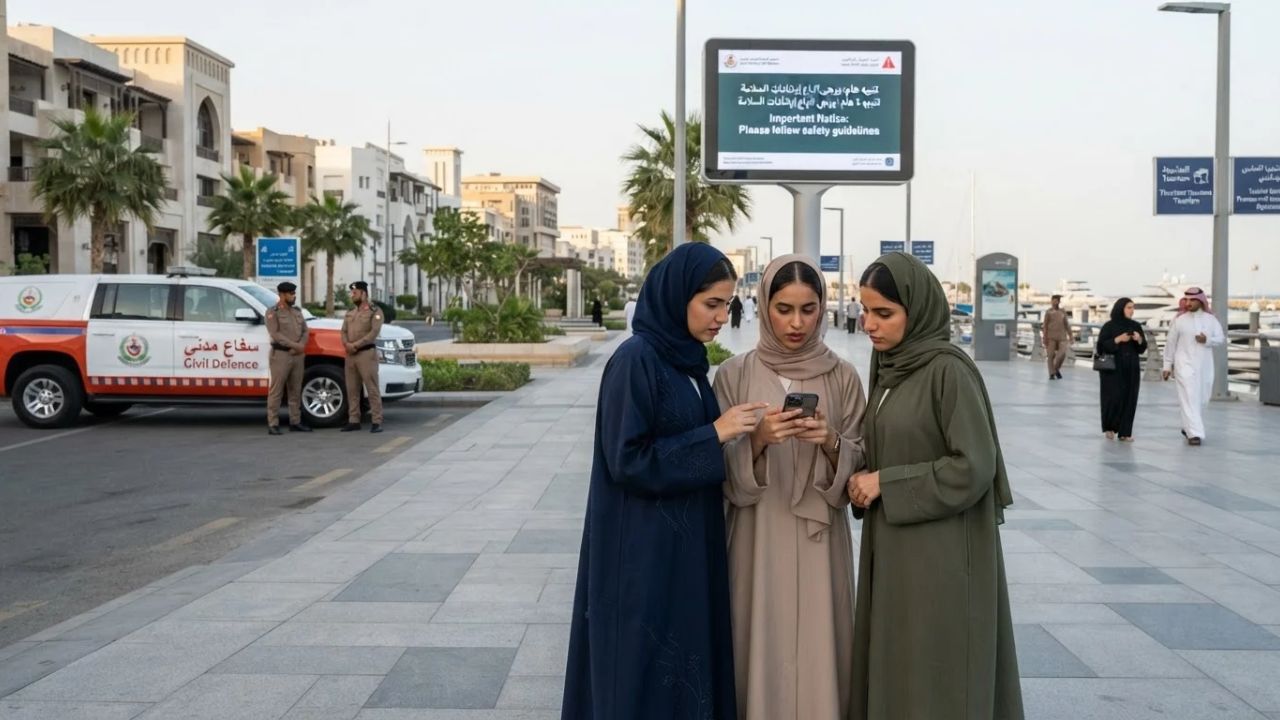
Image generated by AI
Mobile devices across western and southern Saudi Arabia recently sounded synchronized sirens as the Kingdom's National Early Warning Platform broadcast an urgent safety alert across six major travel territories. Covering the Red Sea commercial metropolis of Jeddah Governorate, the cool mountain heights of Abha and Taif Governorate, coastal Jazan Province, the ancient heritage valley of AlUla Governorate, and the coastal hub of Yanbu, the alerts activated comprehensive Civil Defence protocols in response to regional security tensions involving cross-border drone and missile activity linked to Yemen's Houthi movement. Within hours of the coordinated alert, Saudi Civil Defence confirmed that the immediate danger had passed, authorizing normal public life, intercity transportation, and tourism activities to proceed without a single major airport closure or travel cancellation. For international visitors exploring the Kingdom under Vision 2030, the incident offered an inside look into one of the world's most advanced civil defense communication systems in active operation.
The Modern Safety Architecture: How Saudi Civil Defence Manages Regional Risk
The activation of the National Early Warning Platform reflects the serious investments Saudi Arabia has made to protect its rapidly growing population of international visitors and local residents. During the alert window, Civil Defence directives were broadcast directly to mobile handsets in multiple languages, advising individuals to seek shelter inside buildings, remain indoors, and stay clear of glass windows, balconies, external doorways, and rooftops until official clearance was issued.
What made the response remarkable from a travel perspective was the total absence of panic and disruption. Unlike historical crises that led to prolonged transit chaos, modern safety systems functioned with clinical efficiency. International flights into King Abdulaziz International Airport (KAIA) in Jeddah—the Kingdom’s busiest aviation gateway for leisure, business, and Umrah pilgrimages—maintained their operational schedules overseen by the General Authority of Civil Aviation (GACA). Ground transport, high-speed rail links, and mountain roads in Asir remained open under security monitoring, allowing travelers already in the country to continue their journeys with minimal delay once the all-clear was confirmed.
What Makes These Saudi Destinations Different: From Ancient Coral to Cloud Forests
The six areas included in the safety alert represent the geographical and cultural diversity that defines Saudi Arabia's contemporary tourism awakening.
In Jeddah, visitors encounter a centuries-old port where ancient maritime trade routes converge. The historic heart of the city, Al-Balad, is inscribed by the UNESCO World Heritage Centre as the Gate to Makkah. Walking through its narrow lanes reveals hundreds of four-story tower houses constructed from delicate Red Sea coral limestone, adorned with intricate, hand-carved teak latticework balconies known as roshan. These shaded balconies allowed ocean breezes to cool traditional residences while preserving household privacy. Today, Al-Balad thrives as an open-air cultural precinct filled with artisanal perfumeries, incense merchants, and contemporary art galleries.
Far to the south, high in the Sarawat Mountains, lies Abha, the capital of the Asir province. Perched at an elevation exceeding 2,200 meters, Abha completely overturns the stereotype of Saudi Arabia as an unrelenting sandy desert. Here, travelers find temperate mountain climates, terraced agricultural hillsides, and juniper cloud forests shrouded in afternoon mist. The region's distinctive heritage is preserved in traditional mud-and-slate fortified towers and the vibrant geometric wall murals (Al-Qatt Al-Asiri) painted by local women inside village homes. Nearby, the coastal province of Jazan offers access to the pristine Farasan Islands marine sanctuary, where mangrove shallows and white sandbars host rare sea birds and dolphins.
To the north, AlUla showcases thousands of years of human civilization carved directly into sandstone cliffs. At Hegra, Saudi Arabia’s first UNESCO World Heritage site, more than 100 monumental tombs with ornate classical facades stand preserved in the desert sands, testifying to the architectural brilliance of the ancient Nabataean Kingdom. In Taif, summer visitors escape the heat among terraced mountain rose farms that have distilled the world's most prized rosewater for centuries, while coastal Yanbu provides serene scuba diving along uncrowded Red Sea coral drop-offs. Through planning tools provided by Visit Saudi, international voyagers can navigate these contrasting regions with confidence.
Visitor Insider Tips: Navigating the Kingdom with Local Confidence
Experiencing Saudi Arabia smoothly requires understanding local cultural norms, environmental factors, and regional transit realities:
- Keep Your Handset Alert Settings Active: Never disable government emergency broadcast alerts on your mobile device. Whether using a local SIM card (such as STC, Mobily, or Zain) or international roaming, the cellular alert system broadcasts life-safety announcements in English and Arabic based on your exact cell-tower location.
- Cultural Etiquette and Photography Boundaries: While Saudi Arabia has relaxed public dress codes for foreign visitors, respectful modesty remains expected. Men and women should cover shoulders and knees in public markets, traditional villages, and religious centers. Never photograph government installations, military infrastructure, communication towers, or border checkpoints.
- Savoring Authentic Regional Flavors: In Jeddah, head to the corniche for najil (Red Sea coral trout) seasoned with cumin and fried crisp, served alongside fragrant spiced rice. In mountain Abha, sample traditional aseedah (a warm savory wheat porridge served with clarified ghee and wild mountain honey) or roasted lamb mandi slow-cooked in underground clay pits. In Taif, sip hot tea infused with fragrant fresh mint and rose petals.
- Where to Base Yourself Across Regions: In Jeddah, stay along the modern Corniche or near Al-Hamra for breezy seaside walking and quick access to Al-Balad. In Abha, choose a mountainside resort along the Al Soudah ridge to wake up above the clouds. In AlUla, base yourself in an eco-lodge nestled within the ancient date palm oasis of the Ashar Valley.
- Transport Hacks: For travel between Jeddah, Mecca, and Medina, bypass intercity highway traffic by booking the Haramain High-Speed Railway, which glides across the desert at 300 km/h in air-conditioned comfort. For long-distance hops to Abha, Jazan, or AlUla, rely on frequent domestic flights operated by Saudia and flynas.
Cultural and Environmental Context: Community Resilience and Heritage Stewardship
The rapid expansion of tourism across Saudi Arabia is deeply connected to local community preservation and regional environmental restoration. In mountain provinces like Asir, tourism revenue directly supports the rehabilitation of ancient agricultural terraces, preventing mountain soil erosion while keeping centuries-old rainwater harvesting methods alive.
In AlUla, the Royal Commission for AlUla enforces strict conservation guidelines that mandate low-density eco-tourism, ban high-rise construction, and fund the reintroduction of indigenous wildlife—including the critically endangered Arabian leopard and desert gazelles—into protected canyon reserves. In coastal Jeddah and Yanbu, marine protection initiatives closely monitor mangrove reforestation and coral health along the Red Sea shelf.
Local communities have embraced foreign visitors with the legendary warmth of Arabian hospitality (karam). Whether stepping into a family-run heritage home in Asir or drinking cardamom-scented Arabic coffee (gahwa) with a dates merchant in Al-Balad, international travelers will discover that authentic local encounters and advanced civic safety protocols work hand in hand.
FAQ: Traveling in Saudi Arabia and Navigating Safety Alerts 2026
What should travelers do if an emergency alert sounds on their phone in Saudi Arabia?
Remain calm, move indoors immediately, stay away from windows, balconies, and rooftops, and monitor official announcements from the Saudi Civil Defence via television or official social media channels.
Did the recent safety alert cause flight cancellations in Jeddah or AlUla?
No. International and domestic flights maintained scheduled operations at King Abdulaziz International Airport (JED) and regional airports, with no widespread cancellations reported.
Is an entry visa required for international tourists visiting Saudi Arabia?
Citizens from over 60 eligible nations can obtain an instant tourist eVisa online through the official portal or secure a visa-on-arrival at major international airports.
What is the best season to explore both the Red Sea coast and mountain regions?
October through April offers ideal weather across the country, featuring warm sunny days along the Red Sea coast and brisk, cool mountain evenings in Abha and Taif.
From the ancient coral arches of Al-Balad to the silent sandstone canyons of Hegra, Saudi Arabia greets the curious traveler with timeless hospitality and watchful care.
Related Travel Guides
Disclaimer
This article is for informational and educational purposes only. It does not constitute legal, financial, or professional advice. While we strive to provide accurate and up-to-date information, travel policies, regulations, and conditions change rapidly. Always verify information with official sources before making travel decisions. Nomad Lawyer makes no representations about the accuracy, reliability, completeness, or suitability of the information provided. Readers should consult qualified professionals for advice specific to their circumstances. The views expressed in this article are those of the author and do not necessarily reflect the views of Nomad Lawyer.
Raushan Kumar
Founder & Lead Developer
Full-stack developer with 11+ years of experience and a passionate traveller. Raushan built Nomad Lawyer from the ground up with a vision to create the best travel and law experience on the web.
Learn more about our team →