
San José Airport Debuts Robot: AI Assistant Transforms Traveler Experience in 2026
San José Mineta International Airport debuts 'José,' an AI-powered robot assistant designed to help travelers navigate terminals and find real-time information. The innovation marks Silicon Valley's latest push to integrate artificial intelligence into airport operations.

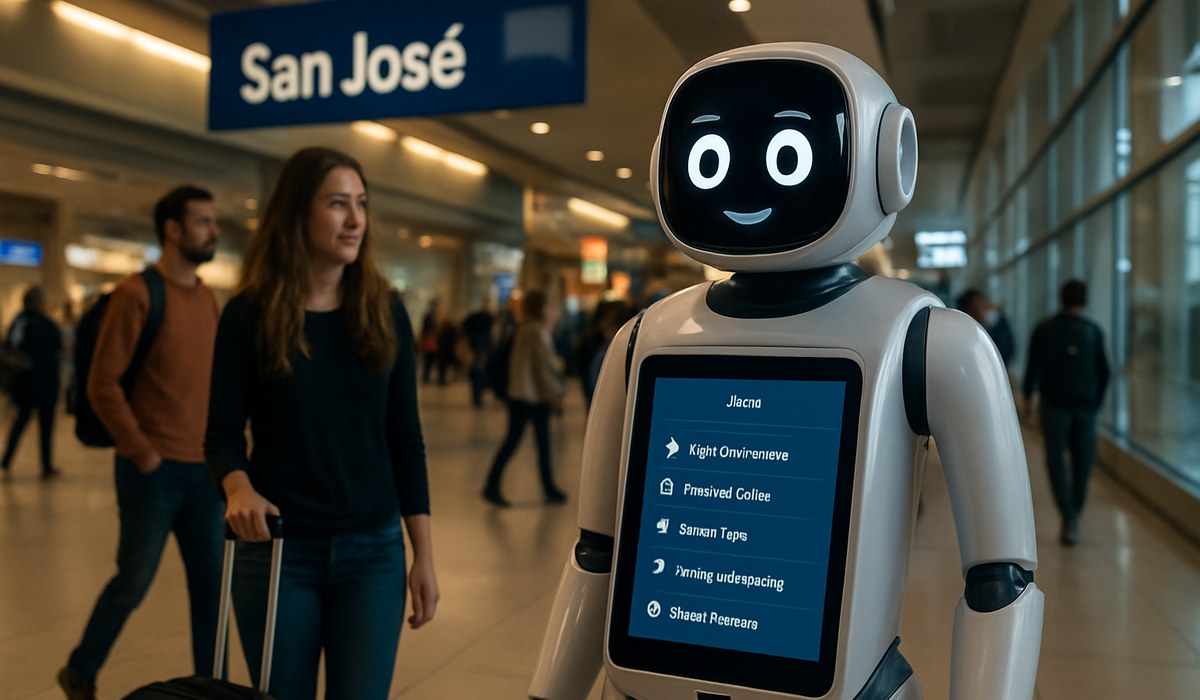
Image generated by AI
San José Airport Debuts Robot to Assist Travelers Navigating Terminals
San José Mineta International Airport (SJC) has launched José, an AI-powered service robot designed to assist travelers with wayfinding, gate information, and real-time facility guidance. The airport debuts robot technology as part of its commitment to enhancing passenger experience through artificial intelligence. José operates continuously in high-traffic terminal corridors, answering questions about security checkpoints, dining options, restrooms, and ground transportation through natural language processing and interactive touch-screen interfaces.
This deployment represents Silicon Valley's most integrated application of AI technology within an airport terminal. The robot integrates live flight data, concession schedules, and operational updates to provide passengers with current, accurate information that adapts as conditions change throughout the day.
How José Assists Travelers with Real-Time Airport Navigation
José helps travelers navigate San José Mineta International Airport by providing step-by-step wayfinding directions and identifying optimal routes through terminal areas. The robot can highlight lesser-used security checkpoints during peak periods, direct passengers to baggage claim efficiently, and connect travelers with ground transportation services. When gates are reassigned or services close unexpectedly, José adjusts guidance instantly rather than forcing passengers to rely on outdated signage.
The AI assistant reduces congestion at fixed information counters and staffed service desks. By handling routine directional queries and operational questions, José frees airport personnel to focus on complex customer needs, irregular flight situations, and passengers requiring special assistance. This operational efficiency helps distribute foot traffic evenly across concourses during high-volume travel periods. Learn more about airport operations through the FAA's official guidance.
Integration with San José's Broader AI Ecosystem
José does not operate in isolation at San José Mineta International Airport. The robot arrives as the airport continues expanding its AI-enabled mobility infrastructure, including autonomous ride-hailing services connecting terminals with regional neighborhoods. SJC positions itself as California's first commercial airport facility offering robotaxi services, with José complementing autonomous ground transportation technology at the curb level.
Inside terminals, earlier technology experiments paved the way for José's deployment. Interactive customer service kiosks, robotic coffee bars serving travelers, and educational robot demonstrations normalized AI integration across the passenger journey. This layered system—combining robots, autonomous vehicles, self-service kiosks, and mobile apps—enables San José Mineta to manage growth without expanding physical infrastructure proportionally. The airport's technology roadmap reflects Silicon Valley's values of responsible AI adoption paired with accessible, traveler-focused tools.
Accessibility and Design Features Built for Diverse Travelers
José's interface prioritizes approachability alongside technical sophistication, featuring clear displays, intuitive icons, and simple language prompts designed for passengers unfamiliar with AI tools. The robot supports multiple languages, audio guidance, and high-contrast visual design to assist travelers with varying accessibility needs. Large touch-screen elements and step-by-step prompts allow infrequent travelers to navigate conversations naturally and request clarification when needed.
Multilingual support represents a core strength, combining translated text with spoken instructions. This accessibility-first design reflects lessons learned from earlier technology pilots at San José Mineta. The airport emphasizes transparent data handling, clear safety protocols, and robust backup procedures when technology is temporarily unavailable. Passengers preferring traditional assistance methods continue accessing staffed information desks without penalty or delay.
Data Collection and Operational Insights from José Interactions
Each interaction with José generates anonymized usage data that airport operations teams analyze to identify recurring questions and congestion patterns. This intelligence informs decisions about signage placement, staffing allocation, and service expansion priorities. Airport planners use José's data logs to understand which terminal areas experience the highest confusion rates and which passenger demographics benefit most from AI assistance.
These insights feed directly into San José Mineta's long-term infrastructure planning. By tracking which services receive the most inquiries and identifying lesser-known amenities travelers struggle to locate, airport management can optimize terminal layouts and communication strategies. The data-driven approach ensures José's deployment improves not only immediate passenger experience but also shapes sustainable operational improvements across the facility. Check IATA standards for airport service delivery for industry benchmarks.
What This Means for San José Mineta Airport Travelers
Passengers visiting San José Mineta International Airport in March 2026 and beyond should expect:
- Quick answers without waiting in lines: Approach José in terminal corridors for immediate assistance regarding gates, security, facilities, or dining options
- Real-time route optimization: Request step-by-step directions that reflect current gate assignments and the least-crowded security checkpoints
- Multilingual support: Speak or type requests in your preferred language; José responds with translated guidance and audio instructions
- Reliable facility information: Confirm restaurant hours, restroom locations, and ground transportation options without relying on potentially outdated signage
- No pressure to use technology: Staffed information counters remain available if you prefer human assistance or have complex questions requiring personalized attention
- Faster terminal navigation: José's recommendations help minimize walking distances and reduce congestion at chokepoints during peak travel periods
Download the SJC mobile app or ask any airport staff member to point you toward José's locations. The robot appears in designated high-traffic areas wearing clear AI signage.
| Feature | Details | Benefit |
|---|---|---|
| AI Technology Type | Natural language processing with touch-screen interface | Intuitive, multilingual interactions |
| Information Updates | Live integration with flight data and facility schedules | Current, accurate guidance reflecting real-time changes |
| Operational Hours | 24/7 availability in terminal corridors | Assistance available regardless of staff desk hours |
| Languages Supported | Multiple languages with audio option | Accessibility for international passengers |
| Data Privacy | Anonymized interaction logging | Personal information not stored or tracked |
| Backup Support | Staffed information desks remain fully operational | Traditional assistance available if technology fails |
| Accessibility Features | Audio guidance, visual contrast, large icons | Support for passengers with varied accessibility needs |
Frequently Asked Questions About San José's AI Robot Assistant
Why did San José Mineta Airport debut robot technology in 2026? San José Mineta International Airport deployed José to manage growing passenger volumes efficiently without expanding terminal footprints. As Silicon Valley's primary commercial airport, SJC positions itself as a technology showcase. José assists travelers with routine questions, reducing pressure on staffed information desks and freeing personnel for complex customer needs. The robot represents three years of infrastructure planning and earlier successful robotic pilots.
What questions can José help answer at San José Mineta Airport? José assists with wayfinding directions, gate assignments, real-time flight updates, concession hours, restroom locations, security checkpoint options, and ground transportation connections. The robot provides step-by-step routing, identifies lesser-used security lanes during peak periods, and adjusts guidance when flights reassign gates. José cannot handle ticketing issues, lost baggage claims, or complex customer service matters—staffed desks manage those interactions.
How does airport debuts robot technology improve passenger flow through terminals? José distributes foot traffic evenly across concourses by directing travelers toward underutilized pathways and security checkpoints. Real-time guidance reduces time spent consulting signage or waiting for help at service desks. By handling high-volume routine inquiries, José frees staff to manage special assistance requests and irregular operations, creating smoother overall terminal experiences. Data from interactions helps planners identify and resolve congestion bottlenecks.
Will José's deployment affect staffing levels at San José Mineta's information services? No. The airport maintains its full staffing complement while deploying José to enhance service capacity, not replace personnel. José handles baseline informational inquiries, allowing human staff to focus on complex customer needs, special assistance requests, and irregular operations requiring personalized problem-solving. Staffed information desks remain fully operational during all airport hours.
Related Travel Guides
Complete Guide to San José Mineta International Airport (SJC) 2026
How AI Technology is Changing Airport Experiences for Travelers
Ground Transportation and Autonomous Vehicles at Bay Area Airports
Disclaimer
This article is for informational and educational purposes only. It does not constitute legal, financial, or professional advice. While we strive to provide accurate and up-to-date information, travel policies, regulations, and conditions change rapidly. Always verify information with official sources before making travel decisions. Nomad Lawyer makes no representations about the accuracy, reliability, completeness, or suitability of the information provided. Readers should consult qualified professionals for advice specific to their circumstances. The views expressed in this article are those of the author and do not necessarily reflect the views of Nomad Lawyer.
Raushan Kumar
Founder & Lead Developer
Full-stack developer with 11+ years of experience and a passionate traveller. Raushan built Nomad Lawyer from the ground up with a vision to create the best travel and law experience on the web.
Learn more about our team →