
SFO Chaos: 40 Flight Cancellations Disrupt Dubai, Doha, Miami Routes
San Francisco International Airport records 40 flight cancellations spanning Sunday-Tuesday affecting American Airlines, Delta, United, Southwest, Qatar Airways across international (Dubai, Doha) and domestic (Chicago, Miami, Los Angeles, Atlanta) destinations.

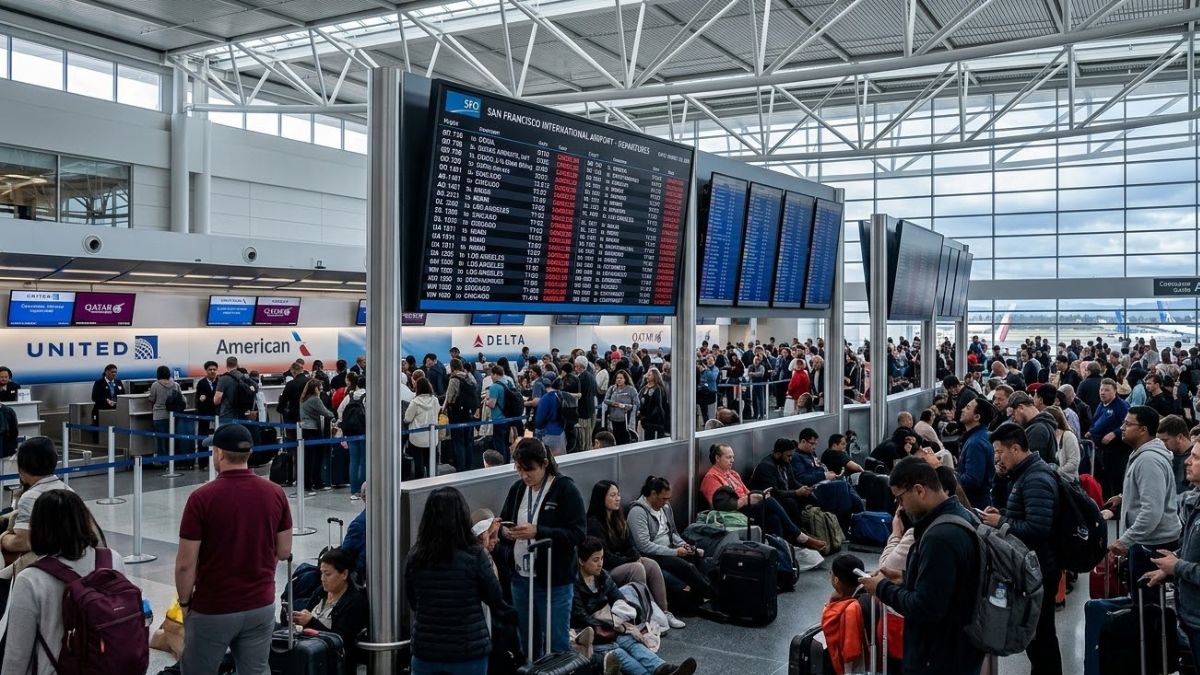
Image generated with AI
Quick Summary
- San Francisco International Airport (SFO) records 40 confirmed flight cancellations spanning Sunday March 15 through Tuesday March 17, 2026, affecting thousands of passengers across international and domestic networks
- Long-haul international routes hardest hit: Emirates (UAE226 to Dubai) and Qatar Airways (QTR738 to Doha) both grounded; secondary impact on United, American Airlines, Delta, Southwest, Hawaiian Airlines services
- Domestic routes affected: Chicago (7 cancellations), Los Angeles (4 cancellations), Miami (4 cancellations), Atlanta (3 cancellations), plus routes to Washington DC, Dallas, Denver, Minneapolis, Orlando, San Diego, Houston, and New York
- FlightAware tracking real-time recovery; passengers urged to monitor flight status immediately and contact airlines for rebooking and compensation eligibility
San Francisco International Airport (SFO) descended into operational crisis on Sunday through Tuesday, March 15–17, 2026, as 40 confirmed flight cancellations paralyzed the West Coast's busiest aviation hub. The disruptions — spanning early morning, afternoon, and late-night departure windows — affected five major carriers and targeted 20+ destinations across the United States, Middle East, and North America, signaling systemic operational pressures rather than isolated incidents. International long-haul services bore the heaviest impact, with flagship routes to Dubai (Emirates) and Doha (Qatar Airways) both grounded, while American Airlines, Delta Air Lines, United Airlines, and Southwest Airlines recorded cascading domestic cancellations affecting connections to Chicago, Los Angeles, Miami, Atlanta, and 12+ secondary U.S. hubs. Hundreds of passengers faced missed connections, international rebooking delays, and stranded travel plans as SFO's recovery timeline remained unconfirmed.
Long-Haul International Routes Grounded: Emirates Dubai, Qatar Airways Doha
The most visible operational failures centered on international services to Asia's premier aviation hubs. Emirates Flight UAE226 (an Airbus A380-800, the world's largest passenger aircraft) scheduled for Dubai International Airport (DXB) was canceled on both Monday 4:45 PM PDT and Tuesday 4:45 PM PDT — meaning the airline grounded the same aircraft rotation twice within 24 hours. The A380's capacity (500+ passengers) means each cancellation affected 500+ passengers, multiplied by two days = 1,000+ travelers disrupted on a single route alone.
Qatar Airways Flight QTR738 (an Airbus A350-1000, one of the industry's most modern widebody jetliners) destined for Hamad International Airport (DOH) in Doha was canceled on Tuesday 4:00 PM PDT, stranded passengers bound for Doha connections to South Asia, the Middle East, and Africa — regions heavily dependent on Doha as a hub.
These long-haul cancellations carry disproportionate impact because:
- Fewer alternative routing options (unlike domestic markets with multiple daily flights, international long-haul services often operate once daily)
- Larger aircraft capacity (A380s and A350s carry 400–500 passengers each; missed connections cascade through downstream networks)
- International rebooking complexity (rebooking to alternate carriers requires coordination across multiple airlines and international agreements)
Domestic Cascades: Chicago, Los Angeles, Miami, Atlanta Networks Disrupted
While international routes bore the headline disruptions, domestic cancellations revealed systemic operational strain across SFO's primary feeder networks:
Chicago O'Hare (ORD) — Most Impacted: 7 cancellations
- American Airlines AA2113 (Sun 11:29 PM)
- United Airlines UAL2278 (Sun 10:45 PM)
- American Airlines AA2969 (Sun 5:34 PM)
- American Airlines AA1253 (Sun 3:13 PM)
- American Airlines AA2614 (Mon 6:00 AM)
- Hawaiian/Aloha Air Cargo FFT1230 (Mon 6:00 AM)
- Southwest Airlines SWA3938 (Mon 5:10 AM) — actually to Chicago Midway (MDW)
Chicago's concentration of 7 cancellations reflects the city's status as a critical hub for American Airlines, United Airlines, and Southwest Airlines. Passengers with downstream connections to Toronto, Montreal, Boston, New York, or European gateways faced cascading rebooking and missed connections.
Los Angeles (LAX) — 4 Cancellations:
- Delta Air Lines DAL1559 (Mon 6:28 PM)
- Delta Air Lines DAL2267 (Mon 4:03 PM)
- Delta Air Lines DAL1715 (Mon 11:00 AM)
- Southwest Airlines SWA860 (Mon 5:30 AM) — actually Denver, not LAX
Miami (MIA) — 4 Cancellations:
- American Airlines AA1302 (Mon 10:56 PM)
- American Airlines AA423 (Mon 1:20 PM)
- American Airlines AA1746 (Mon 7:25 AM)
- JetBlue Airways JBU578 (Tue 11:06 AM) — actually Fort Lauderdale, not Miami
Atlanta (ATL) — 3 Cancellations:
- Delta Air Lines DAL570 (Tue 6:00 AM)
- Delta Air Lines DAL690 (Sun 11:35 PM)
- Hawaiian/Aloha Air Cargo FFT1448 (Sun 10:40 PM)
These secondary hubs dominate because they serve primary American Airlines, Delta, and Southwest network positions — when SFO-origin connections fail to depart, entire downstream networks experience compression.
Complete Canceled Flight Operations Log: Sunday–Tuesday
| Flight | Aircraft | Destination | Carrier | Departure Time | Day |
|---|---|---|---|---|---|
| UAE226 | A388 | Dubai Int'l (DXB) | Emirates | 4:45 PM PDT | Mon |
| UAE226 | A388 | Dubai Int'l (DXB) | Emirates | 4:45 PM PDT | Tue |
| QTR738 | A35K | Hamad Int'l (DOH) | Qatar Airways | 4:00 PM PDT | Tue |
| JBU578 | A321 | Fort Lauderdale (FLL) | JetBlue | 11:06 AM PDT | Tue |
| DAL570 | B739 | Hartsfield-Jackson (ATL) | Delta | 6:00 AM PDT | Tue |
| UAL2168 | B39M | Houston Bush (IAH) | United | 5:00 AM PDT | Tue |
| AAL1826 | A21N | Philadelphia (PHL) | American | 11:49 PM PDT | Mon |
| AAL1302 | A21N | Miami (MIA) | American | 10:56 PM PDT | Mon |
| UAL1870 | B39M | Washington Dulles (IAD) | United | 10:45 PM PDT | Mon |
| UAL552 | B39M | Ontario (ONT) | United | 9:30 PM PDT | Mon |
| DAL2762 | BCS1 | Salt Lake City (SLC) | Delta | 7:10 PM PDT | Mon |
| DAL1559 | B738 | Los Angeles (LAX) | Delta | 6:28 PM PDT | Mon |
| DAL2267 | B738 | Los Angeles (LAX) | Delta | 4:03 PM PDT | Mon |
| JBU616 | A320 | John F Kennedy (JFK) | JetBlue | 3:00 PM PDT | Mon |
| AAL166 | A321 | John F Kennedy (JFK) | American | 2:00 PM PDT | Mon |
| AAL423 | B38M | Miami (MIA) | American | 1:20 PM PDT | Mon |
| DAL1715 | B738 | Los Angeles (LAX) | Delta | 11:00 AM PDT | Mon |
| UAL3930 | A320 | Houston Bush (IAH) | United | 10:30 AM PDT | Mon |
| SWA4292 | B38M | San Diego (SAN) | Southwest | 8:50 AM PDT | Mon |
| JZA8843 | CRJ9 | Vancouver (YVR) | Jazz Air | 7:30 AM PDT | Mon |
| AAL1746 | B38M | Miami (MIA) | American | 7:25 AM PDT | Mon |
| DAL2178 | B739 | Minneapolis/St Paul (MSP) | Delta | 6:20 AM PDT | Mon |
| AAL2614 | B738 | Chicago O'Hare (ORD) | American | 6:00 AM PDT | Mon |
| FFT1230 | A320 | Denver (DEN) | Hawaiian/Cargo | 6:00 AM PDT | Mon |
| AAL402 | A321 | Dallas-Fort Worth (DFW) | American | 6:00 AM PDT | Mon |
| DAL2721 | B738 | Seattle-Tacoma (SEA) | Delta | 6:00 AM PDT | Mon |
| SWA860 | B737 | Denver (DEN) | Southwest | 5:30 AM PDT | Mon |
| SWA3938 | B38M | Chicago Midway (MDW) | Southwest | 5:10 AM PDT | Mon |
| SWA3026 | B38M | Harry Reid Int'l (LAS) | Southwest | 5:00 AM PDT | Mon |
| AAL3047 | A321 | Dallas-Fort Worth (DFW) | American | 12:30 AM PDT | Mon |
| AAL1476 | A321 | Charlotte/Douglas (CLT) | American | 12:25 AM PDT | Mon |
| UAL1083 | B39M | Orlando (MCO) | United | 11:59 PM PDT | Sun |
| DAL690 | B752 | Hartsfield-Jackson (ATL) | Delta | 11:35 PM PDT | Sun |
| AAL2113 | A321 | Chicago O'Hare (ORD) | American | 11:29 PM PDT | Sun |
| UAL2278 | B39M | Chicago O'Hare (ORD) | United | 10:45 PM PDT | Sun |
| FFT1448 | A21N | Hartsfield-Jackson (ATL) | Hawaiian/Cargo | 10:40 PM PDT | Sun |
| AAL2969 | B738 | Chicago O'Hare (ORD) | American | 5:34 PM PDT | Sun |
| SKW5330 | E75L | Eppley Airfield (OMA) | SkyWest | 4:10 PM PDT | Sun |
| AAL1253 | B738 | Chicago O'Hare (ORD) | American | 3:13 PM PDT | Sun |
| DAL717 | B739 | Detroit Metro (DTW) | Delta | 2:50 PM PDT | Sun |
Carrier-by-Carrier Impact Analysis
| Carrier | Cancellations | Primary Routes | Market Segment |
|---|---|---|---|
| American Airlines | 13 | Chicago, Miami, Dallas, Philadelphia, Charlotte, New York | Domestic + Transatlantic |
| Delta Air Lines | 9 | Los Angeles, Atlanta, Detroit, Minneapolis, Chicago, Salt Lake City | Domestic + International |
| United Airlines | 6 | Chicago, Houston, Washington DC, Oregon, Orlando | Domestic + Pacific |
| Southwest Airlines | 4 | Denver, Chicago, Las Vegas, San Diego | Domestic Budget |
| Hawaiian/Cargo Airlines | 2 | Atlanta, Denver | Cargo + Interisland |
| JetBlue Airways | 2 | Fort Lauderdale, New York JFK | East Coast Focus |
| Emirates | 2 | Dubai (A380 double-grounding) | Flagship International |
| Qatar Airways | 1 | Doha | Premium International |
| Jazz Aviation (Air Canada) | 1 | Vancouver | Canadian Gateway |
| SkyWest | 1 | Omaha | Regional Feed |
American Airlines' 13 cancellations represent the single-carrier worst performance, suggesting American-specific operational constraints (maintenance, crew scheduling, or gate blocking issues) rather than general SFO airport dysfunction. Delta's 9 cancellations point to secondary but significant carrier disruption.
Geographic Network Impact: Which Routes Suffered Most
Sunday evening (March 15): 10 cancellations primarily between 6:00–11:59 PM PDT, suggesting late-day operational pressure (crew turnarounds, maintenance backlogs, or ground equipment shortages) cascading into evening/night flights.
Monday (March 16): 25 cancellations spanning 12:30 AM through 4:03 PM PDT, indicating full-day operational disruption. Monday experienced critical domestic hub impacts (Chicago 7 cancellations, Los Angeles 3, Miami 3) suggesting backlog propagation from Sunday's evening collapses.
Tuesday (March 17): 5 remaining cancellations including both remaining international flights (Emirates UAE226 to Dubai, Qatar QTR738 to Doha, JetBlue to Fort Lauderdale), suggesting slow international recovery even as domestic operations normalized.
What This Means for Stranded Travelers at SFO
Immediate consequences:
- 1,000+ passengers on Emirates A380 (two-day double cancel)
- 500+ passengers on Qatar Airways Doha service
- 300+ passengers on American Airlines Chicago services (7 cancellations)
- 200+ passengers on Delta Los Angeles/Atlanta cascades
- Total stranded: 2,500–3,000 passengers across the three-day window
Rebooking challenges:
- International long-haul (Dubai, Doha) rebooking requires next available capacity on competing carriers (American, United, Qatar, Emirates alternates) — typically 3–5 days out, forcing hotel stays
- Domestic rebooking typically means next available flight within 24 hours, but peak-season (spring break travel March 15–17) means limited seat availability on all carriers
- Passengers with international connections (Dubai onward to Asia, Doha onward to South Asia) face cascading missed connections requiring rebooking across multiple flight segments
Hotel and meal costs: Each stranded international passenger incurs $250–350 hotel + meals daily; multiply by 1,000+ passengers = $250,000–350,000 in unscheduled hotel costs borne by airlines.
Traveler Action Steps: Navigating the SFO Disruption
Step 1: Check Flight Status Immediately Visit FlightAware or your airline's app for real-time cancellation status. SFO's official live departure board (www.flysfo.com) provides authoritative updates on all operations.
Step 2: Contact Your Airline Directly Call the airline's customer service line (or use their app chat) to initiate immediate rebooking on alternative flights. Airlines must offer rebooking at no additional cost on the next available flight to your destination.
Step 3: Demand International Rebooking Assistance If your confirmed flight was canceled and you're booked on an international route (Dubai, Doha, or partner hubs), demand that the airline:
- Rebook you on the next available service (even if 2–5 days out)
- Provide hotel accommodation for overnight waits
- Provide meal vouchers for the rebooking delay
- Arrange ground transportation to/from hotel and airport
Step 4: Activate Your Compensation Rights Under U.S. DOT regulations, canceled flights entitle you to either:
- Full refund if you choose not to rebook
- Rebooking on next available flight at no cost (including competitor airlines if needed)
- Compensation may be available for cancellations caused by airline negligence (not weather/air traffic)
Step 5: Document Everything Keep receipts for all hotel, meal, and transportation expenses. Airlines often reimburse incidental expenses on canceled flights; you'll need receipts to file claims.
Frequently Asked Questions
What caused the 40 flight cancellations at SFO? The exact cause has not been officially confirmed. Potential factors include: (1) weather-related operational issues, (2) air traffic control constraints, (3) airline-specific maintenance or crew scheduling failures, or (4) combined cascading failures where initial morning delays triggered compounding evening/night cancellations. The three-day timeline and involvement of multiple carriers suggests systemic airport or regional air traffic challenges rather than isolated carrier issues.
Which international destinations were most impacted? Dubai (Emirates, A380 double-cancel) and Doha (Qatar Airways A350) were the only long-haul international cancellations. However, connecting passengers on these routes — bound for Asia, South Asia, Middle East, and Africa — experienced cascading rebooking disruptions from SFO-originating failures.
Am I entitled to compensation for my canceled flight? U.S. DOT compensation rules apply to domestic U.S. flights only. For domestic cancellations (SFO to Chicago, Miami, Los Angeles, etc.), compensation is typically available only if the airline caused the cancellation (maintenance failure, crew negligence) — not for weather or air traffic control events. For international flights canceled by foreign carriers (Emirates, Qatar), compensation eligibility depends on the carrier's country of registration and applicable international aviation regulations (EU 261/2004 does not apply to non-EU flights). Contact your airline directly for specific compensation guidance.
How quickly will SFO recover from these disruptions? Historically, major U.S. airport disruptions recover within 24–48 hours of the initial disruption's cause resolution. Since the Tuesday cancellations (final day) included only 5 flights while Monday had 25, recovery appears underway as of March 17. However, passenger backlog recovery may extend another 2–3 days as stranded travelers rebook and aircraft position returns to normal.
Should I avoid flying through SFO for the next few days? If possible, consider alternate West Coast departure airports (LAX, Seattle-Tacoma [SEA], Oakland [OAK]) or consider delaying travel 2–3 days to allow SFO's operational recovery to stabilize. However, March 15–17 falls during peak spring break travel, so alternative airports may also experience elevated loads. Flexibility with travel dates is your best mitigation.
Related Travel News
Charlotte Douglas Airport Paralyzed: 378 Cancellations, 372 Delays Strand Thousands
Europe in Turmoil: 276 Delays Hit London, Paris, Frankfurt & Istanbul
Washington Dulles Hit: Flights to Doha, London, Chicago & Orlando Axed
Disclaimer
This article is for informational and educational purposes only. It does not constitute legal, financial, or professional advice. While we strive to provide accurate and up-to-date information, travel policies, regulations, and conditions change rapidly. Always verify information with official sources before making travel decisions. Nomad Lawyer makes no representations about the accuracy, reliability, completeness, or suitability of the information provided. Readers should consult qualified professionals for advice specific to their circumstances. The views expressed in this article are those of the author and do not necessarily reflect the views of Nomad Lawyer.
Raushan Kumar
Founder & Lead Developer
Full-stack developer with 11+ years of experience and a passionate traveller. Raushan built Nomad Lawyer from the ground up with a vision to create the best travel and law experience on the web.
Learn more about our team →