
Regent Seven Seas Widens Veranda Suites on Explorer-Class Ships Ahead of 2026 Prestige Launch
Regent Seven Seas Cruises is expanding entry-level Veranda Suites across its Explorer-class fleet, raising the baseline for ultra-luxury balcony accommodations ahead of the new Prestige class.

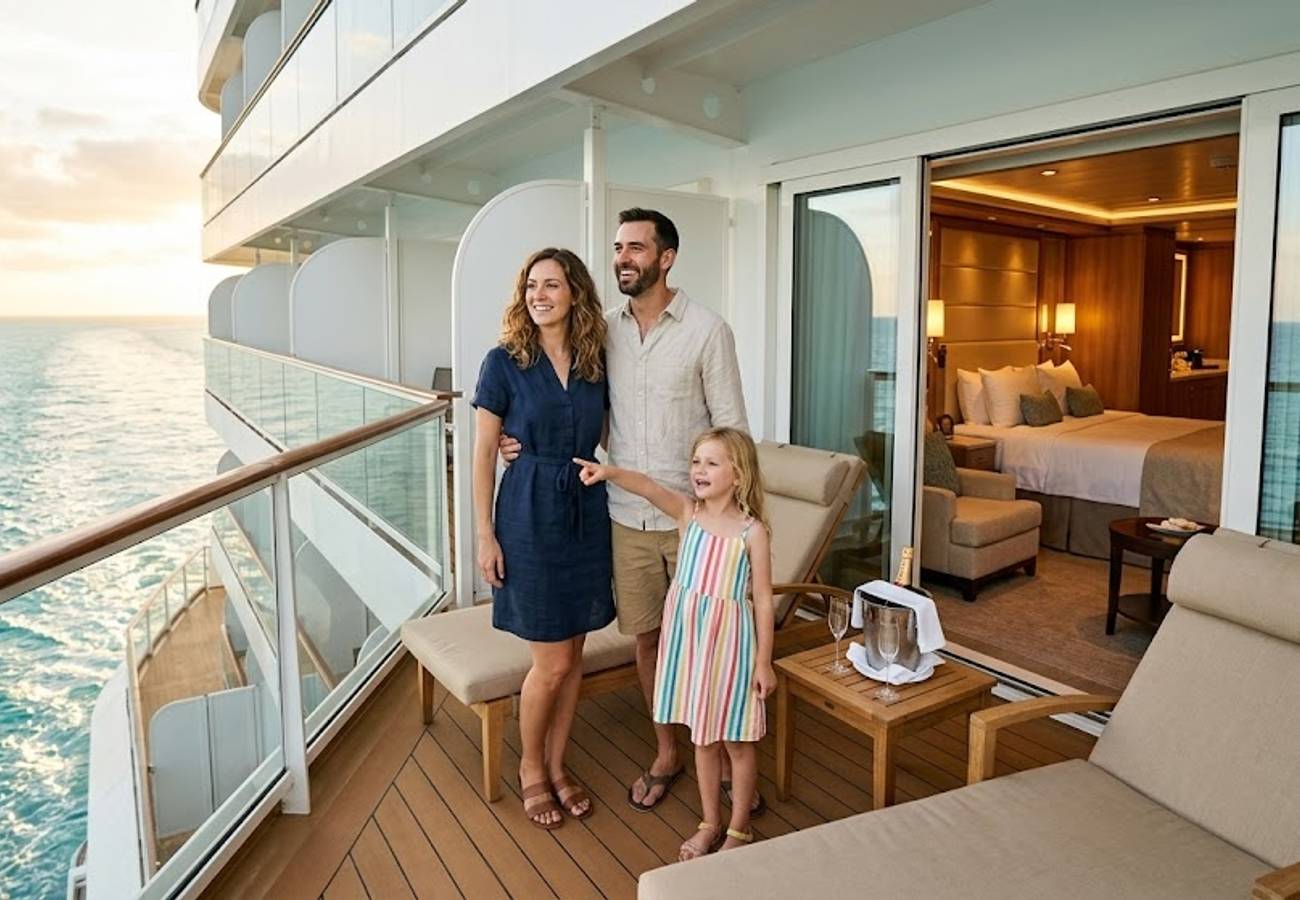
Image generated by AI
Regent Seven Seas Cruises is quietly rebalancing its entry-level Veranda Suites across the Explorer-class trio, lifting square footage baselines and balcony depth ahead of the new Seven Seas Prestige arriving in late 2026.
The Local Trend Revealed
Regent Seven Seas Cruises is placing renewed emphasis on its Veranda and Deluxe Veranda Suites aboard Seven Seas Explorer, Seven Seas Splendor and Seven Seas Grandeur. The Explorer-class trio already offers an all-suite, all-balcony layout, but recent fleet materials and brochures for sailings from 2025 onward highlight expanded square footage ranges and balcony space for the entry-level categories that many guests book first.
On Seven Seas Explorer, early marketing described Veranda Suites starting from around 300 square feet including balcony. More recent technical and sales documents group Veranda and Deluxe Veranda Suites at higher overall size ranges, with some layouts approaching those once associated with mid-tier suites on older vessels. These adjustments align with Regent's long-term strategy of offering what it markets as one of the highest space-to-guest ratios in the industry.
The shift is not a radical redesign of the Explorer-class ships, which entered service between 2016 and 2023. Rather, it is an incremental rebalancing of accommodations. Deck plans, updated photography and cabin descriptions signal that more floor area and balcony depth are being directed into standard suite types, supporting the line's positioning that even its most accessible accommodations are notably generous by cruise standards.
Cultural & Environmental Value
The renewed attention on Veranda Suites arrives as competing luxury and premium lines continue to grow their own suite inventories and introduce dedicated suite-only ship zones. Regent's approach on the Explorer class concentrates instead on scaling up the size and finish of baseline balcony suites throughout the ship.
For the visitor, the real impact is a raised sense of space and privacy without needing to climb to Penthouse or specialty tiers. Recent Regent voyage brochures for 2025 to 2027 sailings, along with updated online deck plans, show subtle yet meaningful changes in how Veranda and Deluxe Veranda Suites on Explorer-class vessels are described and marketed. Suite size bands have been revised to emphasize interior living space combined with expanded balconies, and some previously higher categories have been consolidated or repositioned relative to the entry-level veranda categories.
For travel advisors and repeat guests, these changes are most evident in the way category letters and descriptions are clustered. Where earlier materials separated certain Veranda Suite categories by narrow size differences, newer documents group them within broader ranges that highlight an overall increase in standardization at a higher square-footage baseline. This effectively lifts the perceived starting point for luxury on board, even before guests consider Penthouse or specialty suites.
While cabin footprints on a built ship are physically fixed, cruise lines can manage perceived space by redefining inventory, assigning different categories to the most spacious layouts, and giving more visibility to those cabins in marketing. Reports from cruise specialists and brochure analysis suggest Regent is using these tools to ensure that more guests booking Veranda Suites on Explorer-class ships receive layouts that feel noticeably larger than equivalent categories on older tonnage.
New Prestige Class Reinforces Veranda Strategy
The introduction of the forthcoming Seven Seas Prestige class provides further context for the Explorer-class Veranda Suite refresh. Press materials describing Seven Seas Prestige, which is scheduled for delivery in late 2026, underline an all-balcony, all-suite concept with 12 accommodation categories, including a range of Deluxe Veranda Suites starting at approximately the high 200s in square footage.
According to published coverage of the Prestige design, these veranda accommodations extend up to around 440 square feet, with particular emphasis on balcony dimensions and outdoor living. That places Prestige's veranda categories broadly in line with, or slightly above, the upper end of the updated Veranda Suite ranges cited for Explorer-class ships, effectively raising the bar for entry-level luxury across the fleet.
This continuity between Explorer-class enhancements and Prestige-class design suggests Regent is working to standardize a larger veranda footprint as the norm on future ships. As the new class debuts, Explorer, Splendor and Grandeur are expected to serve as a bridge, with their reemphasized Veranda Suites helping to familiarize guests with the idea that more interior and balcony space comes as standard.
Fleetwide refurbishment plans for older ships, including Seven Seas Voyager and Seven Seas Mariner, further indicate that Regent is aligning legacy tonnage with the look, feel and sizing benchmarks established on Explorer-class vessels and refined for Prestige. In practice, this means guests moving among ships over several years are likely to find veranda accommodations trending larger and more consistent.
Competitive Pressures in Ultra-Luxury Suites
The move to highlight expanded Veranda Suites on the Explorer-class ships comes amid intense competition in the ultra-luxury cruise segment. Rival brands have introduced expansive new suite concepts, some with private pools, multi-level layouts and exclusive access decks, driving expectations for space and privacy at sea. Regent has responded at the top end with its flagship Regent Suites, measuring more than 4,000 square feet on Explorer-class ships, but the current shift focuses attention back to the entry point of the suite ladder.
Travel industry reports note that demand for larger balcony accommodations has remained resilient even as overall cruise pricing has fluctuated. Voyages featuring Explorer-class ships frequently highlight the proportion of higher-category and veranda cabins in promotional materials, suggesting that guests are increasingly prioritizing space and balcony access when choosing itineraries.
By emphasizing expanded Veranda Suites, Regent positions the Explorer class as an attractive option for travelers who want ultra-luxury service but may not wish to book into the highest suite tiers. The strategy reinforces the message that spacious, high-spec accommodation is available even at the line's entry categories, a key differentiator as more brands court affluent cruisers with new tonnage.
Analysts following the segment suggest this focus on veranda inventory could also support yield management, as ships with larger and more desirable standard suites may sustain higher base fares across a broader swath of accommodations, not only at the very top end.
Visitor Insider Tips
Travelers booking future Explorer-class voyages should pay close attention to suite diagrams and category codes. Some of the more spacious veranda layouts appear to be concentrated on specific decks and in midship or aft positions, making them some of the most sought-after standard suites on board.
Booking timing matters. Travel advisors report that reclassified veranda cabins with deeper balconies tend to be secured early by repeat guests and suite collectors. Booking 12 to 18 months ahead of departure improves access to the most generous layouts before inventory tightens.
Category code literacy. Recent brochures group Veranda and Deluxe Veranda Suites within broader size bands rather than narrow incremental ranges. Review the updated deck plans on Regent's official site and cross-reference category letters with square footage figures before locking in a reservation.
Balcony orientation. Aft-facing veranda layouts on Explorer-class ships often offer deeper outdoor space and unobstructed wake views. Midship veranda suites provide greater stability in open ocean passages, a practical consideration for longer transoceanic itineraries.
Onboard etiquette. Explorer-class ships maintain a refined evening dress code in main dining venues. Veranda Suite guests have full access to specialty restaurants, but reservations for Prime 7 and Chartreuse should be secured at the start of the voyage, as tables fill quickly.
Tourism Outlook
The long-term impact of Regent's Veranda Suite expansion is a redefinition of what entry-level luxury means at sea. By raising the baseline across Explorer-class ships and carrying that standard into the Prestige class, Regent is signaling that generous balcony space is no longer a premium upgrade but a core expectation.
For the broader ultra-luxury segment, this puts pressure on competitors to justify smaller standard suites at comparable price points. As fleetwide refurbishments reach Seven Seas Voyager and Seven Seas Mariner, guests can expect a more consistent veranda experience across the entire Regent fleet, narrowing the gap between legacy tonnage and newer builds.
For travel advisors, the streamlined category structure simplifies the booking conversation. Fewer narrow step-changes between suite levels mean sellers can position Explorer-class veranda accommodations as a dependable ultra-luxury baseline rather than a compromise for guests who do not step up to higher suite levels.
The new ultra-luxury baseline is no longer measured by what sits at the top of the ship, but by how much space greets you at the door.
Related Travel Guides
Disclaimer
This article is for informational and educational purposes only. It does not constitute legal, financial, or professional advice. While we strive to provide accurate and up-to-date information, travel policies, regulations, and conditions change rapidly. Always verify information with official sources before making travel decisions. Nomad Lawyer makes no representations about the accuracy, reliability, completeness, or suitability of the information provided. Readers should consult qualified professionals for advice specific to their circumstances. The views expressed in this article are those of the author and do not necessarily reflect the views of Nomad Lawyer.
Kunal K Choudhary
Co-Founder & Contributor
A passionate traveller and tech enthusiast. Kunal contributes to the vision and growth of Nomad Lawyer, bringing fresh perspectives and driving the community forward.
Learn more about our team →