
Qatar Airways Reclaims the Gulf: Double-Daily Abu Dhabi Services Reintroduced to Tackle Middle East Travel Chaos and Global Airport Disruptions
Qatar Airways has reinstated twice-daily flights between Doha and Abu Dhabi, providing a high-frequency buffer against regional travel chaos and disruptions.

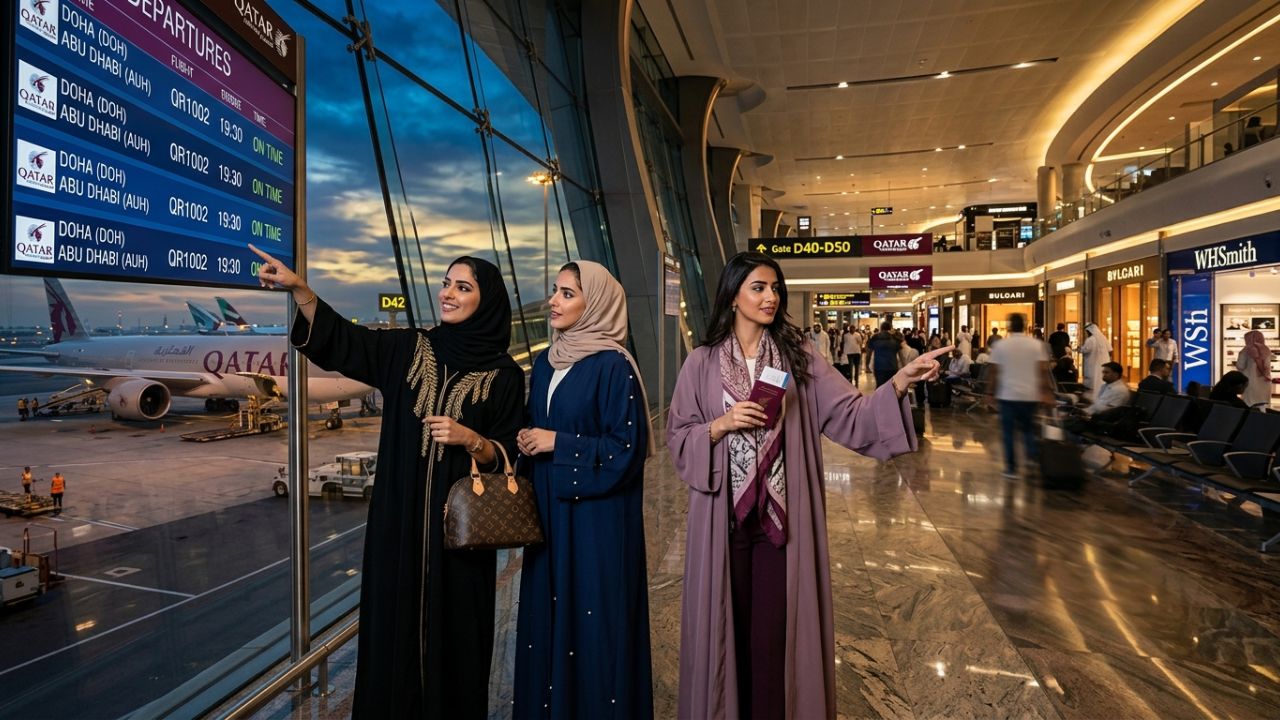
Image generated by AI
In a decisive maneuver to fortify its dominance in the Middle Eastern aviation landscape, Qatar Airways has officially reinstated its double-daily passenger services between Doha and Abu Dhabi. This major airline news update marks a significant escalation in the carrier’s phased network recovery, re-establishing a high-frequency "Air Bridge" between two of the Gulf’s most powerful financial hubs. As the region continues to navigate a volatile season of travel chaos and systemic airport disruptions, the reintroduction of twice-daily rotations is being hailed as a critical "Reliability Buffer." For the 2026 traveler, this move provides a high-tech sanctuary from the unpredictable flight cancellations that often plague lower-frequency routes, offering seamless, morning-and-evening connectivity to Qatar Airways’ massive global hub at Hamad International Airport (DOH).
Breaking: The 'Double-Daily' Rebound in the UAE
The restoration of the Doha (DOH) – Abu Dhabi (AUH) corridor is the centerpiece of a wider, carefully managed regional strategy. By returning to twice-daily operations, Qatar Airways is not just increasing seat capacity; it is providing the flexibility required for same-day business travel and high-yield transcontinental connections. This development completes the airline's "Triple-Emirate" presence, complementing its existing high-frequency services to Dubai and Sharjah.
Aviation analysts suggest that this is a definitive aviation update on the resilience of the Gulf Cooperation Council (GCC) market. Instead of a rapid, high-risk restoration, the airline has employed a "Phased Rebuild" model, ensuring that each new rotation is backed by robust ground support and crew availability. This measured approach is specifically designed to minimize the risk of the localized airport disruptions that occur when carriers over-leverage their resources during a travel surge.
Expanded Overview: From Iraq to India—The Phased Network Rebuild
The reintroduction of Abu Dhabi flights is just one chapter in a broader narrative of Middle Eastern connectivity. Over the last quarter, Qatar Airways has successfully restored services to several high-demand destinations across the Levant and Central Asia. In Iraq, the airline has reactivated services to Baghdad, Basra, and Erbil, while in the wider region, daily operations have resumed to Bahrain, Damascus, and Kozhikode.
Each of these reinstatements functions as a "Feeder Link" into the Doha hub. By channeling passengers from these regional nodes into its transcontinental network, Qatar Airways is able to maintain superior load factors and operational efficiency across six continents. This "Hub-and-Spoke" synergy is the airline's primary defense against travel chaos, as it allows for rapid passenger re-accommodation through a centralized node in the event of unforeseen flight cancellations elsewhere in the network.
Section-Wise Breakdown: Evaluating the Gulf Restoration Strategy
Abu Dhabi (AUH): The Premium Business Link
The reintroduction of morning and evening rotations to Abu Dhabi is specifically tailored for the corporate sector. Business travelers can now execute same-day meetings between Doha and Abu Dhabi without the need for overnight stays, effectively bypassing the logistical travel chaos of multi-carrier transfers.
The Iraq Expansion: Baghdad, Basra, and Erbil
The restoration of the Iraqi routes marks a major milestone in regional stability. These flights provide essential connectivity for the energy and reconstruction sectors, linking Iraq directly with the global markets of Europe, Asia, and North America via a single, reliable transfer in Doha.
Damascus and Kozhikode: Humanitarian and Labor Corridors
The daily services to Damascus and Kozhikode are critical for the expatriate and labor populations of the Gulf. These "VFR" (Visiting Friends and Relatives) routes require high levels of schedule integrity to avoid the airport disruptions that can occur when large family groups are displaced by short-notice cancellations.
Regulatory and Airspace Compliance: The Safe Haven Model
Qatar Airways’ phased restoration is strictly aligned with evolving aviation updates on regional airspace safety. By taking a "Step-by-Step" approach, the airline ensures that every reinstated flight complies with the latest security protocols, providing a "Safe Haven" for travelers who are wary of the geopolitical instability affecting other parts of the Middle East.
Flight Details: Qatar Airways Regional Restoration Matrix (2026)
The following table providing the current status of Qatar Airways’ regional network expansion as of May 16, 2026.
Qatar Airways Regional Restoration Matrix (2026)
| Destination (from Doha) | Frequency Status | Key Operational Benefit | Connectivity Goal |
|---|---|---|---|
| Abu Dhabi (AUH) | Double-Daily (Reinstated) | Same-day business travel | Global Hub Feeding |
| Dubai (DXB) / Sharjah | Multiple Daily | High-frequency UAE access | Regional Integration |
| Baghdad / Basra (Iraq) | Reinstated | Energy sector connectivity | Central Asia Bridge |
| Bahrain (BAH) | Daily (Resumed) | Regional short-haul stability | GCC Synergy |
| Damascus (Syria) | Daily (Resumed) | Humanitarian / VFR support | Levant Connectivity |
| Kozhikode (India) | Daily (Resumed) | Labor / VFR corridor | Indian Subcontinent |
Passenger Impact: The 'Rebooking Shield' of High Frequency
For the 2026 traveler, the restoration of double-daily Abu Dhabi services offers a tangible reliability dividend.
- Same-Day Flexibility: Choose from morning or evening departures, allowing for maximum efficiency in business or leisure itineraries.
- Rebooking Shield: In the rare event of flight cancellations, a double-daily schedule means passengers can often be re-accommodated on the very next flight, avoiding multi-day travel chaos.
- Seamless Hub Transit: Abu Dhabi flights are timed to align with the massive "Global Wave" of departures from Doha to London, New York, Tokyo, and Sydney.
- Sanctuary from Disruptions: By choosing a full-service legacy carrier with high frequency, travelers avoid the airport disruptions and baggage backlogs associated with lower-capitalized, low-frequency airlines.
Industry Analysis: The Logic of Measured Recovery
Aviation specialists believe that Qatar Airways’ phased model is the "New Standard" for post-disruption recovery.
- Resource Optimization: By reinstating routes in stages, the airline ensures that its award-winning service standards are not diluted by a sudden surge in demand.
- Market Resilience: Serving multiple UAE cities (Abu Dhabi, Dubai, Sharjah) allows the airline to distribute its load and minimize the risk of a single-point failure grounding its entire Emirates operation.
- Hub Competitiveness: Strengthening the regional "Feeder Network" is the only way to compete with the rising aviation updates from Saudi Arabia’s Riyadh Air and other emerging Gulf players.
Conclusion: A Masterclass in Regional Connectivity
The reintroduction of twice-daily flights between Doha and Abu Dhabi is a definitive aviation update that confirms Qatar Airways’ role as the preeminent connector of East and West. By prioritizing reliability, frequency, and hub efficiency, the airline is proving that the travel chaos of the past can be overcome through strategic discipline. As the Iraqi, Syrian, and Emirati routes continue to regain density, the world can look to Doha as a beacon of operational stability. For the global traveler, the "Gulf Air Bridge" is officially back, offering a seamless path to six continents and a significant reduction in the airport disruptions of the modern era.
Key Takeaways
- Restoration: Qatar Airways reinstates double-daily flights between Doha and Abu Dhabi.
- Strategy: Phased network rebuild to ensure operational stability and safety.
- Other Restorations: Iraq (Baghdad, Basra, Erbil), Bahrain, Damascus, and Kozhikode.
- Focus: Higher frequency to support business travel and global hub connections.
- UAE Presence: Complements existing services to Dubai and Sharjah.
- Benefit: Provides a "Rebooking Shield" against flight cancellations and travel chaos.
Related Travel Guides
Disclaimer
This article is for informational and educational purposes only. It does not constitute legal, financial, or professional advice. While we strive to provide accurate and up-to-date information, travel policies, regulations, and conditions change rapidly. Always verify information with official sources before making travel decisions. Nomad Lawyer makes no representations about the accuracy, reliability, completeness, or suitability of the information provided. Readers should consult qualified professionals for advice specific to their circumstances. The views expressed in this article are those of the author and do not necessarily reflect the views of Nomad Lawyer.
Kunal K Choudhary
Co-Founder & Contributor
A passionate traveller and tech enthusiast. Kunal contributes to the vision and growth of Nomad Lawyer, bringing fresh perspectives and driving the community forward.
Learn more about our team →