
Orlando International Airport Expands With Seven New Gates As Florida Tourism Demand Drives Major Capacity Upgrade
Orlando International Airport Expands With Seven New Gates As Florida Tourism Demand Drives Major Capacity Upgrade

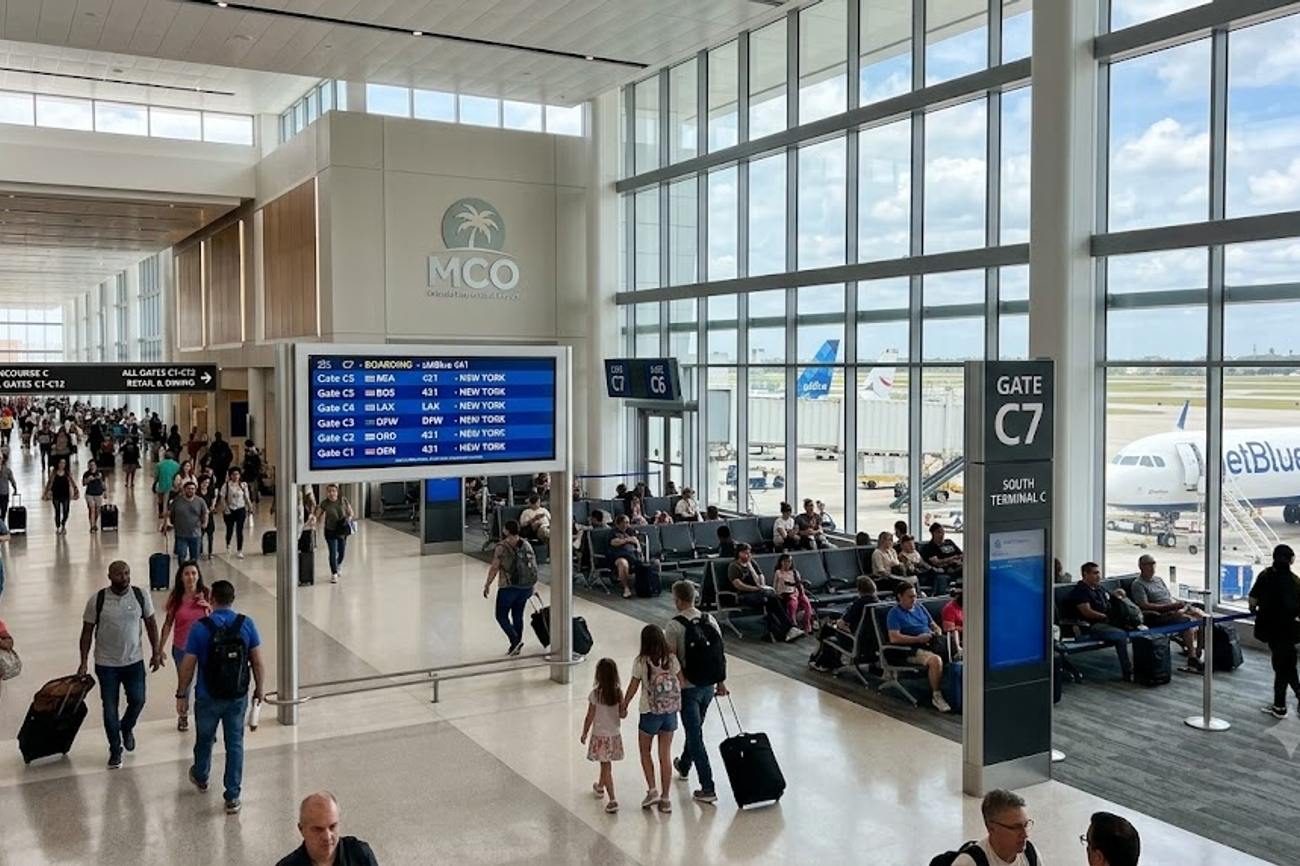
Image generated by AI
Passenger throughput at Orlando International Airport (MCO) has surged to over 50 million annual travelers, creating a capacity bottleneck that has triggered a $934.6 million capital injection. This investment represents a strategic shift from the initial launch of Terminal C toward a granular expansion of existing airside infrastructure to mitigate gate congestion.
The MCO Expansion in Numbers: Scaling for 50 Million+
The Greater Orlando Aviation Authority (GOAA) is executing a high-capital strategy to synchronize infrastructure with a passenger volume that now exceeds 50 million individuals per year. The primary driver of this expansion is the critical shortage of aircraft stands during peak windows, which directly impacts on-time performance (OTP) and airline scheduling flexibility.
The financial commitment is divided into two primary streams: a $934.6 million increase to the Capital Improvement Program (CIP) and a separate $968.5 million operational budget for FY2027. This total financial commitment of over $1.9 billion underscores the scale of MCO's transition from a regional hub to a global tourism gateway.
The technical core of the project focuses on Airside 2, which currently manages Gates 100–129. By adding at least seven new gates, the airport is attempting to resolve the "gate-wait" phenomenon, where arriving aircraft must hold on the taxiway because their assigned gate is still occupied by a departing flight. This expansion is not merely about volume but about operational velocity—reducing aircraft turnaround times to allow for higher flight frequencies.
Beyond the gates, the investment targets the "friction points" of the passenger journey. This includes systemic upgrades to baggage handling, rental car infrastructure, and parking facilities. These improvements are designed to align MCO with the global standards tracked by IATA, where the focus has shifted from mere capacity to the "seamless journey" metric.
Regional Infrastructure Benchmarks and Capacity Shifts
When comparing MCO’s growth trajectory to other major Florida hubs, a pattern of aggressive infrastructure scaling emerges. While many airports are focusing on terminal aesthetics, MCO is prioritizing "airside" capacity—the actual physical space where planes park and load.
The expansion of Airside 2 follows the recent deployment of Terminal C, signaling a multi-phase growth strategy. The goal is to prevent the "capacity ceiling" that often plagues high-growth tourism destinations. By increasing the number of gates, MCO is effectively lowering the risk of flight cancellations and delays caused by ground congestion.
The following table illustrates the shift in MCO's financial and physical priorities leading into the FY2027 cycle:
| Metric | Previous State / Baseline | New Projection / Investment | Shift Impact |
|---|---|---|---|
| Capital Investment | Standard CIP Budget | +$934.6 Million | Infrastructure Acceleration |
| Gate Capacity (Airside 2) | Gates 100–129 | +7 New Gates | Increased Scheduling Flexibility |
| Annual Passenger Volume | Growing toward 50M | 50 Million+ | Critical Mass Threshold |
| FY2027 Operating Budget | Previous Fiscal Cycle | $968.5 Million | Operational Sustainability |
| Funding Model | Mixed | 0% Local Tax Reliance | Commercial Self-Sufficiency |
This data indicates that MCO is operating as a self-sustaining commercial entity. By relying on airline terminal rentals, landing fees, and concession revenues rather than tax funding, the airport is mirroring the corporate efficiency models seen in major European hubs. This financial independence allows for faster pivots in infrastructure spending when Statista data shows a spike in international tourism demand.
Practical Traveler Advisory and Strategic Insights
For the individual traveler, these numbers translate into specific changes in the booking and airport experience. The addition of seven gates is a leading indicator that airlines will likely increase flight frequencies to Orlando, particularly during the Q4 holiday peak and the spring break window.
Booking Advice for Q3 and Q4: If you are planning a trip to Central Florida in the coming year, expect a gradual increase in flight options. However, because the airport is currently in a state of active construction and expansion, "curbside-to-gate" transit times may remain volatile.
- Buffer Time: Maintain a minimum 3-hour arrival window for domestic flights and 4 hours for international flights. While the $934.6 million investment aims to improve flow, the construction phase of new gates and parking upgrades often creates temporary bottlenecks.
- Flight Selection: Look for flights arriving at Airside 2. With the expansion of Gates 100–129, airlines operating in this sector will likely have better on-time performance as gate congestion eases.
- Ground Transportation: The investment in rental car infrastructure suggests that the transition from the terminal to the rental lot will become more efficient. Travelers should monitor the GOAA updates for new rental car facility openings to optimize their exit from the airport.
Future Projections: The Reliever Strategy
The GOAA's strategy extends beyond the main passenger terminal. The allocation of separate FY2027 funding for Orlando Executive Airport (ORL) reveals a broader regional aviation plan. By investing in ORL as a "reliever airport," the authority is attempting to divert general aviation and corporate traffic away from MCO.
This is a classic hub-and-spoke optimization. By moving private and commercial charters to ORL, MCO can dedicate 100% of its expanded gate capacity to high-volume commercial carriers. This reduces the "mixing" of slow-moving private aviation with fast-turnaround commercial jets, further improving the on-time performance metrics for the average traveler.
Based on the current trajectory, MCO is positioning itself to handle a passenger volume that could potentially exceed 60-70 million annually within the next decade. The focus on technology—specifically in baggage handling and passenger processing—suggests that the airport is preparing for the integration of biometric boarding and AI-driven crowd management, similar to trends observed in World Travel & Tourism Council reports on smart city integration.
FAQ: Orlando Airport Expansion 2027
Will these expansions lead to higher ticket prices? No. The expansion is funded through a $968.5 million operating budget and commercial revenues (rentals, concessions), not through increased passenger taxes. In fact, more gates typically lead to more competition and increased flight frequency, which can stabilize fares.
Which airlines will benefit most from the new gates? Airlines currently operating out of Airside 2 (Gates 100–129) will see the most immediate benefit. This allows them to schedule more flights without worrying about gate availability, likely leading to more frequent domestic connections.
Is this a good time to book flights to Orlando? Yes. As MCO increases its capacity and improves on-time performance, the reliability of travel to Central Florida improves. However, always book 8-12 weeks in advance for peak seasons to avoid the price surges associated with high demand.
How will the "reliever airport" (ORL) affect the average tourist? Indirectly, it helps you. By moving private jets and corporate aircraft to Orlando Executive Airport, MCO reduces runway and taxiway congestion, which means your commercial flight is less likely to be delayed on the tarmac.
The data is clear: Orlando is no longer just a destination; it is scaling its infrastructure to become a primary global aviation node.
Tags: MCO-Capacity-Growth-2027, GOAA-Capital-Investment, Florida-Aviation-Infrastructure, Airside-2-Expansion, Orlando-Passenger-Metrics-50M
Related Travel Guides
Disclaimer
This article is for informational and educational purposes only. It does not constitute legal, financial, or professional advice. While we strive to provide accurate and up-to-date information, travel policies, regulations, and conditions change rapidly. Always verify information with official sources before making travel decisions. Nomad Lawyer makes no representations about the accuracy, reliability, completeness, or suitability of the information provided. Readers should consult qualified professionals for advice specific to their circumstances. The views expressed in this article are those of the author and do not necessarily reflect the views of Nomad Lawyer.
Naina Thakur
Contributor & Travel Specialist
Travel enthusiast and legal writer covering visa regulations, responsible tourism, and cultural journeys across global destinations.
Learn more about our team →