
Northeast Corridor Train Journey: How Baltimore, DC, Philadelphia, and New York Form One Trip
Explore America's 457-mile Northeast Corridor by train, linking Baltimore, Washington DC, Philadelphia, and New York City into one seamless rail holiday.

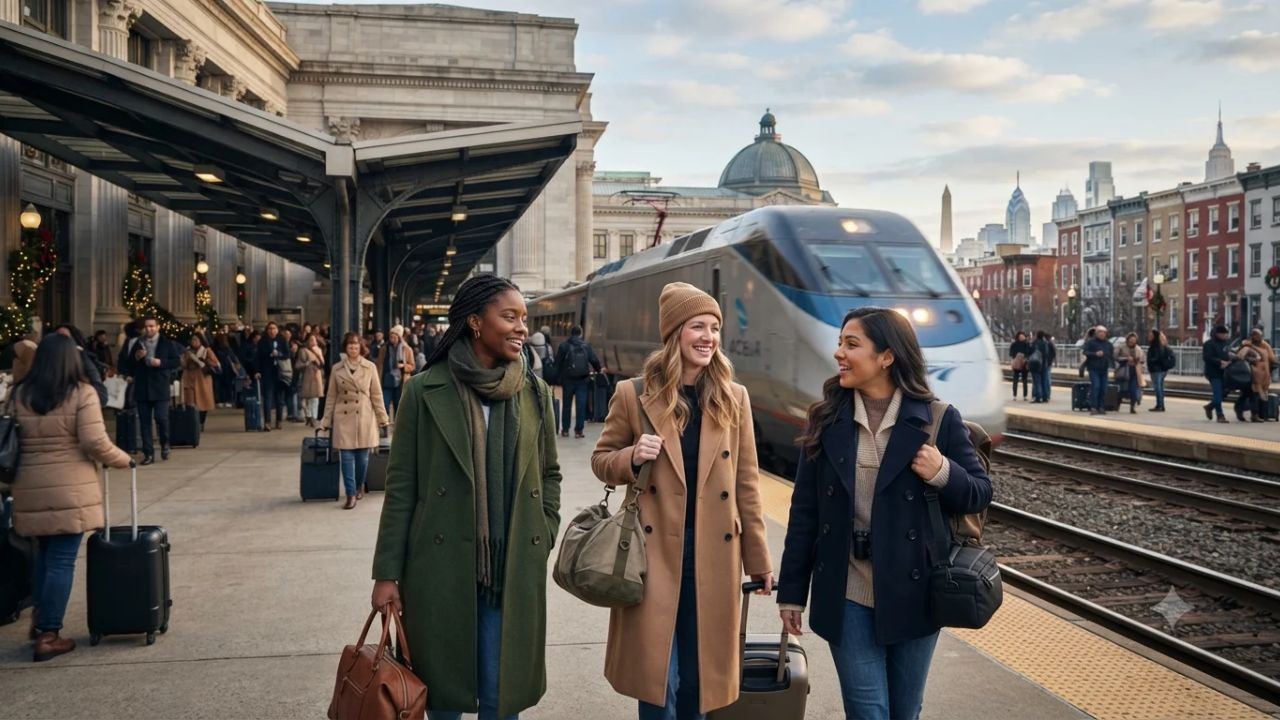
Image generated by AI
While millions of international visitors waste precious vacation hours queuing at airport security gates to hop between East Coast destinations, a single 457-mile electrified steel spine carries over 750,000 passengers each day across four world-class cities without a single runway delay. Stretching from Washington DC to Boston, the Northeast Corridor supports over 2,200 daily passenger trains, linking downtown railway halls directly to historic neighborhoods, waterfront promenades, and national monuments. Anchored across a regional economic territory home to 51 million residents that accounts for 20 per cent of United States GDP and 30 per cent of national employment, a well-planned rail itinerary through Baltimore, Washington DC, Philadelphia, and New York City transforms four fragmented destination breaks into an effortless urban grand tour.
The 457-Mile Steel Spine: Re-Engineering Multi-City American Travel
The sheer efficiency of the Northeast Corridor rewrites the conventional logic of American holiday planning. Federal data from the Federal Railroad Administration illustrates the immense aviation congestion surrounding these metropolitan centers in FY2024: Baltimore/Washington International processed 246,131 aircraft movements, Philadelphia recorded 313,091, Reagan National saw 299,526, Newark handled 425,384, and New York JFK recorded 475,683. Flying between these cities requires early arrivals, baggage restrictions, and costly 45-minute highway transfers into downtown cores.
In contrast, Amtrak's high-frequency Acela and Northeast Regional services drop travelers straight into central stations: Washington Union Station, Baltimore Penn Station, Philadelphia William H. Gray III 30th Street Station, and New York Moynihan Train Hall.
The corridor is also undergoing a transformative generational upgrade. South of Baltimore, Amtrak is replacing the 1.4-mile Civil War-era B&P Tunnel—which opened in 1873, forces passenger trains to crawl at 30mph, and represents a single point of failure for 15 million annual Amtrak and MARC commuter passengers—with the modern Frederick Douglass Tunnel. With tunnel-boring machines slated to launch in 2028, this massive infrastructure project will eliminate the southern corridor's primary bottleneck, securing faster and more dependable travel between Washington and Baltimore.
What Makes Baltimore, DC, Philadelphia, and New York Different
The defining strength of this rail journey lies in the distinct cultural and historical identities packed into a three-hour transit radius.
Baltimore serves as an unhurried, character-rich opening chapter. Visit Baltimore reported over 28.7 million visitors in 2025—a 6.3 per cent increase over 2019 levels—generating more than $4.3 billion in economic impact and supporting 123,600 regional jobs. Charm City offers authentic brick rowhouse architecture, maritime shipyard heritage, and lively creative communities clustered around Fells Point and Mount Vernon.
Forty minutes south, Washington DC delivers unmatched monumental density. The national capital welcomed 27.2 million visitors in 2024, including 25 million domestic travelers and 2.2 million international guests. Visitor spending reached $11.4 billion—with lodging accounting for $4.6 billion, or roughly 40 per cent of the total—generating $2.3 billion in tax revenue and sustaining 111,500 jobs. While international travelers accounted for only 8 per cent of total visitation, their longer stays drove 27 per cent of total expenditure. The city offers neoclassical avenues and world-renowned museum collections along the National Mall, overseen through the National Park Service.
Heading north, Philadelphia provides the historic bridge of American democracy. The city welcomed 26.6 million visitors in 2024 (and 43.9 million across Greater Philadelphia), generating a record $4.5 billion in visitor spending and approximately $7.0 billion in total economic impact. Spending was exceptionally balanced: food and beverage captured 26 per cent of expenditure, lodging 25 per cent, transport 23 per cent, retail 14 per cent, and recreation 12 per cent, while hotel occupancy reached 66.4 per cent across 4.7 million room nights demanded. Its historic core is anchored by Independence Hall, designated a celebrated UNESCO World Heritage Centre site.
Finally, New York City provides the roaring metropolitan crescendo. Recording 64.3 million visitors in 2024 (including 13 million international arrivals), direct visitor spending exceeded $51 billion, sparking an estimated $79 billion in total economic output across the city and state. The transition from Baltimore’s harbor taverns to New York's five-borough theatrical stage creates an unforgettable narrative arc.
Visitor Insider Tips
Structuring this multi-city rail holiday requires moving beyond generic tourist itineraries. For the ideal pace, avoid the rushed 5-night Express option (one night each in Baltimore, DC, and Philadelphia, and two in New York). Instead, book the 8-night Balanced trip (two nights in each city) or the 10-to-12-night Immersive itinerary to give each destination room to breathe.
When purchasing Amtrak tickets, book four to eight weeks ahead to secure Saver and Value fares on the Northeast Regional. These services run at nearly identical speeds to the premium Acela along this segment while costing up to 60 per cent less.
Station navigation offers its own advantages. In Baltimore, step out of Penn Station straight into the cultural district of Mount Vernon, home to the Walters Art Museum and historic brownstone inns. In Philadelphia, explore 30th Street Station's soaring Art Deco main concourse before boarding a free five-minute regional rail link into Center City. In New York, alight beneath the skylights of Moynihan Train Hall, which offers polished passenger waiting lounges, clean restrooms, and direct underground subway access to the A, C, E, 1, 2, and 3 lines.
Culinary exploration should be rooted in local neighborhoods. In Baltimore, visit Lexington Market for colossal lump blue crab cakes seasoned with Old Bay, or sample fresh oysters along the waterfront docks of Fells Point. In Washington DC, head to historic U Street for a legendary half-smoke sausage at Ben's Chili Bowl. In Philadelphia, bypass tourist steak counters and explore Reading Terminal Market for warm roast pork sandwiches layered with broccoli rabe and sharp provolone. In New York, grab traditional hand-rolled bagels in the Lower East Side before dining at neighborhood trattorias across Greenwich Village.
Cultural and Environmental Context
Choosing rail over air travel on the Northeast Corridor is an impactful ecological choice. Intercity electric trains produce up to 83 per cent fewer greenhouse gas emissions per passenger-mile than driving alone or taking short-haul regional flights. By channeling passenger traffic directly into existing downtown rail terminals, the corridor minimizes the need for airport land reclamation, highway widening, and suburban sprawl.
Furthermore, this multi-city rail framework distributes economic benefits equitably across the region. Rather than concentrating visitor spending entirely within Manhattan or the luxury hotel enclaves of downtown Washington, traveling by train directs vital tourism revenue into independent neighborhoods, historic public markets, and municipal transit systems across Baltimore and Philadelphia. Travelers participate in a living network where modern mobility honors historic urban conservation.
FAQ: Visiting the Northeast Corridor 2026
What is the best direction to travel along the Northeast Corridor?
Traveling southbound from New York to Washington (or northbound from Washington/Baltimore to New York) works equally well. Ending in New York provides a dramatic grand finale, while ending in DC offers a relaxed, monument-focused conclusion.
How far in advance should I book Amtrak tickets for the best fares?
Book tickets four to eight weeks in advance. Amtrak uses dynamic pricing, meaning fares rise significantly during the final two weeks before departure.
Do travelers need to pass through security checkpoints at Amtrak stations?
Amtrak does not require traditional airport-style TSA security queues. Passengers can arrive twenty to thirty minutes before departure and walk directly to boarding gates.
Is train travel between these four cities safe for solo travelers?
Yes. Northeast Corridor trains and major stations are heavily staffed, well-lit, and monitored by Amtrak Police, providing safe and comfortable transit day and night.
The true spirit of American travel is discovered not from six miles high, but from a window seat watching the cities unfold along the tracks.
Related Travel Guides
Europe to Latin America Direct Flights: The Insider Guide to Transatlantic Routes in 2026
North America Luxury Winter Travel: Big Sky Heights, Deer Valley Expansion, and Lake Louise Escapes
10 Best Historic Walking Tours in Washington DC and Philadelphia According to Reddit 2026
Disclaimer
This article is for informational and educational purposes only. It does not constitute legal, financial, or professional advice. While we strive to provide accurate and up-to-date information, travel policies, regulations, and conditions change rapidly. Always verify information with official sources before making travel decisions. Nomad Lawyer makes no representations about the accuracy, reliability, completeness, or suitability of the information provided. Readers should consult qualified professionals for advice specific to their circumstances. The views expressed in this article are those of the author and do not necessarily reflect the views of Nomad Lawyer.
Raushan Kumar
Founder & Lead Developer
Full-stack developer with 11+ years of experience and a passionate traveller. Raushan built Nomad Lawyer from the ground up with a vision to create the best travel and law experience on the web.
Learn more about our team →