
The Great Basin Void: Inside Nevada’s Seven-Town Dark Sky Stargazing Corridor in 2026

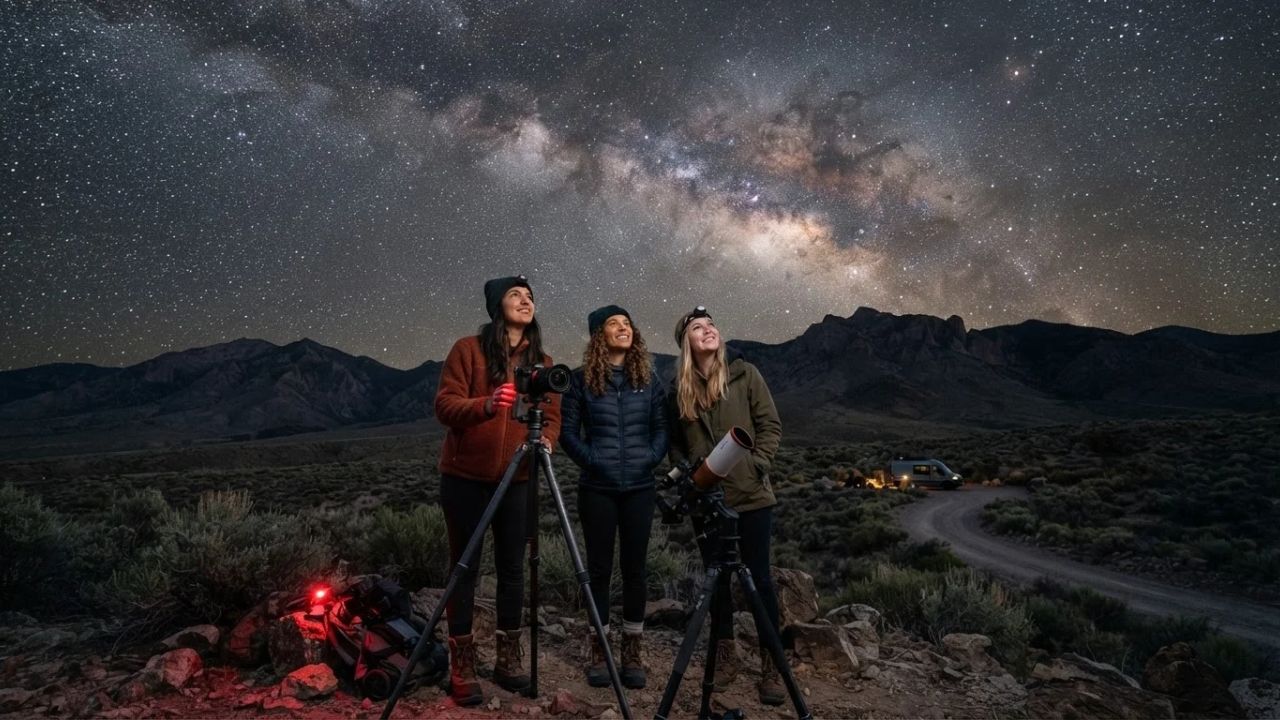
In the high desert silence of northwestern Nevada’s Massacre Rim, ambient starlight on a moonless night is so shockingly intense that the silver ribbon of the Milky Way casts distinct shadows across the sagebrush. While the neon glare of the Las Vegas Strip commands international attention, seven remote desert outposts—Tonopah, Ely, Baker, Gerlach, Austin, Caliente, and Boulder City—have formed an unprecedented regional alliance to turn unpolluted nocturnal darkness into America’s ultimate astronomical frontier, offering travelers pristine Bortle Class 1 night skies.
Stepping out of a vehicle in the heart of the Great Basin long after midnight, the sheer scale of the cosmos is overwhelming. In an era where artificial skyglow blurs the night sky for 80% of North Americans, these isolated Nevada communities have recognized that their greatest modern asset is absolute darkness. By enacting rigorous outdoor lighting ordinances, investing in specialized observation infrastructure, and partnering with national park rangers, rural Nevada has transformed isolation into economic resilience, creating a sanctuary where the cosmos remains visible exactly as our ancestors beheld it.
The Celestial Migration: Seven Nevada Outposts Defeating Urban Light Pollution
The movement to safeguard Nevada’s nocturnal environment unites seven distinct communities across hundreds of miles of high-altitude desert. Rather than treating darkness as an accidental byproduct of geography, these municipalities actively engineer their lighting footprints:
- In Tonopah, perched at an elevation exceeding 6,000 feet, the Clair Blackburn Memorial Stargazing Park provides specialized concrete pads engineered specifically to eliminate ground vibration during long-exposure astrophotography.
- In Ely, the historic Nevada Northern Railway operates the legendary Star Train, carrying visitors aboard vintage steam locomotives into pitch-black desert valleys where National Park Service rangers deliver live cosmic narration and assemble high-powered mobile telescopes beneath the open sky.
- In Baker, situated at the entrance of Great Basin National Park, the community holds certification as an International Dark Sky Community, protecting the research clarity of the Great Basin Observatory—the first research-grade robotic telescope installed within a U.S. National Park.
- In Gerlach, bordering the Black Rock Desert, off-grid travelers access the Massacre Rim International Dark Sky Sanctuary, recognized globally as one of the darkest, most optically transparent places on Earth.
- Along Highway US-50 near Austin, situated at over 6,600 feet in the Toiyabe Range, night drivers explore the Hickison Petroglyph Recreation Area, where ancient rock art carvings align with unpolluted constellations.
- In Caliente, rugged canyon walls framing Cathedral Gorge State Park and Kershaw-Ryan State Park provide natural geological light shields, enabling regular night photography masterclasses.
- In Boulder City, located just 30 miles from the glittering Las Vegas Strip, civic leaders strictly enforce dark-sky ordinances that ban commercial searchlights and mandate fully shielded fixtures, allowing visitors to experience night kayaking on Lake Mead and guided after-dark hikes through Sloan Canyon National Conservation Area.
To achieve dark-sky certification overseen by DarkSky International, these municipalities adhere to strict engineering codes. Residential and commercial outdoor lighting is capped at under 3,000 lumens per plot, and standard 4,000K white LEDs have been replaced with warm amber fixtures rated at or below 2,200K Correlated Color Temperature. This eliminates high-frequency blue wavelengths that cause Rayleigh scattering in the atmosphere, cutting municipal grid power expenditures by 25% to 40% within 24 months of enactment.
What Makes the Great Basin Night Sky Unique: Basin-and-Range Topography and Scotobiology
The astronomical superiority of central Nevada is deeply rooted in physical geology. The state sits within the Basin-and-Range province, a distinct geological formation characterized by parallel north-south mountain ranges reaching elevations between 6,000 and 13,000 feet. These mountain ridges act as colossal topographical ramparts, providing 75% to 95% physical obstruction against light domes originating from distant metropolitan centers like Las Vegas, Reno, and Salt Lake City.
Simultaneously, high base valley elevations (between 5,000 and 7,000 feet) and arid conditions—with relative humidity frequently dipping below 15%—virtually eliminate water vapor in the atmospheric column. This minimal moisture content prevents optical refraction, yielding razor-sharp star clarity that professional astrophotographers struggle to find anywhere else on the continent. Over 65% of overnight visitors in Tonopah and Gerlach carry specialized gear, including star-tracking mounts and modified mirrorless sensors, generating over 45 million organic media impressions annually.
Beyond astronomy, protecting darkness supports scotobiology—the scientific study of how biological systems rely on natural darkness. Research across these protected corridors reveals a 15% to 22% increase in native desert flora reproduction due to restored pollination cycles by nocturnal moths and beetles. Dark skies also safeguard critical hunting territory for more than 18 native bat species, alongside nocturnal apex predators like Great Horned Owls and Barn Owls.
The cultural layer is equally profound. For the Western Shoshone (Newe) and Southern Paiute (Nuwuvi), constellations served for millennia as a sacred navigational atlas, seasonal calendar, and oral library. At Hickison Petroglyph Recreation Area, rock art dating back 3,000 to 10,000 years aligns precisely with solar equinoxes, solstices, and major planetary alignments, grounding modern dark-sky travel in timeless Indigenous cosmology.
The economic returns are equally compelling. While standard daytime highway travelers spend an average of $75 to $90 per day on quick fuel and snacks, dedicated nocturnal travelers ("noctourists") generate daily expenditures ranging from $185 to $240. This economic boost has driven an 18% to 32% year-over-year surge in lodging tax revenues across Tonopah and Baker. Experiential astro-hospitality has evolved rapidly, with luxury off-grid geodesic domes near Baker commanding between $450 and $850 per night, booked four to eight months in advance. Multi-day astrophotography workshops charging tuition between $1,500 and $3,200 have increased off-season winter lodging occupancy by 28%, while guided nocturnal scorpion tours using ultraviolet black lights have extended average visitor stays from 1.5 to 3.8 nights.
Visitor Insider Tips
Embarking on a dark-sky expedition across Nevada’s high desert requires specialized preparation and field discipline.
First, plan your journey around the astronomical new moon. The optimal observation window spans seven days: three days before, the night of, and three days after the monthly new moon. Arriving during a full moon washes out faint nebulae and the arm of the Milky Way, reducing even Bortle 1 skies to moderate visibility.
Second, respect red-light field etiquette. When approaching observation sites like Tonopah’s Stargazing Park or the Great Basin Astronomy Amphitheater, switch off vehicle headlights well before entering parking bays and use only red-filtered flashlights. Human eyes require 20 to 30 minutes to build rhodopsin for peak night vision; a single flash of white light instantly resets this biological clock.
Third, prepare for extreme desert temperature drops. High-altitude desert nights are deceptively cold; even during midsummer, valley temperatures can plummet from 35°C (95°F) at sunset to near freezing by 02:00. Pack thermal base layers, windproof down jackets, insulated gloves, and sturdy boots.
Fourth, master high-desert driving logistics. Highway US-50 and remote gravel tracks leading to Massacre Rim have stretches exceeding 100 miles without fuel or mobile reception. Carry a paper road map, two full-sized spare tires, a portable 12-volt air compressor, and at least five liters of drinking water per person. On your route, stop at Tonopah’s historic 1907 Mizpah Hotel or enjoy family-style Basque dining in nearby regional hubs.
Cultural and Environmental Context
Nevada’s dark-sky corridor represents a visionary transition from extractive economies to sustainable conservation. For over a century, rural Nevada relied heavily on hard-rock mining, timber cutting, and cattle ranching—industries vulnerable to global boom-and-bust cycles. Dark-sky tourism introduces a completely non-consumptive economic model that monetizes the pristine night sky without disturbing a single stone.
Supported by state initiatives through Travel Nevada, rural communities collaborate closely with federal agencies, state parks, and tribal councils. Indigenous-led astro-heritage tours ensure that ancient Western Shoshone cosmological traditions are preserved and respectfully shared.
Furthermore, this regional shield protects world-class national treasures like Great Basin National Park, where 4,000-year-old ancient Bristlecone pines—some of the oldest living trees on Earth—grow beneath the unpolluted starlight. By demonstrating that environmental lighting controls reduce municipal energy bills while generating high-value tourism revenue, Nevada provides a masterclass in how small communities can safeguard the global commons while revitalizing their local economies.
FAQ: Stargazing in Nevada’s Dark Sky Corridor 2026
What is a Bortle Class 1 dark sky? The Bortle Scale measures night-sky brightness from Class 9 (inner-city light pollution) to Class 1 (pristine celestial darkness). Nevada’s Class 1 corridors allow observers to view the Milky Way, zodiacal light, and distant galaxies without artificial glare.
Where is the best base for stargazing in Nevada? Tonopah offers specialized concrete observation pads at its Stargazing Park, Ely provides the historic night-sky Star Train, and Baker offers direct access to Great Basin National Park’s research observatory.
What specialized gear should travelers bring for night-sky viewing? Essential equipment includes red-lens headlamps, warm winter-grade thermal clothing, sturdy tripods, wide-aperture lenses (f/2.8 or faster) for astrophotography, and binoculars or portable spotting scopes.
How does dark-sky conservation protect desert wildlife? Scotobiology research shows that eliminating artificial light pollution restores nocturnal pollination cycles for native desert flora by 15% to 22% and preserves vital nighttime hunting corridors for 18 native bat species and desert owls.
When the last switch is thrown and the false sun fades, the desert whispers its oldest truth: we were never alone in the dark.
Related Travel Guides
Disclaimer
This article is for informational and educational purposes only. It does not constitute legal, financial, or professional advice. While we strive to provide accurate and up-to-date information, travel policies, regulations, and conditions change rapidly. Always verify information with official sources before making travel decisions. Nomad Lawyer makes no representations about the accuracy, reliability, completeness, or suitability of the information provided. Readers should consult qualified professionals for advice specific to their circumstances. The views expressed in this article are those of the author and do not necessarily reflect the views of Nomad Lawyer.
Raushan Kumar
Founder & Lead Developer
Full-stack developer with 11+ years of experience and a passionate traveller. Raushan built Nomad Lawyer from the ground up with a vision to create the best travel and law experience on the web.
Learn more about our team →