
USA Travel Alert: MSP Airport Faces Tighter Seats Ahead of 2026 MEA Holiday Rush

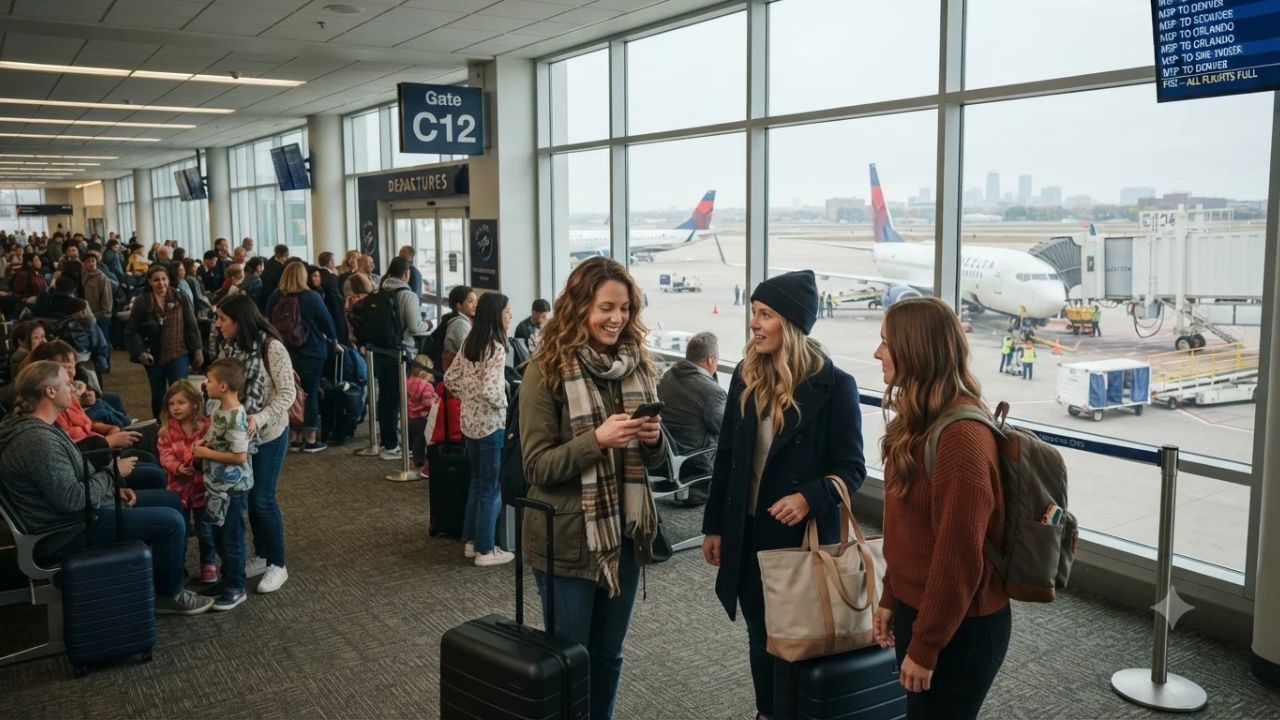
Image generated by AI
Handling approximately 36 million passengers annually while generating $21.3 billion in economic output, Minneapolis–Saint Paul International Airport (MSP) is entering autumn 2026 under severe operational tension as commercial carriers trim seat allocations ahead of the annual MEA school-break rush. With peak single-day checkpoint volumes projected to eclipse the 52,000 travelers recorded during the 2025 holiday surge, Minnesota's primary aviation complex faces an acute imbalance between surging family leisure demand and restricted aircraft seat supply.
The MEA Holiday Anomaly: High-Velocity Leisure Demand on a Regional Hub
The Minnesota Educators Association (MEA) annual break creates one of the most intense, short-fuse travel spikes in the United States aviation system. While traditional holiday travel periods such as Thanksgiving or Christmas span an entire week or more with staggered departures, the MEA window compresses tens of thousands of school families into an identical 72-hour departure block. Starting Wednesday afternoon and extending through Thursday morning, Twin Cities households simultaneously head toward warm-weather beach corridors, international resort gateways, and major amusement parks across Florida, California, and the Desert Southwest.
This intense concentration of departures places extreme pressure on every level of Minnesota's primary transit gateway. Operating under the governance of the Metropolitan Airports Commission (MAC), MSP supports approximately 93,350 regional jobs and anchors the commercial life of the Upper Midwest. However, because MEA is a hyper-localized state holiday rather than a nationwide observance, national carriers do not typically add extra widebody aircraft or supplementary frequencies to accommodate the spike.
Instead, regional scheduling decisions are governed by broader corporate capacity adjustments. Throughout late 2025 and 2026, major domestic carriers adopted strict capacity discipline to protect profit margins against volatile jet fuel expenses. Rather than flying half-empty planes during the slower mid-autumn weeks, airlines reduced regional frequencies and deployed smaller narrowbody aircraft on secondary routes. The direct result for Minnesota flyers is a compressed seat market where seat inventory evaporates weeks earlier than in past years.
Terminal Logistics and Ground Transit Bottlenecks: Terminal 1 vs Terminal 2
Managing this surge requires strict operational separation across MSP's twin commercial terminals, which function almost as two distinct airports connected by light rail and airfield taxiways. More than 80 percent of all MSP passenger traffic flows through Terminal 1 (Lindbergh), the sprawling hub facility that serves Delta Air Lines and its SkyTeam alliance partners. Terminal 2 (Humphrey) absorbs the remaining volume, functioning as the primary operating base for hometown carrier Sun Country Airlines alongside low-cost carriers such as Southwest Airlines and Allegiant Air.
Because leisure travel dominates the MEA window, families traveling in groups of four, five, or six absorb airport infrastructure differently than solo business commuters. Checked baggage volumes double, curb dwell times increase, and checkpoint screening lanes process higher ratios of strollers, car seats, and carry-on liquid compliance checks.
| Facility & Metric | Share of Airport Volume | Primary Carrier Anchors | Peak Processing Tools | Critical Roadway Access |
|---|---|---|---|---|
| Terminal 1 (Lindbergh) | >80% Total Passengers | Delta Air Lines, United, American | MSP RESERVE, Clear, TSA PreCheck | FLEX Lane Upper/Lower Bypass |
| Terminal 2 (Humphrey) | <20% Total Passengers | Sun Country, Southwest, Allegiant | Standard & Expedited Checkpoints | Purple Ramp Express Transit Lane |
| Parking & Ground Shuttles | 30,000+ Stall Capacity | All On-Site Commercial Ramps | Pre-Booked Electronic Stalls | Interstate 494 & Highway 5 |
| Airfield Scale & Output | 36M Annual Travelers | Dual Hub Networks | 4 Active Runways (Parallel/Cross) | Central Apron Control |
To prevent severe vehicle gridlock outside Terminal 1, airport authorities operate the FLEX Lane, which redirects personal vehicles away from congested standard baggage-claim doors to alternative loading zones. At Terminal 2, drivers can utilize the Purple Ramp Express Lane to stage passenger pickups without circling outer terminal loops. Additionally, airport administrators urge local drivers to utilize free cell-phone waiting lots to keep terminal approach ramps clear of idling cars.
Inside the security perimeter, screening logistics are monitored closely by the Transportation Security Administration (TSA). Terminal 1 passengers can schedule complimentary 15-minute security screening windows through the MSP RESERVE platform, an appointment system designed to smooth out morning checkpoint spikes and reduce standby wait times.
Capacity Discipline and Fleet Rationalization: Why Seats Are Disappearing
The tightening of seat capacity across the Upper Midwest is not an operational accident; it is the culmination of post-pandemic fleet rationalization. Domestic airlines have systematically grounded or retired older 50-seat regional jets in favor of larger 76-seat to 150-seat mainline aircraft like the Airbus A220 and Boeing 737 MAX. While this transition delivers superior fuel efficiency and lower seat-mile costs, it often results in reduced daily flight frequencies between hub cities and regional outposts.
When airlines reduce daily departures from five down to three, the total daily seat inventory on key leisure corridors shrinks. For business flyers, this schedule adjustment represents a minor inconvenience. For families bound by strict school schedules during MEA weekend, it creates an immediate inventory bottleneck. Morning flights to Orlando, Phoenix, and Cancun sell out months ahead of departure, leaving late-booking passengers with high-fare regional connections or undesirable multi-stop itineraries through Chicago O'Hare or Denver International.
Maintaining robust airline competition remains essential for stabilizing fares at Minneapolis-Saint Paul International Airport (MSP). With Delta Air Lines commanding a dominant hub position and Sun Country providing counter-balancing low-cost point-to-point service, any schedule reduction by either carrier immediately pushes average leisure fares upward across the entire Twin Cities metropolitan basin.
Expert Analysis: Pricing Inelasticity, Disruption Vulnerability, and the Rebooking Trap
For travelers booking flights out of MSP during peak autumn weekends, the direct consequence of reduced seat capacity is an unprecedented vulnerability to irregular operations. In an era when commercial jetliners routinely fly with load factors exceeding 90 percent, an airline has virtually zero spare capacity to absorb stranded passengers when mechanical snags, convective storms, or crew scheduling timeouts occur.
The pricing pressure this creates means that last-minute seat purchases during MEA week can easily double or triple standard shoulder-season ticket prices. When a family of four faces a flight cancellation on an aircraft with zero open seats on subsequent departures for the next 48 hours, airlines can no longer simply rebook them onto the next flight. The direct result is that travelers risk losing prepaid non-refundable resort stays, cruise departures, and car rentals while waiting on standby lists in Minneapolis.
To mitigate this structural risk, travelers must abandon the habit of selecting flights purely on entry-level ticket prices. Basic economy tickets that restrict same-day standby rights, prevent advance seat selection, or impose punitive change fees are hazardous during peak travel surges. Securing morning departures provides the strongest operational insurance: early flights utilize aircraft that overnighted on the airfield, insulating travelers from cascading afternoon system delays.
Equally important, checking flight status through dedicated airline digital channels and reserving on-site airport parking weeks in advance is now a baseline necessity. When regional aviation gateways operate near peak terminal saturation, passive travel habits inevitably lead to missed connections and stranded luggage.
Key Takeaways
- High-Density Holiday Spike: The Minnesota Educators Association (MEA) school break concentrates tens of thousands of outbound leisure travelers into a compact 72-hour window, surpassing 52,000 daily checkpoint screenings.
- Capacity Squeeze: Airlines serving MSP have trimmed regional frequencies and overall seat counts, creating higher average load factors and fewer open seats on popular holiday routes.
- Economic Gateway Role: MSP processes roughly 36 million passengers annually, generating $21.3 billion in regional economic activity and supporting over 93,350 jobs throughout Minnesota.
- Terminal Transit Realities: Terminal 1 processes over 80 percent of passenger volume, requiring active traffic tools like the FLEX Lane and MSP RESERVE appointment screening to prevent terminal gridlock.
- Disruption Risk: High passenger load factors leave airlines with minimal spare seats to recover from cancellations, making morning departures and flexible fare classes essential for holiday flyers.
FAQ: MSP Airport MEA Holiday Travel 2026
How early should passengers arrive at MSP during MEA weekend?
Airport authorities recommend arriving at least two hours prior to scheduled domestic departures and three hours ahead of international flights. Increased family check-in traffic, checked luggage, and parking congestion require additional terminal processing time.
How does the MSP RESERVE appointment system work?
MSP RESERVE allows passengers departing Terminal 1 to reserve a dedicated security screening time slot up to seven days before departure. The free reservation provides an expedited checkpoint line, avoiding peak holiday queues.
What causes severe flight price spikes during Minnesota's MEA break?
Because MEA is a localized school holiday, airlines do not add widespread extra flights. High demand from thousands of families competing for a reduced pool of seats drives dynamic airfare algorithms upward rapidly.
What are the best options for parking at MSP during peak periods?
Travelers should pre-book on-site terminal parking ramps online at least two weeks before departure. If on-site terminal ramps fill to capacity, off-site private parking lots along Highway 5 and I-494 provide shuttle connectivity.
In an aviation ecosystem where airline seats are strictly rationed and departure gates operate at full throttle, mastering terminal logistics and securing early departures remains the only dependable insurance policy for the modern holiday flyer.
Related Travel Guides
Minnesota MSP Airport Airline Cost Battle & Winter Hub Travel Guide
US Airports Operating Fee Hikes & Autumn Travel Logistics Guide
Disclaimer
This article is for informational and educational purposes only. It does not constitute legal, financial, or professional advice. While we strive to provide accurate and up-to-date information, travel policies, regulations, and conditions change rapidly. Always verify information with official sources before making travel decisions. Nomad Lawyer makes no representations about the accuracy, reliability, completeness, or suitability of the information provided. Readers should consult qualified professionals for advice specific to their circumstances. The views expressed in this article are those of the author and do not necessarily reflect the views of Nomad Lawyer.
Preeti Gunjan
Contributor & Community Manager
A passionate traveller and community builder. Preeti helps grow the Nomad Lawyer community, fostering engagement and bringing the reader experience to life.
Learn more about our team →