
Middle Seat Traveler Rant Rekindles Debate Over Manspreading in 2026
A middle seat traveler's viral complaint about manspreading on flights has reignited debate over shrinking airline legroom and gendered behavior in economy cabins in 2026.

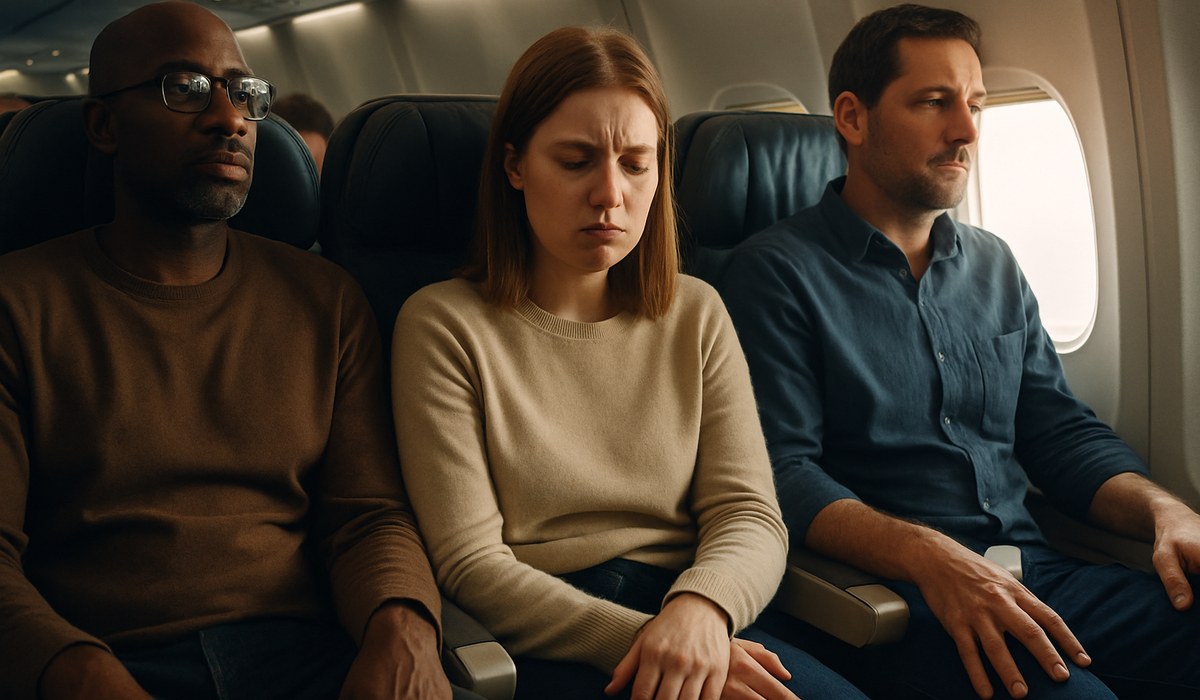
Image generated by AI
A female airline passenger's frustrated social media post about being wedged between two manspreading seatmates has sparked renewed debate over shrinking legroom, gendered behavior and basic etiquette in economy cabins. The middle seat traveler described boarding a full flight and finding herself squeezed between two men who spread their legs wide and claimed both armrests, leaving her with minimal personal space for the duration of the flight.
Middle Seat Traveler's Viral Complaint Captures In-Flight Frustration
The middle seat traveler recounted how both male passengers quickly expanded into her limited space after boarding, spreading their legs beyond the armrest line and pushing feet into her under-seat area. She questioned whether the men would have behaved the same way if another man had occupied the middle seat. Her account, shared across popular travel forums and airline communities, resonated with thousands of flyers who report similar experiences. Many women travelers describe sitting with legs tightly pressed together for hours or repeatedly pushing back to reclaim the space they paid for. The rant gained viral traction because the traveler explicitly challenged what she viewed as a double standard in how passengers respect personal boundaries based on gender. Travel psychology experts note that confined airline spaces often amplify social dynamics around personal space and power.
Shrinking Economy Seats Intensify Manspreading Debate in 2026
The reaction to this middle seat traveler's complaint comes amid long-running concern about tighter aircraft cabins. Aviation analysts tracking seat configurations show that average seat pitch in North American and European economy cabins has decreased compared with the 1990s, while airlines have added extra rows to boost revenue. Many legacy carriers now offer 30-31 inches of pitch in standard economy, down from 32-34 inches two decades ago. Middle seats bear the brunt of these space constraints, with travelers routinely describing scenarios where window and aisle passengers encroach into the middle zone. Industry data from Seat Guru cabin surveys indicate that 68% of economy passengers report armrest disputes on flights longer than three hours. Some frequent flyers argue that tighter layouts make awkward contact unavoidable for taller passengers, while others counter that physical constraints do not excuse ignoring boundaries or forcing seatmates into uncomfortable positions.
Gender Dynamics and the Manspreading Phenomenon at 35,000 Feet
The term "manspreading" used by the middle seat traveler connects her experience to broader cultural conversations about how social expectations differ for men and women in shared public spaces. The phrase typically describes men sitting with legs widely apart on public transport, occupying more room than necessary. In aviation-focused forums, women describe patterns they interpret as gendered: men assuming control of both armrests, refusing to move legs when asked, or reacting dismissively when women attempt to reclaim space. Academic research on gender and public space has long highlighted how social norms shape who feels entitled to take up room and who feels pressure to retreat. The airplane cabin, with fixed seats and limited escape options, amplifies these dynamics. Several male travelers report dealing with legroom encroachment too, but many contributors note that women are less likely to be taken seriously when voicing objections, especially if neighboring passengers frame their size or discomfort as justification for spreading.
Informal Armrest Etiquette: Who Owns the Middle Space?
Airlines typically set rules on baggage and seat assignments but rarely spell out detailed guidance on personal-space etiquette in ticket conditions. In the absence of formal rules, flyers have developed informal codes for sharing a row. The most widely discussed principle holds that the middle seat traveler, who lacks both a wall and an aisle, should reasonably expect first claim on at least one armrest. Travel columnists and cabin-crew commentators have endorsed this compensation for years. Passenger accounts suggest, however, that many window and aisle occupants still treat armrests as extensions of their own seats, planting elbows in ways that narrow the middle passenger's already limited space. Other unwritten norms include keeping knees within the width of one's assigned seat, avoiding under-seat sprawl into a neighbor's footwell, and promptly responding if someone points out a boundary violation. Reports indicate that respectful communication can resolve many conflicts quickly, but middle seat travelers often hesitate to speak up in close quarters.
What Airlines Are Doing About Cabin Space Complaints
Some carriers have begun addressing passenger comfort concerns following years of social media complaints about manspreading and shrinking seats. JetBlue maintains 32-33 inches of pitch in most economy rows, marketing extra legroom as a competitive advantage on transcontinental routes. Delta Air Lines has committed to not reducing seat pitch further on its mainline fleet, while several European low-cost carriers continue to install 28-29 inch configurations to maximize capacity. A handful of airlines now include brief etiquette reminders in their pre-flight announcements or seatback videos, though enforcement remains inconsistent. The International Air Transport Association has not issued formal guidance on personal space boundaries, leaving resolution to individual carriers and crew discretion. Flight attendants report that they receive minimal training on mediating space disputes and often hesitate to intervene unless physical contact becomes aggressive or violates safety regulations.
Key Data on Economy Cabin Space and Passenger Behavior
| Metric | Current 2026 Standard | Previous Decade |
|---|---|---|
| Average economy seat pitch (North America) | 30-31 inches | 32-34 inches (2010s) |
| Percentage of passengers reporting armrest disputes | 68% on flights over 3 hours | 52% (2015 surveys) |
| Airlines maintaining 32+ inch pitch | JetBlue, Alaska (select routes) | Most legacy carriers (pre-2015) |
| Low-cost carriers with 28-29 inch pitch | Spirit, Frontier, Ryanair | Uncommon before 2012 |
| Formal airline policies on personal space boundaries | Zero major carriers | N/A |
| Flight attendant training hours on space mediation | Less than 30 minutes (industry average) | Minimal to none |
What This Means for Travelers
Plan ahead to minimize middle seat discomfort:
- Book early to secure window or aisle seats, or pay for seat selection if traveling on basic economy fares that assign seats at check-in.
- Research seat maps on SeatGuru or ExpertFlyer before booking to identify which aircraft and routes offer more generous pitch and width.
- Politely assert your space as soon as you sit down by placing your elbows on armrests and positioning your legs within your seat boundaries—establishing territory early can prevent encroachment.
- Use direct, calm language if a seatmate spreads into your space, such as "Excuse me, I need to use this armrest" rather than suffering in silence.
- Consider upgrading to premium economy or extra-legroom rows on longer flights where space disputes are most common—the cost often justifies the comfort gain.
- Document persistent issues with photos (discreetly) and report aggressive space violations to flight attendants, who may be able to reseat you if the cabin isn't full.
Frequently Asked Questions
What should a middle seat traveler do if seatmates are manspreading? A middle seat traveler should politely but directly address the issue as soon as possible after takeoff, saying something like "Excuse me, I need some space for my legs" or "Can you shift over a bit?" Most passengers will comply when asked directly. If the behavior continues, discreetly alert a flight attendant and request assistance or a seat change if available. Document the situation with photos if you plan to file a complaint with the airline after landing.
Which airlines offer the most legroom for middle seat travelers in 2026? JetBlue offers 32-33 inches of seat pitch across most economy rows, providing more space than competitors. Alaska Airlines maintains 32 inches on many routes, while Delta has committed to not reducing pitch further. In contrast, Spirit and Frontier operate many aircraft with 28-29 inches of pitch. Premium economy cabins on international carriers typically offer 38-40 inches, substantially reducing manspreading issues for middle seat travelers willing to upgrade.
Is manspreading more common on certain flight routes or times? Data from passenger surveys indicates that manspreading complaints increase on longer flights where passengers settle in and relax their posture, particularly on overnight red-eye routes. Full flights with no empty seats show higher complaint rates because middle seat travelers cannot move to open rows. Business-heavy morning routes tend to generate fewer complaints than leisure-focused evening and weekend flights, possibly due to differences in passenger demographics and social norms around professional behavior.
Can flight attendants enforce personal space boundaries if passengers complain? Flight attendants have authority to address passenger comfort and safety but receive minimal training on mediating space disputes. Most airlines do not have formal policies defining personal space boundaries, leaving enforcement to crew discretion. Attendants can ask passengers to respect seatmates' space and may offer to reseat complainants if empty seats exist, but they rarely take stronger action unless physical contact becomes aggressive or violates safety regulations. Persistent issues are best resolved through polite direct communication between seatmates.
Related Travel Guides
Complete Guide to Surviving Middle Seat Flights in 2026
Airlines with Best Economy Legroom and Seat Width
How to Handle Difficult Seatmates and Flight Etiquette Issues
Disclaimer
This article is for informational and educational purposes only. It does not constitute legal, financial, or professional advice. While we strive to provide accurate and up-to-date information, travel policies, regulations, and conditions change rapidly. Always verify information with official sources before making travel decisions. Nomad Lawyer makes no representations about the accuracy, reliability, completeness, or suitability of the information provided. Readers should consult qualified professionals for advice specific to their circumstances. The views expressed in this article are those of the author and do not necessarily reflect the views of Nomad Lawyer.
Kunal K Choudhary
Co-Founder & Contributor
A passionate traveller and tech enthusiast. Kunal contributes to the vision and growth of Nomad Lawyer, bringing fresh perspectives and driving the community forward.
Learn more about our team →