
Middle East Travel Impacted with 572 Delays and 47 Cancellations at Dubai, Kuwait and More Airports
Middle East Travel Impacted with 572 Delays and 47 Cancellations at Dubai, Kuwait and More Airports

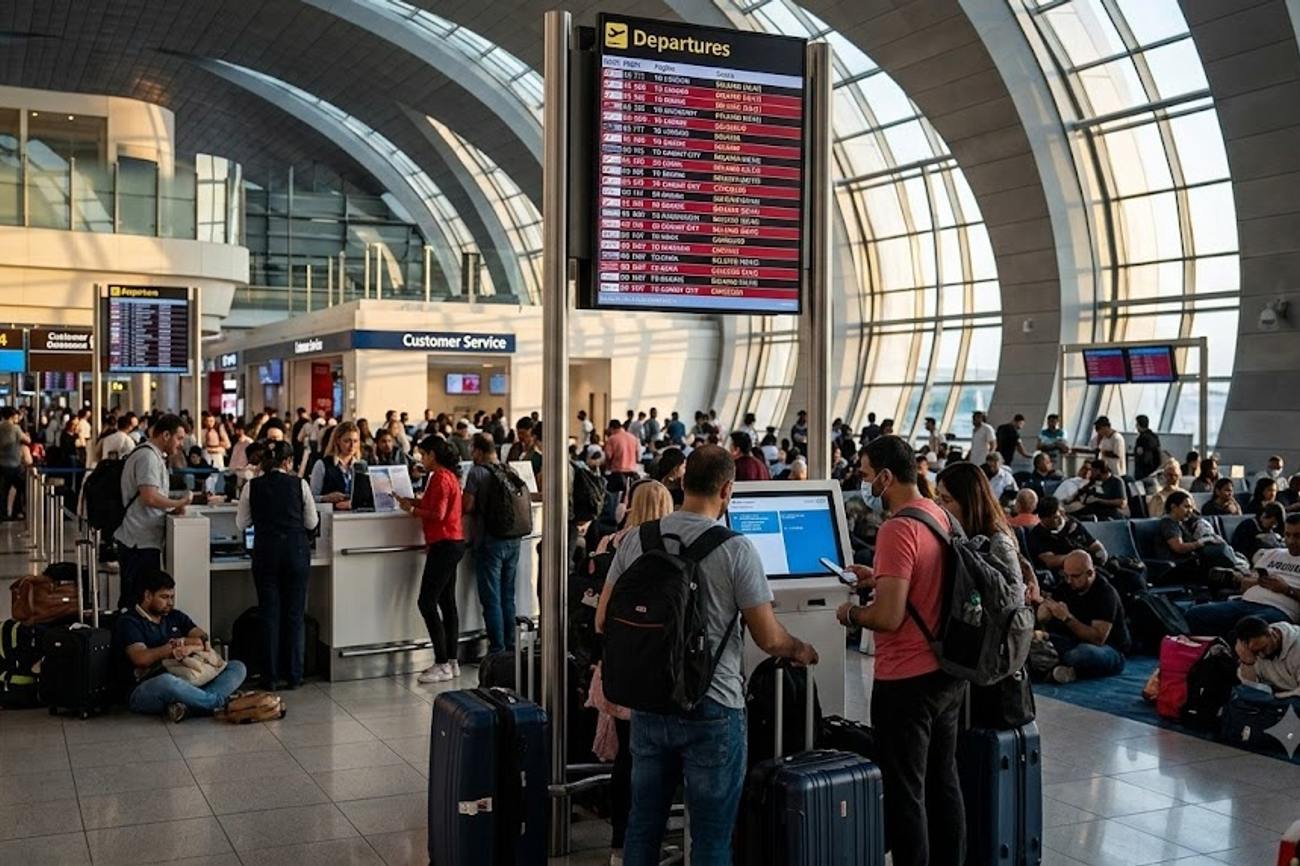
Image generated by AI
Middle East aviation hubs have seen a concentrated surge in operational instability, with 572 recorded delays and 47 cancellations across key gateways in a single reporting window. This represents a systemic strain on the region's "super-connector" model, where a disruption at a single node like Dubai International (DXB) or Istanbul (IST) triggers a cascading effect across three continents.
The Middle East Disruption Index: September 2026
The current data reveals a high concentration of instability within the primary transit hubs of the UAE and Türkiye. Dubai International Airport (DXB) stands as the most impacted facility, recording 157 delays and 7 cancellations. Istanbul Airport (IST) follows closely with 143 delays and 5 cancellations, highlighting the vulnerability of the Europe-Asia corridor.
Within the United Arab Emirates, the pressure is split between the two major hubs, with Abu Dhabi International Airport (AUH) reporting 99 delays and 2 cancellations. The Saudi Arabian market shows a different pattern of disruption; while Jeddah (75 delays, 9 cancellations) and Riyadh (72 delays, 9 cancellations) mirror the hub-centric delays of the UAE, smaller regional airports are experiencing "clean" cancellations—flights removed from the schedule entirely without preceding delays. Specifically, Abha Regional Airport saw 8 delays and 6 cancellations, while Gizan Regional Airport and Najran Domestic Airport each recorded 4 cancellations with 0 reported delays.
The operational impact on carriers varies significantly by business model. Etihad Airways faced the steepest percentage of instability, with 80 delays representing 23% of its flights, despite only 2 cancellations (0% of flights). In contrast, Turkish Airlines dealt with the highest raw volume of delays at 118, which accounts for 7% of its operations, alongside 3 cancellations (0% of flights). FlyDubai saw 33 delays (11% of flights) and 3 cancellations (1% of operations), while Saudia recorded 47 delays (9% of operations) and 12 cancellations (2% of flights). Royal Jordanian remained the least affected of the major regional players, with 6 delays (4% of operations) and 2 cancellations (1% of flights).
Comparative Operational Pressure: Hub vs. Regional
When comparing the data, a clear divide emerges between the "Mega-Hubs" and "Regional Feeders." Mega-hubs are characterized by high delay volumes but low cancellation percentages, as airlines fight to keep slots open for connecting traffic. Regional airports in Saudi Arabia, however, are seeing higher cancellation rates relative to their volume, suggesting a lower priority for aircraft recovery during airspace instability.
The following table breaks down the disruption levels by airport to illustrate the disparity in operational pressure:
| Airport Name | Delays | Cancellations | Primary Impact Type |
|---|---|---|---|
| Dubai International (DXB) | 157 | 7 | High Volume Delay |
| Istanbul Airport (IST) | 143 | 5 | Transit Corridor Strain |
| Abu Dhabi International (AUH) | 99 | 2 | Carrier-Specific (Etihad) |
| Jeddah (JED) | 75 | 9 | Gateway Instability |
| Riyadh (RUH) | 72 | 9 | Business Travel Disruption |
| Kuwait International (KWI) | 18 | 1 | Moderate Regional |
| Abha Regional | 8 | 6 | High Cancellation Ratio |
| Gizan Regional | 0 | 4 | Pure Cancellation |
| Najran Domestic | 0 | 4 | Pure Cancellation |
This data aligns with broader trends tracked by IATA, where airspace volatility in the Middle East often leads to "slot congestion," forcing airports like DXB and IST to hold aircraft on tarmacs rather than cancelling flights, which would jeopardize thousands of international connections.
Practical Traveler Advisory and Strategic Insights
The data suggests that the risk is not evenly distributed. If you are flying through a major hub, your primary risk is a significant delay that could jeopardize a tight connection. If you are flying into a regional Saudi airport, your primary risk is a total flight cancellation.
For those traveling through Dubai (DXB), Istanbul (IST), or Abu Dhabi (AUH), the current 7% to 23% delay rate for major carriers means that "legal" connection times (minimum connection times) are currently insufficient. Travelers should ensure a minimum of 4 hours between flights to account for the current operational volatility.
For passengers using Saudia or FlyDubai, the cancellation rates (2% and 1% respectively) are low, but the delay rates (9% and 11%) are significant. If you are booking travel for Q4 2026, avoid "self-transfer" tickets where the airline is not responsible for the connection. The volatility in Riyadh and Jeddah suggests that domestic-to-international transfers are currently the most fragile link in the chain.
Travelers are advised to utilize real-time tracking via FlightAware or similar data providers rather than relying solely on airport screens, as the data indicates that modifications are happening rapidly across the network.
Regional Airspace Projection
The concentration of delays in Istanbul and Dubai indicates that the disruption is likely tied to airspace restrictions or timetable modifications rather than airport-specific technical failures. When two separate hubs in different countries show near-identical delay spikes (157 in DXB vs 143 in IST), the cause is typically systemic.
Based on current trajectory and UNWTO growth projections for Middle East tourism, these hubs are operating at near-peak capacity. This means there is very little "slack" in the system to absorb delays. As we move into the peak travel season, any continued airspace instability will likely lead to an increase in the "Pure Cancellation" trend seen in Gizan and Najran, as airlines prioritize their high-margin long-haul routes over regional feeders. We expect a shift where regional flights are sacrificed to maintain the integrity of the international hubs.
FAQ: Middle East Aviation Disruption 2026
Which airline is currently the most unreliable for timing? Based on the September 21 data, Etihad Airways has the highest delay percentage, with 23% of its flights delayed. While cancellations are low, timing predictability is currently at its lowest among the listed carriers.
Should I avoid flying through Dubai or Istanbul right now? Avoidance is not necessary, but buffer time is. These airports have the highest raw number of delays (157 and 143). If your itinerary has a connection under 3 hours, you are at high risk of missing your flight.
Why are smaller airports like Gizan seeing cancellations but no delays? Regional airports often lack the "priority" status of hubs. When airspace is restricted, airlines cancel low-occupancy regional flights to reallocate aircraft and crews to maintain critical international connections in Dubai or Riyadh.
Will these disruptions lead to higher ticket prices? Short-term instability usually does not raise base fares, but it increases the cost of "last-minute" rebooking. Travelers should ensure they have comprehensive travel insurance that covers "trip interruption" specifically for the Middle East region.
The data confirms a fragile equilibrium in Middle East aviation: the hubs are holding, but the regional arteries are beginning to snap.
Related Travel Guides
Disclaimer
This article is for informational and educational purposes only. It does not constitute legal, financial, or professional advice. While we strive to provide accurate and up-to-date information, travel policies, regulations, and conditions change rapidly. Always verify information with official sources before making travel decisions. Nomad Lawyer makes no representations about the accuracy, reliability, completeness, or suitability of the information provided. Readers should consult qualified professionals for advice specific to their circumstances. The views expressed in this article are those of the author and do not necessarily reflect the views of Nomad Lawyer.
Raushan Kumar
Founder & Lead Developer
Full-stack developer with 11+ years of experience and a passionate traveller. Raushan built Nomad Lawyer from the ground up with a vision to create the best travel and law experience on the web.
Learn more about our team →