
Los Angeles International Airport (LAX) Hammered by Delays: Delta, United, and American Struggle
A cascading wave of operational friction has struck Los Angeles International Airport (LAX), generating heavy delays for Delta, United, and American Airlines across the West Coast.

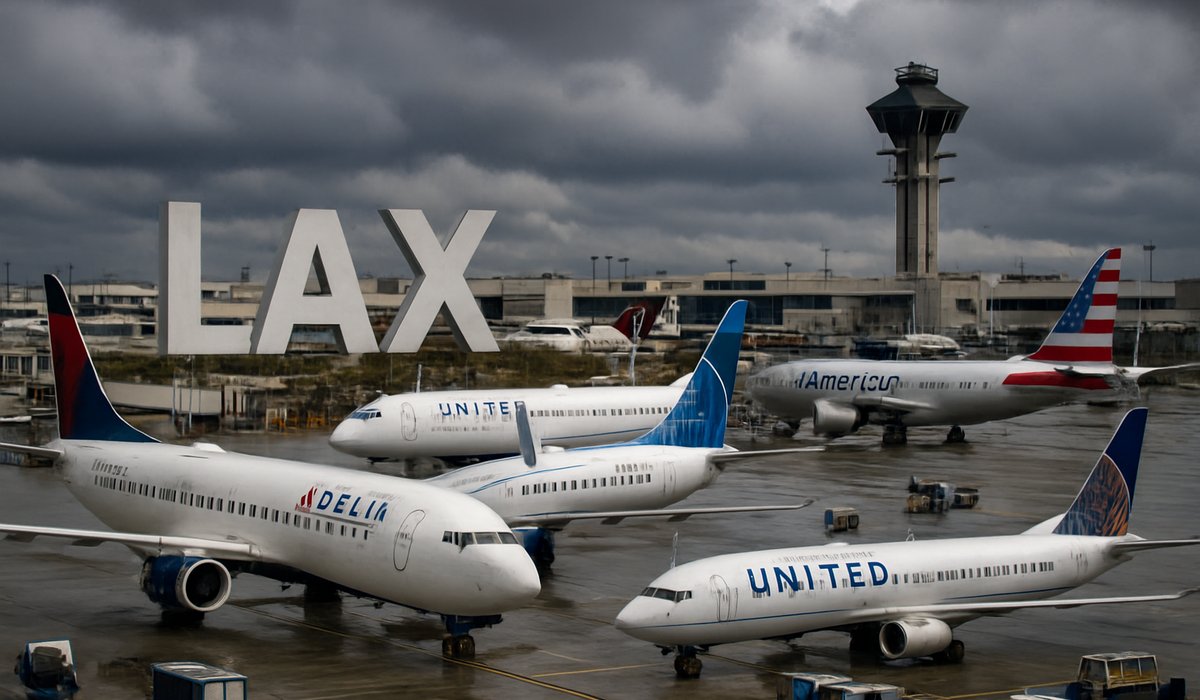
Image generated by AI
The West Coast Megahub Squeezed
Inflicting heavy operational pain on the primary aviation artery of the United States West Coast, Los Angeles International Airport (LAX) has sustained a rapidly compounding wave of flight delays and specific groundings, heavily paralyzing domestic and international flows. On a complex travel day in early April 2026, the massively popular Southern California mega-hub recorded a sudden, intense spasm of operational friction. While initial groundings hovered at a deceptively minor six massive wide-body and regional jets across Delta, United, and American Airlines, this microscopic spark instantly triggered a massive, mathematically devastating wave of rolling delays that completely saturated all major concourse operations.
The core vulnerability exposed by this specific failure is the highly constrained physical footprint of LAX. Unlike sprawling midwestern hubs, LAX is geographically locked by the Pacific Ocean and dense urban infrastructure. When the "Big Three" US legacy carriers—Delta, United, and American—all simultaneously absorb sudden runway flow constraints, the physical taxiways violently clog. Massive widebody aircraft arriving from completely clear weather zones like Tokyo or London are mathematically forced into extended holding patterns over the Pacific or brutal tarmac waits upon landing, simply because the departure gates are physically blocked by delayed outbound jets.
The Trans-Pacific and Domestic Ripple
The physics of this LAX disruption rapidly infected the entire routing grid.
Because LAX serves as the absolute vital transit point for Pacific-bound flights and transcontinental jumps to New York and Chicago, an anomaly here instantly traps thousands across multiple time zones. Aircraft completely scheduled to execute fast, high-frequency hops to San Francisco, Las Vegas, and Phoenix were forced into agonizing ground holds. Simultaneously, long-haul jumps to Honolulu, Kailua-Kona, Paris, and Seoul experienced severe turbulence in their scheduling matrices. Highly exhausted passengers were pushed into hours of immediate uncertainty as digital departure boards rapidly shifted timelines deeper into the night, stretching the airport's already strained Terminal 4, Terminal 7, and Tom Bradley International Terminal to their absolute breaking points.
The LAX Disruption Matrix (April 2026)
| Target Concept | The Specific Operational Trauma | The Strategic Implication |
|---|---|---|
| The Primary Airlines | Delta, United, American network congestion. | Absolute saturation of LAX's specialized individual terminal operations. |
| The Ripple Effect | Massive cascading delays destroying outbound hops. | Immediate schedule failure spreading to Las Vegas, SFO, and Chicago. |
| The Passenger Reality | Total gridlock of terminal seating and lounges. | Travelers mathematically forced into extreme physical concourse fatigue. |
What Guests Get
- Redefining 'The Mega-Hub Penalty' — realizing that utilizing incredibly complex, heavily crowded mega-hubs (like LAX) mathematically exposes you to extreme delay risk when physical gate space evaporates.
- The destruction of 'The Golden Triangle' — grasping that highly aggressive, lucrative West Coast commuter flights (LA to SF to Vegas) completely disintegrate during localized system gridlock.
- Micro-economic lounge exhaustion — understanding that an airport delay of this magnitude instantly completely overwhelms LAX's premium lounge network, entirely evaporating the value of business-class tickets and elite status.
What This Means for Travelers
If you are trapped in the LAX terminal gridlock: You must execute immediate, highly disciplined defensive logic. Because LAX operates as a massive U horseshoe of distinct, internally disconnected terminals, you cannot easily walk between American (Terminal 4), Delta (Terminal 3), and United (Terminal 7) to seek alternate airlines without exiting security and boarding incredibly congested shuttle buses. If your flight is severely delayed, completely abandon the massive rebooking line. Open your smartphone, strictly utilize your own credit card to purchase a brand-new flight out of nearby alternate airports like Hollywood Burbank (BUR), Long Beach (LGB), or John Wayne (SNA), and execute a rapid $50 rideshare bypass.
Surviving the Ground Halt: If your aircraft has actually landed at LAX but the captain announces the gate is occupied by a delayed plane, mentally prepare for an incredibly brutal experience. Federal law strictly mandates airlines must return passengers to a terminal gate if a tarmac delay crosses the three-hour mark for domestic flights. Prepare your personal resources (water, restroom needs) immediately upon hearing a gate-hold announcement at LAX.
FAQ: Decrypting the West Coast Airport Trap
Why does LAX suffer heavy delays compared to DFW or Denver? LAX possesses only four parallel runways packed into a tiny physical landmass, compared to DFW's seven sprawling runways or Denver's six massive ones. When weather or ATC flow restrictions hit Los Angeles, the mathematical threshold for physical saturation is breached significantly faster.
Are there better alternatives to flying into LAX? Absolutely. If your final destination is Orange County, Disneyland, or coastal LA, flying directly into John Wayne Airport (SNA) or Long Beach (LGB) bypasses the terror of LAX completely. If your destination is the San Fernando Valley or Hollywood, Burbank Airport (BUR) is infinitely superior.
Does airline elite status help during a massive delay? It provides exactly one distinct mathematical advantage: elite members are placed higher on the automated digital rebooking priority list for the incredibly few physical seats remaining on the next outbound jet. It does not, however, magically create a new airplane or clear the airspace constraint.
External Resources
- Los Angeles International Airport (LAX) Live Status
- FlightAware Live LAX Tracking Data
- Burbank Airport (BUR) Alternate Operations
Related Travel Guides
The LAX Alternative Strategy: Burbank, Long Beach, and John Wayne
The Master Guide to Surviving US Domestic Flight Cancellations
Decoding the 'Point-to-Point' Airline Risk: Flying Regional Carriers
Disclaimer
This article is for informational and educational purposes only. It does not constitute legal, financial, or professional advice. While we strive to provide accurate and up-to-date information, travel policies, regulations, and conditions change rapidly. Always verify information with official sources before making travel decisions. Nomad Lawyer makes no representations about the accuracy, reliability, completeness, or suitability of the information provided. Readers should consult qualified professionals for advice specific to their circumstances. The views expressed in this article are those of the author and do not necessarily reflect the views of Nomad Lawyer.
Raushan Kumar
Founder & Lead Developer
Full-stack developer with 11+ years of experience and a passionate traveller. Raushan built Nomad Lawyer from the ground up with a vision to create the best travel and law experience on the web.
Learn more about our team →