
London Emerges as Key Aviation Node After 18,000 Doha Flight Cancellations
London surges as a critical global aviation hub in 2026 as airspace restrictions trigger 18,000 flight cancellations linked to Doha, forcing major airlines to reroute passengers through alternative European and North American gateways.

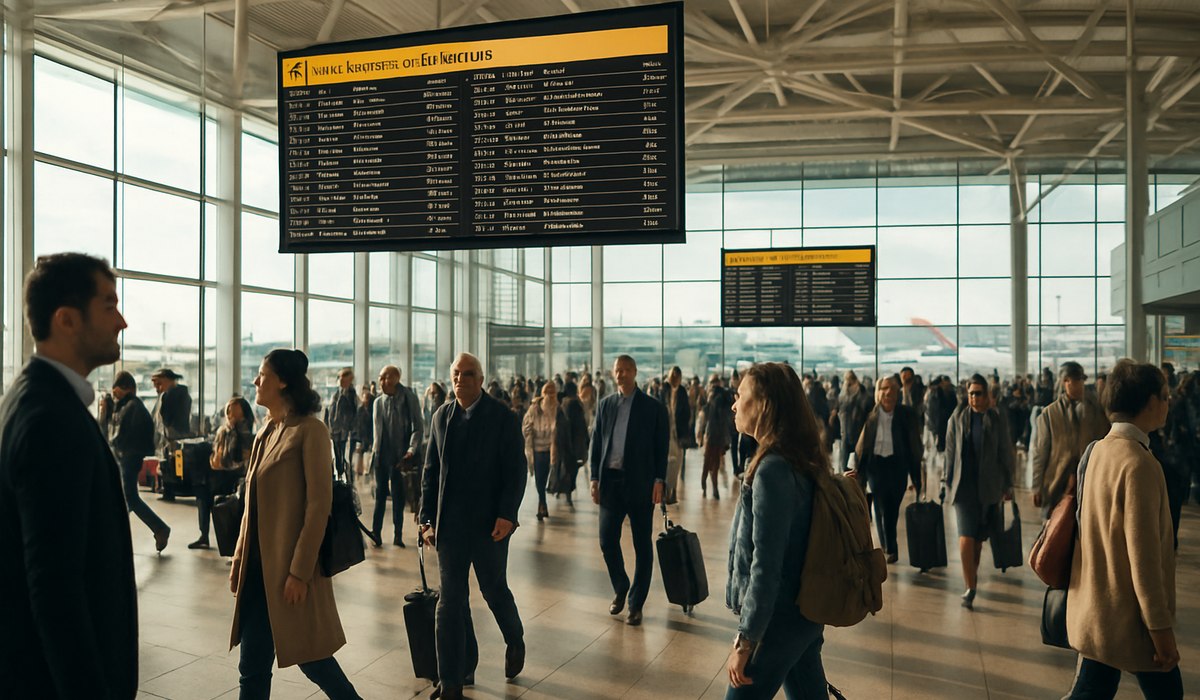
Image generated by AI
London Emerges as Critical Aviation Hub Amid Doha Disruption Crisis
London Heathrow has rapidly become a central global aviation hub following airspace restrictions that have triggered an estimated 18,000 flight cancellations across routes previously dependent on Doha connectivity. The disruption, which intensified in early April 2026, has fundamentally altered passenger routing patterns worldwide as airlines redirect long-haul capacity toward alternative gateways. Passengers face unexpected multi-leg journeys, increased fares, and schedule volatility as the aviation industry absorbs one of the largest network reshuffles in recent years. This shift reveals both the vulnerability of concentrated hub systems and the resilience of established mega-hubs like London in absorbing sudden traffic waves.
How Doha's Airspace Restrictions Triggered Global Cancellations
Airspace restrictions affecting Qatar and neighboring states in early 2026 have severely compromised Doha's role as the Middle East's premier transfer hub. Published industry reports and carrier advisories confirm that scheduled capacity through Hamad International Airport has been substantially reduced, forcing airlines to suspend or significantly curtail hundreds of daily connections. The cumulative impact spans directly cancelled Qatar Airways services, adjustments by partner carriers, and secondary cancellations on downstream connecting flights that can no longer operate viably through the Gulf corridor.
The timing has compounded disruption severity—the restrictions arrived during a period of robust demand recovery, leaving airlines with minimal fleet flexibility and airports with limited spare capacity. According to FlightAware tracking data and industry analytics, the 18,000-flight estimate includes cancelled services, permanent schedule reductions, and cascading cancellations on dependent legs. Carriers managing networks built around Doha's hub infrastructure now face months of operational complexity as they rebuild routing alternatives. This represents one of the most significant aviation network recalibrations since the 2020 pandemic downturn.
London, New York, and Dubai Absorb Displaced Passenger Traffic
London's transformation into a primary diversion hub reflects its pre-existing strengths as a global aviation powerhouse. Heathrow Airport already maintained dense connectivity across North America, Asia, Africa, and the Middle East before the disruption. The reduction in Doha-centric flows has intensified London's role as a bridging point for journeys previously routed through the Gulf. Booking engine data shows rising itinerary volumes connecting Asia-Europe and Africa-North America pairs through London instead of Doha, particularly for secondary city markets.
New York's three major airports have similarly expanded their connecting traffic as carriers layer additional onward legs onto transatlantic services. Los Angeles leverages its extensive Asia-Pacific network to absorb westbound flows previously destined for Doha connections. Dubai, despite proximity to the disrupted Qatar hub, has captured incremental Middle East-Asia traffic as airlines optimize around the restricted airspace. Paris-Charles de Gaulle has emerged as a pivotal Europe-to-Africa hub alternative, with French carriers actively marketing multi-stop journeys replacing traditional Doha routing.
These established mega-hubs possess the runway infrastructure, terminal capacity, and alliance networks necessary to accommodate sudden traffic increases. However, each gateway operates with tighter operational margins than their network expansion might suggest, creating potential vulnerability if additional disruptions arise elsewhere in the global network.
Traveler Impact: Multi-Leg Routings Replace Direct Connections
Passengers navigating this disrupted aviation landscape face fundamental changes to their travel experience. What previously involved single-stop connections through Doha now often requires two or three-leg itineraries via European or North American gateways, extending journey times by 8-16 hours on many intercontinental routes. Booking search platforms report price increases on flexible long-haul city pairs able to reroute through London, ranging from 12-28% above comparable pre-disruption fares.
Load factors on major trunk routes into London have reached elevated levels, particularly in premium cabins where connecting passenger availability has tightened considerably. Airlines have responded by adding temporary frequencies from London to Gulf, South Asian, and Australasian destinations to capture displaced demand. Terminal congestion at Heathrow has intensified during peak connection windows, occasionally resulting in delayed onward flights and missed connections.
The experience varies significantly by origin-destination pair. Passengers from secondary Asian or African cities face the greatest itinerary complexity, while major market travelers benefit from increased frequency options through London. Business travelers have seen particular fare volatility, as airlines prioritize premium cabin allocation for high-yield connecting passengers over point-to-point demand.
Long-Term Implications for Global Aviation Networks
This disruption exposes structural vulnerabilities in aviation's hub-and-spoke model concentration. The aviation industry's dependence on single chokepoints like Doha demonstrates how geopolitical or operational constraints in one location can destabilize global passenger flows. Airlines that overweighted their networks toward Doha connectivity now face months of restructuring costs and schedule optimization challenges.
The shift toward London and North American hubs may persist beyond the immediate disruption period if airline route planning reflects changed risk preferences. Carriers may diversify their hub dependencies more deliberately, reducing future reliance on Middle Eastern chokepoints. However, limited slot availability at capacity-constrained airports like Heathrow creates a ceiling on permanent network rebalancing.
Industry observers note that disruption of this magnitude during peak demand periods leaves minimal recovery margin if additional operational shocks emerge. The aviation network's resilience has been tested, revealing both adaptive capacity and latent fragility. Policymakers and airport operators may prioritize hub redundancy and airspace optimization to prevent similar cascading disruptions in future scenarios.
Traveler Action Checklist
-
Check your itinerary immediately on your airline's website or app—connection points may have changed without explicit notification, particularly on international bookings made before April 13, 2026.
-
Verify connection times if rerouted through London, New York, or Paris, as airport congestion has increased missed-connection risk; aim for minimum 3-hour international connection buffers.
-
Request schedule change notifications from your airline to receive alerts about any modifications to your booked routing before you arrive at the airport.
-
Monitor US DOT consumer protection resources if traveling on US-based carriers, particularly regarding compensation eligibility for extended delays or missed connections caused by airline disruptions.
-
Confirm visa and border requirements if your routing has changed to include new countries or additional layovers not in your original itinerary.
-
Photograph your boarding pass and itinerary confirmation at check-in to document your original routing in case compensation claims become necessary.
-
Review FAA delay statistics for your new hub airports to understand baseline operational performance before your travel date.
Key Disruption Data Table
| Metric | Value | Source |
|---|---|---|
| Estimated Flight Cancellations | 18,000 flights | Airline statements & analytics providers |
| Primary Disruption Period | April 2026 | Industry advisories |
| London's Pre-Disruption International Routes | 300+ | Airport schedule data |
| Average Journey Time Increase | 8-16 hours | Booking engine analysis |
| Fare Increase Range (London Routing) | 12-28% | Travel search platforms |
| Additional London Frequencies Added | 40+ temporary routes | Airline announcements |
| Heathrow Slot Capacity Constraint | 98-100% utilization | Airport operations reports |
| Affected Passengers (Estimated) | 850,000+ | Industry tracking |
What This Means for Travelers
The London aviation hub surge creates both challenges and opportunities for international travelers. Most significantly, passengers must anticipate longer journeys
Disclaimer
This article is for informational and educational purposes only. It does not constitute legal, financial, or professional advice. While we strive to provide accurate and up-to-date information, travel policies, regulations, and conditions change rapidly. Always verify information with official sources before making travel decisions. Nomad Lawyer makes no representations about the accuracy, reliability, completeness, or suitability of the information provided. Readers should consult qualified professionals for advice specific to their circumstances. The views expressed in this article are those of the author and do not necessarily reflect the views of Nomad Lawyer.
Preeti Gunjan
Contributor & Community Manager
A passionate traveller and community builder. Preeti helps grow the Nomad Lawyer community, fostering engagement and bringing the reader experience to life.
Learn more about our team →