
LAX Flight Cancellations: KLM United JetBlue American Airlines Cancel 4 Flights 50 Delays July 2026
Four major airlines cancelled flights at Los Angeles International Airport with 50 delays disrupting travel across the US, Europe, Middle East, and Asia on July 5, 2026.

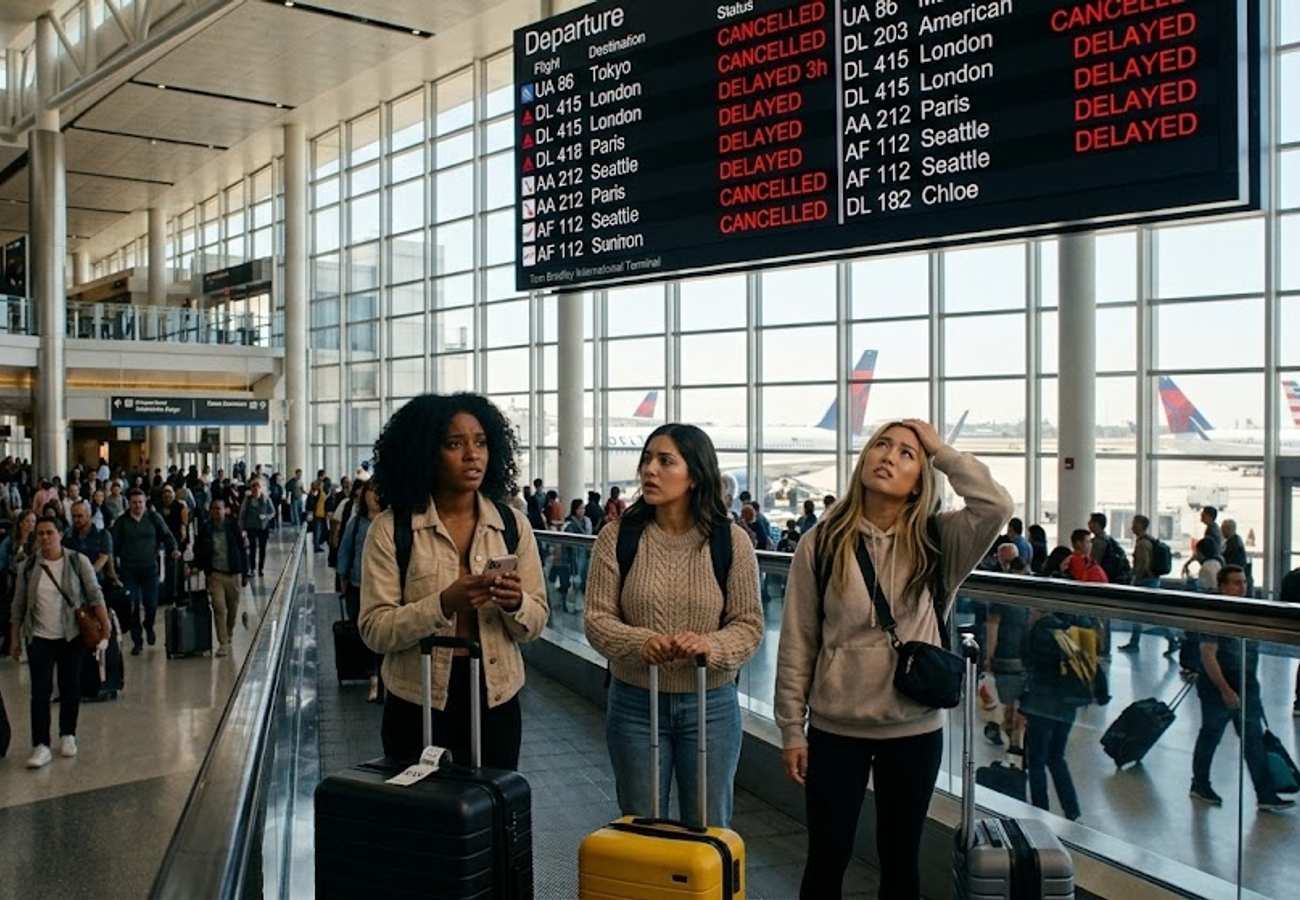
Image generated by AI
Operational Breakdown at LAX: Four Cancellations, Fifty Delays
Los Angeles International Airport (LAX) experienced significant operational disruption on July 5, 2026, as four major carriers cancelled flights and logged dozens of delays across domestic and international networks. KLM Royal Dutch Airlines, United Airlines, JetBlue Airways, and American Airlines each scrubbed one flight, while collectively recording 50 delayed departures. The cascading effect impacted hundreds of passengers traveling to destinations spanning the US, Canada, France, Switzerland, the UAE, and beyond.
| Airline | Cancelled Flights | Delayed Flights |
|---|---|---|
| KLM | 1 | 0 |
| United Airlines | 1 | 20 |
| JetBlue Airways | 1 | 6 |
| American Airlines | 1 | 24 |
| Total | 4 | 50 |
Data source: FlightAware
Network Impact: A Broad Geographic Footprint
The disruption rippled across an extensive route network touching five continents. Affected domestic destinations included New York City, Newark, Atlanta, Boston, Baltimore, Charlotte, Denver, Dallas, Detroit, Fort Lauderdale, Jackson, Las Vegas, Orlando, Chicago, Miami, Milwaukee, New Orleans, Phoenix, Louisville, San Francisco, San Jose, St. Louis, Austin, El Paso, Washington D.C., Oakland, Omaha, Philadelphia, Prescott, Salt Lake City, and Sacramento.
International destinations impacted included Toronto, Amsterdam, Paris, Rome, Zurich, Istanbul, London, Dubai, Guadalajara, Mexico City, Puerto Vallarta, Los Cabos, Guanacaste, Nadi, Auckland, Honolulu, Kailua-Kona, Lihue, Kahului, Taipei, Tokyo, Hong Kong, Brisbane, Guangzhou, Shanghai, Beijing, and Vancouver. The sheer breadth of affected cities demonstrates how operational disruptions at a single mega-hub can cascade across global aviation networks within hours.
American Airlines Bears the Heaviest Delay Burden
Among the four carriers, American Airlines recorded the highest number of delays at 24, alongside its single cancellation. The carrier's extensive domestic network from LAX meant that even modest schedule adjustments affected a large number of departures across its system.
United Airlines followed with 20 delayed flights and one cancellation, reflecting its substantial LAX operation linking passengers to hubs including Newark, Denver, San Francisco, and international gateways serving Tokyo, Hong Kong, Shanghai, Brisbane, and Auckland. The volume of United delays suggests broader operational challenges beyond isolated incidents.
JetBlue Airways reported one cancellation and six delays, primarily affecting transcontinental and West Coast services to New York, Boston, and Fort Lauderdale. While the carrier's LAX operation is smaller than American or United, the disruption still affected hundreds of passengers on critical domestic corridors.
KLM Royal Dutch Airlines cancelled one flight on its Los Angeles-Amsterdam route, though it reported no additional delays. The single cancellation nonetheless disrupted connecting traffic through Amsterdam Airport Schiphol for passengers heading to destinations across Europe and beyond.
Strategic Business Impact: Capacity, Competition, and Passenger Flow
The July 5 disruption underscores a persistent vulnerability at LAX, one of the world's busiest international aviation gateways. When multiple carriers experience simultaneous operational setbacks — even at modest scale — the compounding effect on passenger flow, gate availability, and connecting traffic creates disproportionate disruption.
For American Airlines, the 24 delays represent a significant operational cost. Each delayed departure triggers downstream effects: crew scheduling disruptions, gate occupancy extensions, increased fuel burn from holding patterns, and potential passenger compensation obligations. At a hub where American competes directly with United, Delta, and Alaska Airlines for domestic market share, reliability metrics directly influence corporate contract renewals and leisure booking decisions.
United's 20 delays similarly strain the carrier's West Coast operation. With LAX serving as a critical connecting point for transpacific traffic, delays at this gateway reverberate across the entire Pacific network. Passengers missing connections to Tokyo, Hong Kong, or Shanghai face limited rebooking options, particularly during peak summer travel when load factors exceed 85 percent on most transpacific routes.
The limited number of cancellations — four total — suggests airlines prioritized delay management over outright flight removals. This strategy preserves revenue but extends passenger wait times and increases the risk of missed connections. The approach reflects current industry operational philosophy: maintaining schedule integrity even at the cost of on-time performance, particularly during peak summer travel periods when rebooking options remain constrained by high load factors across competing carriers.
Passenger Rights and Recourse Options
Passengers affected by the LAX disruptions should understand their entitlements under applicable regulations. For European carriers like KLM operating flights from the US, EU Regulation 261/2004 establishes compensation frameworks for cancellations and significant delays. Passengers on cancelled KLM flights from LAX to Amsterdam may be entitled to compensation of up to €600, depending on notice period and rebooking arrangements.
For US carriers — United, JetBlue, and American Airlines — the Department of Transportation requires airlines to provide refunds for cancelled flights when passengers choose not to accept alternative arrangements. However, mandatory compensation for delays does not currently exist under US federal law. Individual airline contracts of carriage outline specific obligations regarding meal vouchers, hotel accommodations, and rebooking priorities during irregular operations.
Operational Response and Airport Coordination
LAX faced mounting pressure across departure and arrival boards as airlines adjusted schedules and managed passenger flow throughout the day. The airport's status displays reflected accumulating delays across multiple terminals, creating longer wait times and increased uncertainty for travelers.
The geographic spread of affected terminals — with American, United, JetBlue, and KLM operating from different concourses — meant passenger impact was distributed rather than concentrated. This reduced the risk of terminal-level congestion but complicated unified passenger communication and support efforts.
Broader Industry Context: Summer 2026 Operational Strain
The LAX disruption highlights how even limited cancellations can create widespread travel challenges when accompanied by numerous delays. With four carriers collectively cancelling four flights and recording 50 delays, hundreds of passengers faced schedule changes, extended waiting times, and disrupted connections throughout the day.
As one of the world's busiest international aviation hubs, LAX remains highly sensitive to operational interruptions affecting both domestic and overseas routes. The airport connects North America with Europe, the Middle East, Asia, and the Pacific, making any disruption a multi-region event with cascading consequences for global travel networks.
Real-time data from FlightAware confirmed that while the absolute number of cancellations remained low, the delay volume significantly degraded the passenger experience. Airlines actively modified schedules and itineraries to maintain safety standards, prioritizing operational integrity over on-time performance metrics.
Passenger Guidance: Navigating Disruptions
Travelers through LAX should maintain active flight status monitoring through airline apps and airport information systems. Passengers holding bookings on any of the four affected carriers should verify their flight status before departing for the airport, as schedule adjustments continued throughout the operational recovery period.
For those already at the airport, approaching customer service desks directly often yields faster rebooking than phone-based support during peak disruption periods. Travelers with connecting flights should proactively request rebooking on alternative routings, as airlines typically prioritize passengers who self-advocate during irregular operations.
Maintaining flexibility in travel plans — including considering alternative departure days, nearby airports, or alternative carriers — remains the most effective strategy for navigating summer 2026 operational challenges. Relying on real-time updates, reviewing airline rebooking policies, and building buffer time into itineraries all reduce the stress of unexpected schedule changes.
Even four cancellations at a mega-hub like LAX can unravel travel plans across five continents — plan accordingly.
Related Travel Guides
Disclaimer
This article is for informational and educational purposes only. It does not constitute legal, financial, or professional advice. While we strive to provide accurate and up-to-date information, travel policies, regulations, and conditions change rapidly. Always verify information with official sources before making travel decisions. Nomad Lawyer makes no representations about the accuracy, reliability, completeness, or suitability of the information provided. Readers should consult qualified professionals for advice specific to their circumstances. The views expressed in this article are those of the author and do not necessarily reflect the views of Nomad Lawyer.
Raushan Kumar
Founder & Lead Developer
Full-stack developer with 11+ years of experience and a passionate traveller. Raushan built Nomad Lawyer from the ground up with a vision to create the best travel and law experience on the web.
Learn more about our team →