
LATAM Airlines Grounds 9 Flights at São Paulo–Guarulhos Airport: 39 Delays Disrupt Brazil Routes July 2026
LATAM Brasil cancelled nine flights and logged 39 delays at São Paulo–Guarulhos International Airport, disrupting domestic and international routes across Brazil, South America, and beyond.

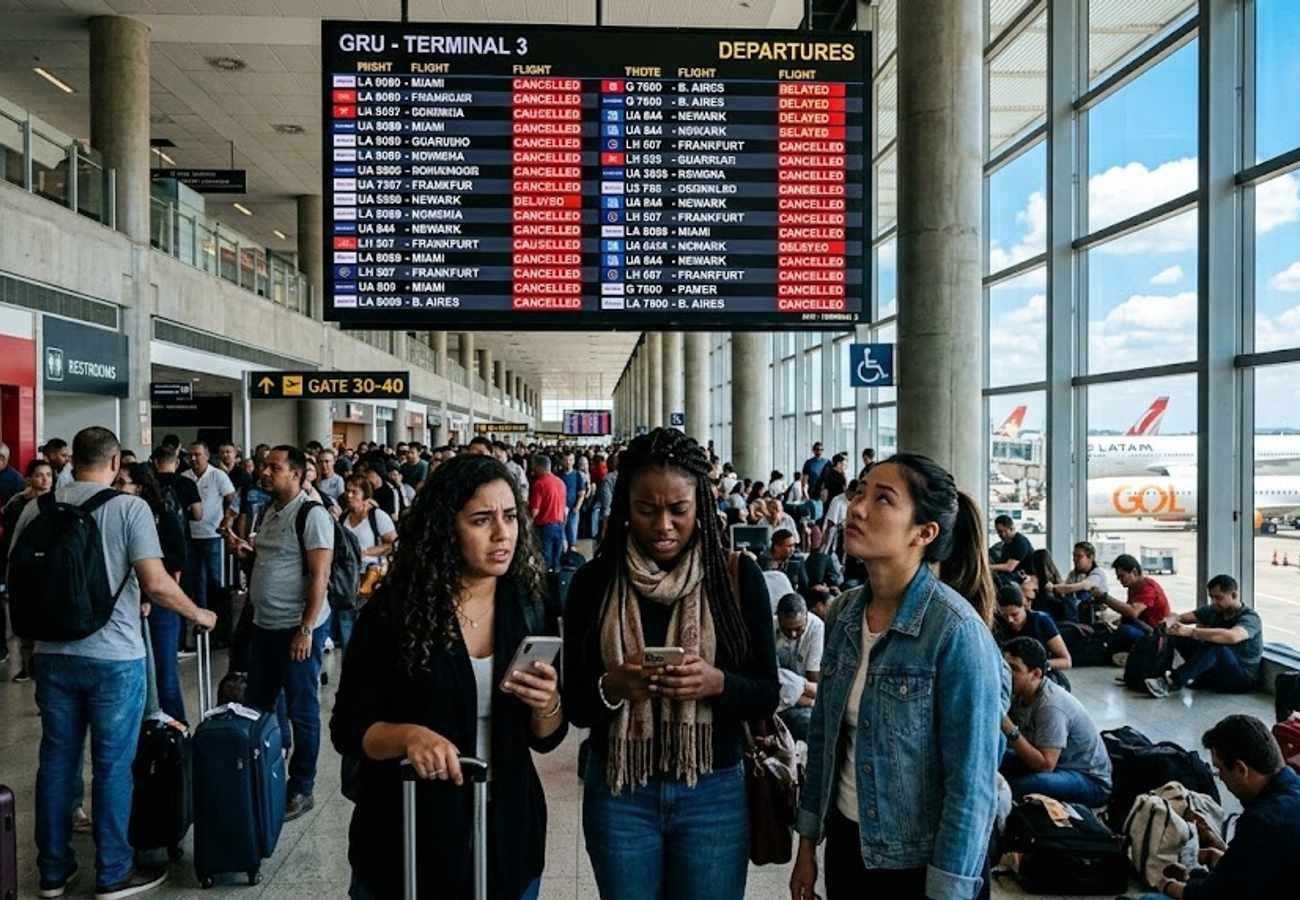
Image generated by AI
LATAM Brasil grounded nine flights at São Paulo–Guarulhos International Airport (GRU) on July 5, 2026, logging an additional 39 delays across its domestic and international network. The disruptions rippled through major Brazilian cities and long-haul gateways, leaving hundreds of travellers scrambling for rebookings and alternative connections. Data sourced from FlightAware confirms that GRU bore the heaviest operational impact across LATAM's South American network during the reporting period.
The cancellations primarily targeted domestic services, hitting routes to Joinville, Salvador, Florianópolis, São Luís, and Maceió. International operations also took a hit, with services to Mendoza, Argentina, among those scrubbed from the schedule. Isolated cancellations surfaced at outlying stations including Joinville, São Luís, Salvador, and Florianópolis, reflecting the cascading effect of disrupted aircraft rotations.
Operational Disruption Summary at GRU
| Airport | Cancelled Flights | Delayed Flights | Airline |
|---|---|---|---|
| São Paulo–Guarulhos International Airport (GRU) | 9 | 39 | LATAM Brasil |
Affected Domestic Routes — Cancellations
| Route Origin | Destination | Status |
|---|---|---|
| GRU | Joinville | Cancelled |
| GRU | Salvador | Cancelled |
| GRU | Florianópolis | Cancelled |
| GRU | São Luís | Cancelled |
| GRU | Maceió | Cancelled |
Affected International Routes — Cancellations
| Route Origin | Destination | Status |
|---|---|---|
| GRU | Mendoza | Cancelled |
Delayed Routes — Network-Wide Impact
| Airport / City | Region | Delay Status |
|---|---|---|
| Rio de Janeiro | Brazil — Domestic | Delayed |
| Porto Alegre | Brazil — Domestic | Delayed |
| Fortaleza | Brazil — Domestic | Delayed |
| Curitiba | Brazil — Domestic | Delayed |
| Recife | Brazil — Domestic | Delayed |
| Buenos Aires | Argentina — International | Delayed |
| Santiago | Chile — International | Delayed |
| Lima | Peru — International | Delayed |
| Bogotá | Colombia — International | Delayed |
| Madrid | Spain — International | Delayed |
| Lisbon | Portugal — International | Delayed |
| Toronto | Canada — International | Delayed |
| Dubai | UAE — International | Delayed |
| Doha | Qatar — International | Delayed |
Strategic Business Impact
GRU functions as the primary operational nerve centre for LATAM Airlines in Brazil. When nine flights go dark at a hub of this magnitude, the financial and logistical consequences compound rapidly. Each cancelled departure strands aircraft out of position, forcing schedule adjustments that propagate through subsequent rotations well beyond the initial disruption window.
The 39 recorded delays tell a broader story. LATAM operates dense domestic frequencies from GRU, and even minor schedule slippage cascades into missed connections, crew duty-time violations, and gate occupancy conflicts. Passengers booked on onward international segments — connecting through GRU to Madrid, Lisbon, Toronto, Dubai, and Doha — faced extended layovers or outright missed departures.
For competing carriers operating at GRU, including GOL Linhas Aéreas and Azul Brazilian Airlines, the disruption presents a short-term opportunity to absorb rebooked passengers. However, it also signals a shared vulnerability: Brazil's concentrated hub architecture means that any single-carrier operational failure at GRU stresses the entire national aviation ecosystem.
Regional Connectivity Fallout
The cancellation of services to Joinville and Florianópolis cuts critical business and leisure links between São Paulo and southern Brazil. These routes typically carry high-yield corporate traffic, and even a single day's disruption translates into measurable revenue loss for the airline and local economies dependent on air connectivity.
The Mendoza cancellation disrupts a niche but strategically important international corridor. Argentine wine tourism and cross-border business travel rely on consistent LATAM service between São Paulo and Mendoza, and the gap forces passengers onto competing carriers or circuitous routing through Buenos Aires.
Delays extending to Buenos Aires, Santiago, Lima, and Bogotá demonstrate how GRU disruptions infect LATAM's broader South American network. These cities serve as secondary hubs and gateway markets, meaning that a scheduling failure in São Paulo degrades operational reliability across multiple countries within hours.
Passenger Guidance and Rights
Travellers affected by the cancellations should monitor LATAM Airlines' official channels for rebooking confirmations and schedule adjustments. The airline's mobile app and website provide real-time flight status updates, and passengers at GRU can visit LATAM service desks for in-person assistance.
Under Brazilian National Civil Aviation Agency (ANAC) regulations, passengers facing cancellations within the airline's control are entitled to rebooking on the next available flight, full refunds, or accommodation and meal assistance if the disruption extends overnight. Travellers should document all communications and retain boarding passes and booking confirmations for potential compensation claims.
For those connecting through GRU to long-haul international destinations, checking alternative routings through other Brazilian gateways — such as Rio de Janeiro–Galeão International Airport (GIG) — may offer faster rebooking options. LATAM's interline agreements with partner carriers could also provide re-accommodation pathways on competing airlines.
Operational Context
The GRU airport authority maintained continuous operations throughout the disruption, meaning that the cancellations and delays originated within LATAM's operational framework rather than from airport-side infrastructure failures. This distinction matters for liability and compensation purposes, as airline-initiated cancellations typically carry stronger passenger entitlements than weather or air traffic control disruptions.
FlightAware data confirms that the disruption pattern — concentrated cancellations at GRU with scattered downstream effects — aligns with aircraft rotation failures rather than systemic weather events. When an airline pulls multiple aircraft from service simultaneously, the scheduling algorithm struggles to reassign tail numbers across subsequent flights, generating the exact delay cascade observed in this incident.
Broader Industry Implications
This disruption underscores a structural reality of Latin American aviation: hub concentration at GRU creates operational efficiency under normal conditions but amplifies risk during irregular operations. LATAM's network design funnels enormous passenger volume through São Paulo, and when the hub falters, the blast radius extends across multiple countries and continents.
For airport operators and aviation regulators, the incident reinforces the case for distributed resilience — ensuring that alternative routing options, interline agreements, and surge capacity exist to absorb passengers when a primary hub experiences simultaneous multiple cancellations. Brazil's aviation market has grown significantly, but its operational fragility during hub-level disruptions remains a competitive vulnerability.
Airlines across South America should treat this event as a stress-test reminder. The ability to rebook passengers rapidly, communicate proactively, and maintain schedule integrity during partial operational failures differentiates market leaders from laggards in an industry where passenger loyalty hinges increasingly on recovery performance rather than on-time statistics alone.
When nine flights fall at a hub that moves millions, the silence at the gate speaks louder than any press release.
Related Travel Guides
Disclaimer
This article is for informational and educational purposes only. It does not constitute legal, financial, or professional advice. While we strive to provide accurate and up-to-date information, travel policies, regulations, and conditions change rapidly. Always verify information with official sources before making travel decisions. Nomad Lawyer makes no representations about the accuracy, reliability, completeness, or suitability of the information provided. Readers should consult qualified professionals for advice specific to their circumstances. The views expressed in this article are those of the author and do not necessarily reflect the views of Nomad Lawyer.
Kunal K Choudhary
Co-Founder & Contributor
A passionate traveller and tech enthusiast. Kunal contributes to the vision and growth of Nomad Lawyer, bringing fresh perspectives and driving the community forward.
Learn more about our team →