
Severe Travel Chaos Isolates Kuujjuaq as Air Inuit Executes 14 Flight Disruptions, Severing Critical Routes to Montreal, Toronto, and Vancouver: Latest Airline News
Critical Arctic transit lifelines have collapsed as Air Inuit records 9 delays and 5 outright cancellations, triggering severe travel chaos and isolating the remote northern Quebec community of Kuujjuaq.

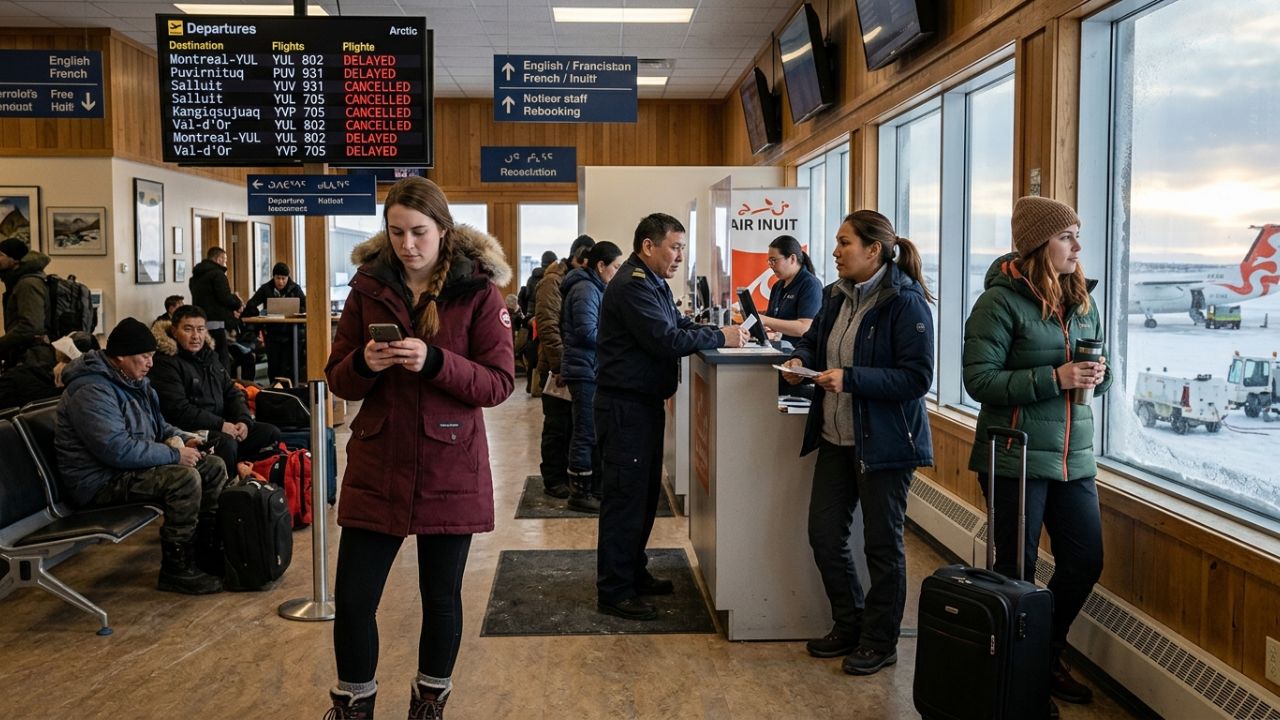
Image generated by AI
In a highly localized but devastating operational breakdown that has completely severed critical Arctic transit lifelines, extreme environmental constraints and irregular scheduling performance have triggered a wave of severe travel chaos across the remote Nunavik region of northern Quebec. According to official flight logs for the current reporting period, Kuujjuaq Airport—a strategically vital aviation node connecting isolated Indigenous communities to southern Canada—has suffered a sudden and highly disruptive wave of 9 flight delays and 5 outright cancellations. Because the entire regional network relies almost entirely on limited carriers, this disruption pattern indicates a severe schedule collapse executed predominantly by Air Inuit, with cascading effects threatening connecting networks operated by Air Canada, WestJet, and Delta Air Lines. As regional airlines struggle to maintain their rotations, massive airport disruptions are currently rippling through the network, entirely cutting off Kuujjuaq's essential connectivity to major hubs like Montreal, Toronto, and Vancouver. This total disruption of the northern Canadian aviation grid represents the premier headline in today's breaking airline news and critical regional aviation updates.
By introducing direct passenger coordination and dynamic scheduling backups, the regional aviation hubs target growing passenger demand across vital commerce sectors. The choice to coordinate flight departures in phases helps to manage gate capacity, supporting the country's broader regional transportation network.
Context: The Collapse of the Nunavik Transit Lifeline
For the thousands of residents and travelers relying on Kuujjuaq Airport to seamlessly connect them to major Canadian hubs and international commercial centers, the current operational reality has degenerated into an absolute logistical nightmare.
The latest data from the northern Quebec aviation network highlights precisely how rapidly environmental constraints and limited aircraft availability can destabilize a tightly scheduled grid. Kuujjuaq Airport serves as the undisputed backbone for passenger and cargo movement in Nunavik. When an airline like Air Inuit is forced to execute 14 combined flight disruptions, the consequences are severe. Because alternative surface transportation options (like roads or rail) are entirely non-existent in this remote Arctic geography, a grounded aircraft immediately traps passengers. The concentration of these disruptions has devastated the highly efficient hub-and-spoke models required to connect passengers onward to Toronto, Montreal, or Vancouver. Travelers utilizing Kuujjuaq as a strategic launchpad to reach major North American hubs are currently experiencing severe knock-on effects, completely missing onward connections as their critical feeder flights are systematically grounded.
To view live flight schedules, real-time terminal maps, or specific delay protocols for the Nunavik network, travelers must consult the official Kuujjuaq Airport directories. For direct booking access, specific baggage rules, and rebooking options, passengers should check the official Air Inuit portal. To explore live flight tracking and monitor the exact severity of the airspace closures, passengers can consult the official FlightAware tracking service.
Section-Wise Breakdown of the Kuujjuaq Meltdown
The Primary Operator: Air Inuit's Schedule Collapse
The sheer volume of the disruption at Kuujjuaq fell almost entirely on the primary regional operator. Air Inuit accounted for the vast majority of the logistical breakdown, executing 5 complete cancellations alongside 8 rolling delays. This irregular scheduling performance indicates severe strain on the carrier's aircraft rotation capabilities. Because Air Inuit functions as the central artery for Nunavik mobility, its inability to maintain timetables directly paralyzed the airport's outbound capacity.
The Ripple Effect: Montreal, Toronto, and Vancouver
While the initial disruptions occurred within the Arctic circle, the resulting travel chaos immediately bled into the broader Canadian airspace. Passengers trapped in Kuujjuaq inherently possess onward itineraries that rely on legacy carriers operating out of the south. When Air Inuit fails to deliver passengers to Montreal, cascading missed connections instantly impact onward flights booked with Air Canada, WestJet, and Delta Air Lines bound for massive international hubs like Toronto and Vancouver.
Unidentified Disruption Variables
Adding to the complexity of the Kuujjuaq breakdown, aviation tracking data explicitly linked a small portion of the disruption activity to an "Unknown Owner" category, which registered exactly 1 flight delay. This highlights the chaotic, multi-layered nature of Arctic aviation, where charter flights, medical transports, and specialized cargo operators frequently share the exact same limited runway infrastructure.
Technical Roster: Kuujjuaq Disruption Matrix
To ensure absolute factual accuracy regarding the specific airlines driving this massive northern aviation failure, the following table details the core operational metrics generated by the Kuujjuaq Airport breakdown:
| Airline / Operating Carrier | Operational Disruption Metric | Regional Travel Market Impact |
|---|---|---|
| Kuujjuaq Airport (Total) | 9 Delays & 5 Cancellations | Severe disruption completely isolates the remote Nunavik community |
| Air Inuit | 5 Cancellations & 8 Delays | Primary carrier suffers extreme irregular scheduling performance |
| Unknown Owner / Charter | 1 Flight Delay | Unidentified aircraft compounds the regional logistical gridlock |
| Air Canada, WestJet, Delta | Severe Missed Connections | Passengers trapped in Kuujjuaq miss major onward flights from Montreal |
| Montreal, Toronto, Vancouver | Destination Cascades | Southern hubs lose expected passenger feed from the Arctic corridor |
Passenger Impact: Stranded in the Arctic Zone
For the everyday passengers currently trapped inside Kuujjuaq Airport, the logistical reality is rapidly deteriorating, and the stakes are significantly higher than a standard commercial delay.
Because Kuujjuaq is not merely a leisure destination, the immediate impact is felt across essential socio-economic lifelines. Delays and cancellations frequently result in missed, highly critical medical appointments at specialized hospitals in Montreal or Quebec City. Furthermore, the disruption of cargo shipments means that essential goods and seasonal supplies fail to reach the community on time. For passengers stranded in transit, the emotional stress is compounded by the severe lack of available overnight accommodation in remote Arctic towns. Travelers who miss their connections to Air Canada or WestJet flights down south are suddenly forced to re-engineer complex, multi-ticket itineraries from an airport with highly limited digital bandwidth and customer service resources.
Industry Analysis: Vulnerability to Arctic Constraints
Aviation industry analysts view the 14-flight disruption wave at Kuujjuaq as a stark demonstration of the inherent vulnerabilities defining remote Canadian transport networks.
Analysts note that while the absolute figures (9 delays, 5 cancellations) appear moderate compared to a massive meltdown at Toronto Pearson, the proportional impact is utterly devastating. Government transportation frameworks in Canada explicitly emphasize the vulnerability of northern airports to harsh, rapidly changing weather patterns and strict aircraft rotation limitations. When a single Air Inuit aircraft is grounded due to a mechanical fault or a sudden Arctic whiteout, there are zero backup aircraft available to absorb the passenger load. Analysts warn that this event explicitly demonstrates that travelers booking complex itineraries out of highly sensitive hubs like Kuujjuaq assume massive, inherent risk, as the system completely lacks the redundancy required to recover swiftly from operational setbacks.
Actionable Advice for Surviving Nunavik Disruptions
If you are a traveler relying on Air Inuit through Kuujjuaq during this massive disruption wave, execute this extreme survival checklist immediately:
- Maintain Absolute Flexibility: Air travelers operating in northern Quebec must accept that strict adherence to timetables is often superseded by absolute safety requirements in challenging environmental conditions. Expect delays as the standard operational baseline.
- Pad Your Southern Connections: If you are flying Air Inuit to Montreal to catch an onward flight with WestJet or Delta, you must buffer your connection by at least 24 hours. Never book a tight, two-hour layover when arriving from the Arctic.
- Monitor Freight and Cargo Priority: Understand that in extreme situations, regional carriers may be forced to prioritize emergency medical evacuations or critical supply deliveries over standard passenger transit.
- Secure Comprehensive Insurance: Because weather volatility drives many of these cancellations, secure premium travel insurance that explicitly covers remote, weather-induced delays and reimburses the immense costs of emergency Arctic accommodation.
FAQ: Kuujjuaq Airport Flight Disruptions 2026
How severe is the current operational breakdown at Kuujjuaq Airport?
Kuujjuaq Airport has suffered a devastating loss of connectivity, officially recording 9 flight delays and 5 outright cancellations across a single operational cycle.
Which specific airline is most affected by this travel chaos?
The disruption wave almost exclusively impacted Air Inuit, which suffered 5 cancellations and 8 delays, alongside 1 delay attributed to an "Unknown Owner."
How do these delays impact broader travel to Montreal, Toronto, and Vancouver?
Passengers stranded in Kuujjuaq are missing critical onward connections operated by Air Canada, WestJet, and Delta Air Lines out of southern hubs like Montreal, triggering severe itinerary cascades to Toronto and Vancouver.
The Breaking Point of the Northern Corridor
The wave of 14 flight disruptions ravaging Kuujjuaq Airport proves definitively that the Nunavik aviation infrastructure operates under immense, constant environmental pressure in 2026. By entirely devastating the highly scheduled operations of Air Inuit, this operational meltdown has ruthlessly exposed the lack of transport redundancy across the remote north. As airlines desperately attempt to reposition their limited fleets and clear the backlog of stranded Arctic passengers and essential cargo, travelers must accept a brutal reality: navigating Kuujjuaq requires extreme itinerary flexibility, aggressive contingency planning, and the absolute understanding that remote aviation is always at the absolute mercy of the elements.
Key Takeaways
- Critical Arctic Breakdown: Kuujjuaq Airport has been paralyzed by severe schedule instability, recording 9 flight delays and 5 outright cancellations.
- Air Inuit Operations Crippled: The vast majority of the disruption fell on the primary regional carrier, Air Inuit, suffering 8 delays and 5 cancellations.
- Southern Hub Cascades: Stranded Arctic passengers are missing vital onward connections with Air Canada, WestJet, and Delta bound for Montreal, Toronto, and Vancouver.
- Socio-Economic Threat: The cancellations severely impact medical evacuations, the delivery of essential goods, and the stability of seasonal supply chains.
- Lack of Transport Redundancy: The disruptions highlight the extreme vulnerability of northern communities, where aviation is the sole method of inter-regional mobility.
Related Travel Guides
Severe Travel Chaos Paralyzes Australia Across Major Airlines
Severe Travel Chaos Paralyzes Kangirsuk Across Air Inuit Network
Kuujjuaq Airport Flight Disruptions and Arctic Connection Strategies on Reddit
Disclaimer
This article is for informational and educational purposes only. It does not constitute legal, financial, or professional advice. While we strive to provide accurate and up-to-date information, travel policies, regulations, and conditions change rapidly. Always verify information with official sources before making travel decisions. Nomad Lawyer makes no representations about the accuracy, reliability, completeness, or suitability of the information provided. Readers should consult qualified professionals for advice specific to their circumstances. The views expressed in this article are those of the author and do not necessarily reflect the views of Nomad Lawyer.
Kunal K Choudhary
Co-Founder & Contributor
A passionate traveller and tech enthusiast. Kunal contributes to the vision and growth of Nomad Lawyer, bringing fresh perspectives and driving the community forward.
Learn more about our team →