
KSRTC Government Bus Trapped in Uncovered Cable Trench Near Sheni Strands Karnataka Commuters
A Karnataka State Road Transport Corporation (KSRTC) bus became immobilized in an open utility trench near Sheni, causing significant delays for students and workers.

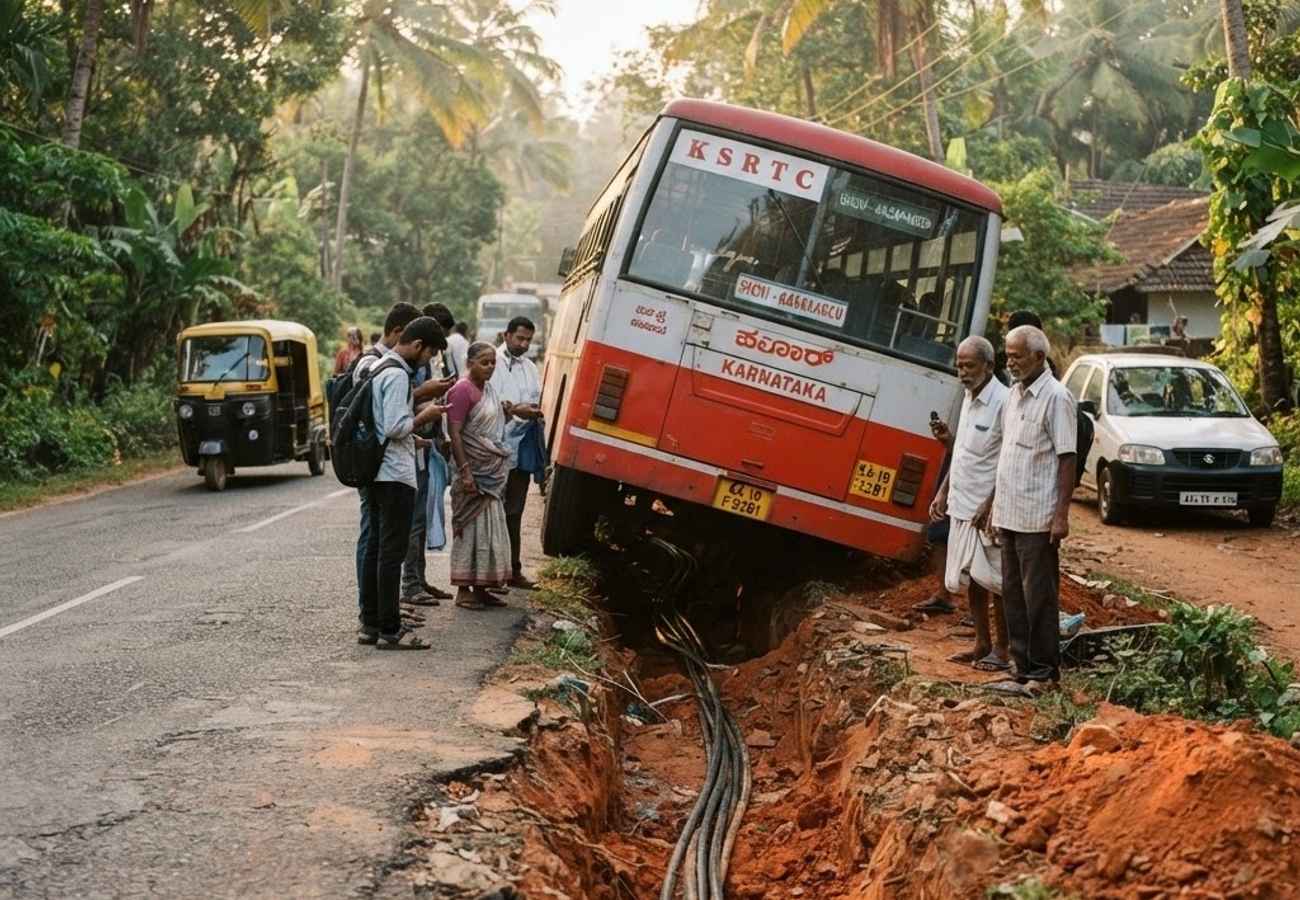
Image generated by AI
[Sheni, Karnataka] — A morning commute turned into a logistical crisis on September 1, 2026, when a Karnataka State Road Transport Corporation (KSRTC) government bus became trapped in an open cable trench near Sheni. The incident left a large number of students and professional employees stranded on the roadside, sparking urgent discussions regarding the safety of utility excavations along rural transit corridors.
The vehicle, which operates a critical link between interior Sullia villages and larger urban hubs, was unable to move after a rear wheel sank into a narrow excavation dug for underground power lines. The disruption occurred during the peak morning window, forcing passengers to abandon the vehicle and seek alternative transport to reach their destinations in Puttur.
Government Route Disruption Near Sheni
According to reports from local media in Dakshina Kannada, the accident took place on the morning of September 1, 2026. The KSRTC bus was navigating the Elimale–Pailaru–Chokkadi–Bellare–Perlampady–Puttur route, traveling from Bellare toward Puttur via Perlampady. As the bus passed through the Sheni area, the soft edge of a roadside trench gave way, causing one of the rear wheels to drop into the excavation.
The bus was heavily loaded with daily commuters, including college students and office-bound workers. While initial reports confirm that no passengers sustained injuries, the immobilized vehicle created a partial blockade of the lane. Because the bus was unable to move under its own power, the morning schedule was completely halted, necessitating the deployment of heavy recovery equipment to extract the vehicle.
The excavation in question is part of a regional infrastructure project to install underground electricity distribution lines. This initiative aims to transition power cables from overhead lines to underground systems to minimize outages caused by storms and environmental factors.
Commuters Forced to Secure Alternative Transport
The immobilization of the bus left passengers in a precarious position, as the vehicle is the primary government-operated service for this specific alignment. With the bus resting sideways in the trench, passengers were forced to disembark and navigate the roadside in search of alternative transit.
Many students heading to educational institutions in Puttur and employees traveling to their workplaces were left waiting for passing private vehicles. In several instances, commuters had to rely on the generosity of private car drivers or pay for unplanned auto-rickshaw trips to reach their destinations. Some passengers were forced to walk to nearby junctions to flag down subsequent services.
This incident highlighted the extreme vulnerability of rural populations who rely on a limited number of state-run buses. In smaller settlements where private transport competition is non-existent, the failure of a single government vehicle can effectively sever the connection to essential employment and education hubs.
Uncovered Utility Trenches Linked to Incident
Local residents and witnesses have pointed directly to the poor management of the construction site as the cause of the accident. Reports indicate that the trench, dug parallel to the carriageway, lacked proper compaction and reinforcement at the shoulder. This created an unstable edge that could not support the weight of a heavy KSRTC bus.
The cabling work is being conducted for MESCOM, the state-owned electricity distribution company serving coastal Karnataka. Community members expressed frustration that sections of the trench near Sheni were left either completely open or insufficiently refilled, posing a significant hazard to any vehicle that might drift slightly off the paved surface.
Beyond the risk to large buses, residents warned that two-wheelers and smaller vehicles are even more susceptible to these "edge failures." The lack of adequate barricading or warning markers along narrow rural roads increases the likelihood of similar accidents, especially during periods of high traffic or poor visibility.
Systemic Strain on Rural Mobility and Infrastructure
The entrapment of the bus in Sheni is not an isolated example of infrastructure failure affecting public transit. Similar patterns have been observed across various Indian states. For example, in August 2026, a state-run super luxury bus in Telangana became bogged down in deep mud at a temporary stand in Uppal, requiring an earthmover for recovery.
These recurring events point to a systemic issue where public transport vehicles must navigate narrow corridors shared with ongoing construction, poor drainage, and a lack of safety barriers. When utility companies fail to reinstate road surfaces to engineered standards, the result is an increased operational risk for transport agencies and a reliability crisis for the public.
For KSRTC, such incidents result in more than just a delayed schedule. Vehicles must be removed from service for structural inspections, and the logistical effort to coordinate cranes in interior taluks often results in hours of downtime.
Urgency for Coordination Between Utility Providers and Road Agencies
The Sheni incident has reignited calls for better synchronization between road maintenance authorities and utility providers like MESCOM. Civic groups and local media have urged that all contractors adhere to strict safety protocols, including:
- Engineered Backfilling: Ensuring trenches are filled and compacted to support heavy axle loads.
- Visible Warning Systems: Implementing clear, reflective markers to alert drivers of unstable shoulders.
- Time-Bound Completion: Prioritizing the closure of excavations before the peak of the monsoon season when soil stability is lowest.
In regions where a single bus route serves as a lifeline for an entire cluster of villages, the failure to secure a worksite can lead to missed examinations for students and lost wages for laborers. As Karnataka continues to expand its underground power grid, the Sheni accident serves as a critical reminder of the need for accountability in rural infrastructure projects.
The incident underscores a dangerous gap between urban infrastructure goals and rural safety execution.
Related Travel Guides
Disclaimer
This article is for informational and educational purposes only. It does not constitute legal, financial, or professional advice. While we strive to provide accurate and up-to-date information, travel policies, regulations, and conditions change rapidly. Always verify information with official sources before making travel decisions. Nomad Lawyer makes no representations about the accuracy, reliability, completeness, or suitability of the information provided. Readers should consult qualified professionals for advice specific to their circumstances. The views expressed in this article are those of the author and do not necessarily reflect the views of Nomad Lawyer.
Kunal K Choudhary
Co-Founder & Contributor
A passionate traveller and tech enthusiast. Kunal contributes to the vision and growth of Nomad Lawyer, bringing fresh perspectives and driving the community forward.
Learn more about our team →