
Kazakhstan's eVTOL Revolution: Central Asia's First Air Taxi Test
Kazakhstan hosted Central Asia's first eVTOL air taxi demonstration near Almaty on May 19, 2026, signaling a major shift toward electric urban air mobility and reshaping regional travel infrastructure.

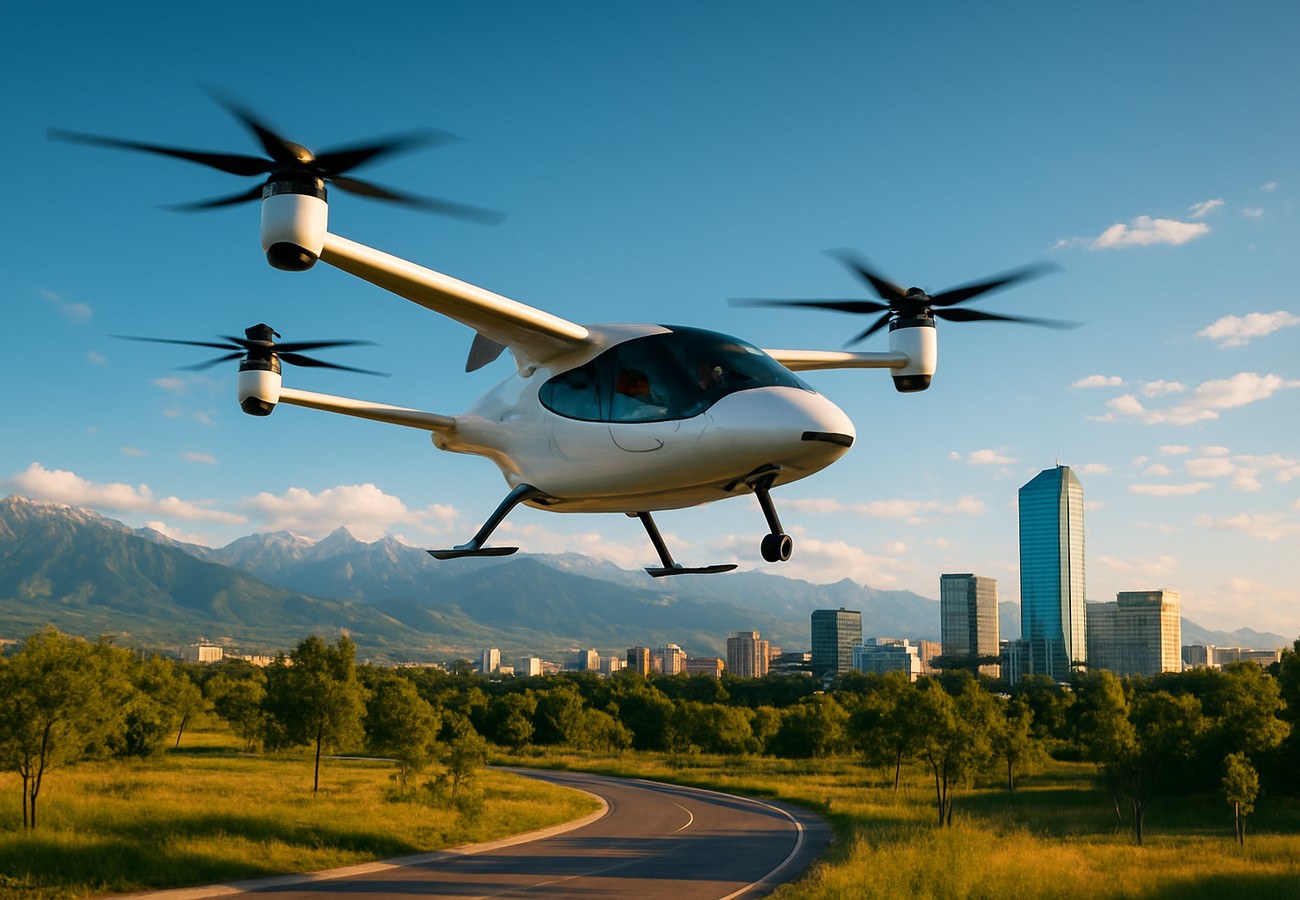
Image generated by AI
Kazakhstan Just Made Central Asia's Biggest Aviation Move in Decades
On May 19, 2026, something quiet but seismic happened near Almaty. A pilotless eVTOL air taxi lifted off in Alatau City, a brand-new smart city under development in the Almaty Region. No passengers. No fanfare. Just a controlled demonstration that positioned Kazakhstan at the centre of Central Asia's future transport revolution.
This wasn't theatre. This was infrastructure planning dressed up as technology news.
The demonstration flight featured the AutoFlight Prosperity aircraft—a sleek, electric vertical take-off and landing machine designed to carry one pilot and five passengers at speeds up to 200 kilometres per hour with a range of 200 kilometres per charge. Powered by 13 electric motors, the aircraft produces zero direct CO₂ emissions and operates with a noise profile that conventional aircraft simply cannot match.
But here's what makes this story matter: Kazakhstan isn't testing air taxis in isolation. The country is building an entire urban air mobility ecosystem from the ground up—complete with vertiports, digital navigation systems, regulatory frameworks, and $300 million in committed investment.
Why This Test Matters More Than You Think
Reddit: "Air taxis sound nice in theory, but the real question is whether governments can actually regulate them without creating chaos. Kazakhstan might crack this code." — r/travel
The Ministry of Artificial Intelligence and Digital Development of the Republic of Kazakhstan officially backed the demonstration. Alatau Advance Air Group led the project with international partners from China, South Korea, Italy, and the United States. This international consortium signals serious money and serious intent.
What separates Kazakhstan's approach from other global air taxi experiments is legal infrastructure. On May 8, 2026—just 11 days before the flight—Kazakhstan signed the Constitutional Law on the Special Legal Regime of Alatau City. This law creates experimental regulatory frameworks, dedicated airspace zones, and specific legal corridors for urban air mobility technologies.
Translation: The country built the rulebook before scaling the technology.
The Alatau City Advantage: Building Transport from Scratch
Alatau City isn't retrofitting air mobility into crowded urban infrastructure. It's being built as a planned smart city with transport integration from day one. Located between Almaty and Konaev, the development sits on valuable transport corridors linking airports, tourism destinations, and logistics hubs.
The official development concept places strategic emphasis on:
- 5G connectivity infrastructure for real-time air traffic management
- Electric transport networks reducing reliance on conventional vehicles
- Automated systems handling low-altitude traffic coordination
- Sustainable urban planning aligned with zero-emissions policy goals
The first vertiport has already broken ground. Future plans include a wider network across Alatau City, Almaty, and key tourism destinations throughout the region.
This isn't speculative. Vertiports—the charging and landing stations for air taxis—are physical infrastructure being constructed now. Without vertiports, air taxis cannot operate. Without regulatory clarity, vertiports cannot be built. Kazakhstan solved the chicken-and-egg problem by addressing law and infrastructure simultaneously.
How Air Taxis Transform Almaty Tourism—and When
The practical travel impact could arrive sooner than most expect. Official project documentation indicates a future air taxi route from Almaty International Airport to Medeu (the famous high-altitude ice skating resort) could take just 10 to 12 minutes—a dramatic reduction from current ground transport times.
For the Almaty Region, this matters because tourism is substantial. The region hosts a major share of Kazakhstan's domestic tourism visitors while Almaty remains one of the country's most important destinations for international arrivals. Key attractions include:
- Ile-Alatau National Park
- Altyn-Emel National Park
- Shymbulak ski resort
- Medeu ice rink and mountain venue
- Lake Balkhash
- Kapchagay Reservoir
A functioning air taxi network transforms these destinations from "day trips" into "accessible afternoon experiences." Premium travellers, business visitors, and high-value short-stay tourists become the early adopters. Mountain tourism accelerates. Airport transfers become seamless for affluent segments.
The technology also enables cargo drones—delivery networks supporting small-scale logistics without ground congestion.
The Investment Reality: $300 Million Signals Serious Commitment
On May 8, 2026, Kazakhstan's national investment portal reported a memorandum between the Ministry of AI and Digital Development, Joby Aero, and Alatau Advance Air Group valued at approximately $300 million US dollars. The agreement covers:
- Development of an air taxi network across Kazakhstan
- Supply of eVTOL aircraft
- Vertiport infrastructure
- Digital navigation systems
This isn't venture capital speculation. This is sovereign investment backed by government memorandums.
Alatau Advance Air Group has also signed separate agreements with AutoFlight for the supply of 50 V2000 and V5000 series aircraft, with additional knowledge-transfer provisions included.
The scale signals industrial commitment. Governments don't underwrite $300 million infrastructure plays on experimental technology. They do so when they believe a market opportunity exists and regulatory clarity is achievable.
The Regulatory Framework: Where Air Taxis Actually Live or Die
Here's the insider reality that most travel journalists miss: Air taxis fail without regulatory infrastructure. Kazakhstan understood this.
Around 40 regulatory instruments are currently under development for Alatau City alone. These rules will govern:
- Air corridors and designated flight paths
- Aircraft certification and airworthiness standards
- Passenger safety protocols and emergency procedures
- Personal data protection during flights
- Drone traffic separation and coordination
- Vertiport operations and maintenance
- Pilot licensing and specialist training
- Insurance and liability frameworks
National aviation legislation amendments are simultaneously under review at the federal level. This two-tier regulatory approach—city-specific innovation rules paired with national aviation standards—is the model other nations will likely copy.
The International Civil Aviation Organization has published guidance on eVTOL certification pathways, but individual nations must still implement their own frameworks. Kazakhstan is doing this proactively rather than reactively.
What's Next: The Critical Timeline
The May 19, 2026 demonstration was proof of concept. Commercial operations are not imminent. Safety approvals, passenger trials, insurance frameworks, and operational procedures remain ahead.
However, the sequence suggests 2027-2028 for initial commercial routes with paying passengers. Airport-to-vertiport transfers are the most likely first service—predictable routes, premium pricing, controlled operations.
Tourism applications would likely follow airport transfers, capitalizing on Almaty's existing mountain tourism infrastructure and international visitor base.
The Broader Central Asian Context
Kazakhstan is making this move at a strategic moment. The region faces transportation challenges: distances are vast, ground infrastructure is dispersed, tourism is growing, and urban congestion in major cities is increasing.
Uzbekistan, Tajikistan, and Kyrgyzstan are watching. If Kazakhstan successfully operates a commercial air taxi network at scale, neighbouring nations will move quickly to develop competing systems.
The eVTOL test isn't just about Almaty. It's Kazakhstan positioning itself as Central Asia's technology leader and claiming first-mover advantage in a transport category that will reshape regional mobility over the next decade.
Kazakhstan just moved from conversation to construction—and that changes everything for Central Asian travel.
Related Travel Guides
Vancouver Airport Chaos: WestJet, Delta, American Face Mass Disruptions
British Airways Airbus A380 Suspended on London-Los Angeles Route for Winter 2026
Disclaimer
This article is for informational and educational purposes only. It does not constitute legal, financial, or professional advice. While we strive to provide accurate and up-to-date information, travel policies, regulations, and conditions change rapidly. Always verify information with official sources before making travel decisions. Nomad Lawyer makes no representations about the accuracy, reliability, completeness, or suitability of the information provided. Readers should consult qualified professionals for advice specific to their circumstances. The views expressed in this article are those of the author and do not necessarily reflect the views of Nomad Lawyer.
Kunal K Choudhary
Co-Founder & Contributor
A passionate traveller and tech enthusiast. Kunal contributes to the vision and growth of Nomad Lawyer, bringing fresh perspectives and driving the community forward.
Learn more about our team →