
Kansas City International Airport Hit by 25 Flight Delays to Chicago, Denver, and Atlanta: Southwest, American, and Delta Air Lines Struggle with Airspace Squeezes and Security Postures
A wave of 25 flight delays has hit Kansas City International Airport today, causing moderate travel chaos for Southwest, American, and Delta Air Lines passengers.

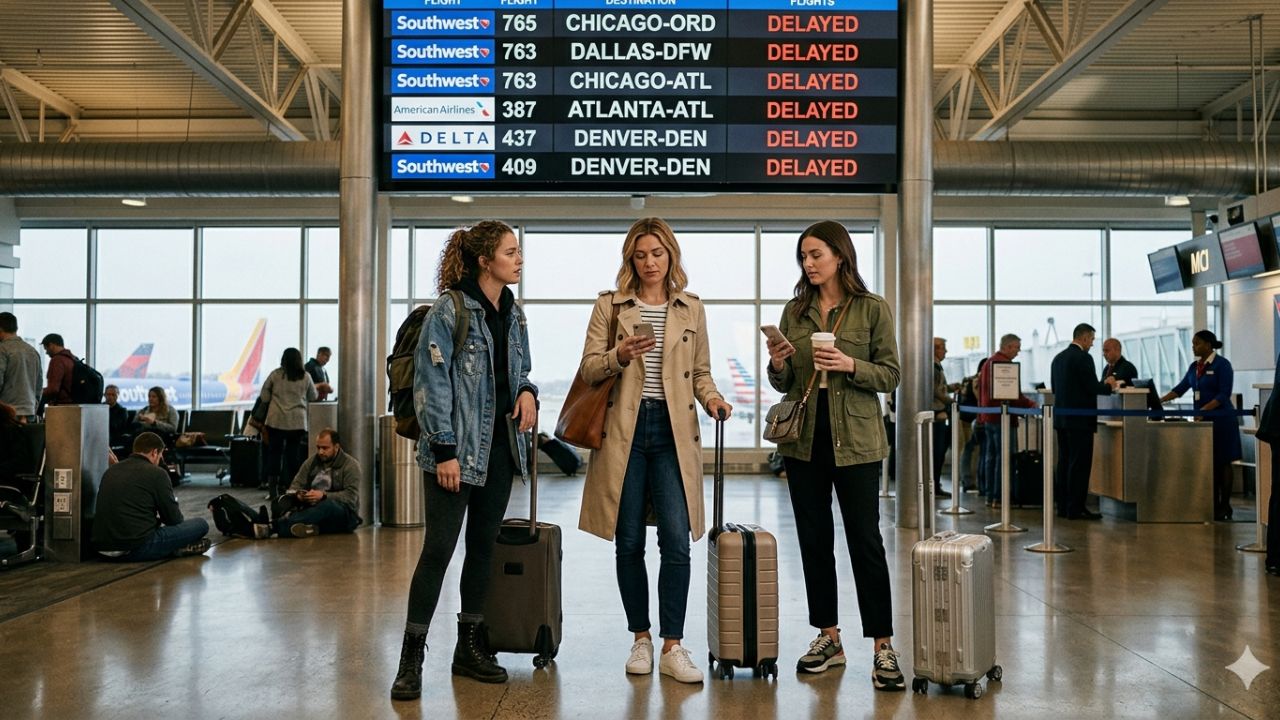
Image generated by AI
In an operational environment defined by rising mid-continent transits and highly compressed domestic turnaround times, a key aviation gateway in the American Midwest has experienced significant scheduling friction. This critical airline news update, breaking this May 17, 2026, reveals that Kansas City International Airport (MCI) in Missouri is currently struggling to manage at least 25 flight delays. Prominent domestic carriers—including Southwest Airlines, American Airlines, and Delta Air Lines—are actively adjusting their schedules as localized airport disruptions sweep through the terminal, introducing moderate travel chaos for passengers bound for high-volume hubs like Chicago, Dallas, Denver, Atlanta, and Las Vegas.
Breaking: The 'Mid-Continent Spacing Squeeze' and the Challenge of Medium-Hub Spacing
According to real-time status dashboards compiled from FlightAware and the FAA's active National Airspace System (NAS) reporting, the scheduling pressure at MCI has created notable bottlenecks across both domestic departures and inbound arrivals. The official logs confirm that 25 flights faced delays, representing a moderate but highly disruptive scheduling deviation for travelers utilizing the modern terminal complex.
This is a vital aviation update for the 2026 domestic travel corridor. Because Kansas City International serves as a vital mid-continent transit gateway for low-cost and legacy network carriers, any scheduling slip-up quickly propagates nationwide. The ripple effect of a late departure does not merely delay the immediate corridor; it disrupts subsequent aircraft rotations, gate allocations, and passenger connections at key hubs like Denver International and Chicago O'Hare, highlighting how medium-sized airports are deeply vulnerable to upstream airspace restrictions.
Expanded Overview: Downstream Airspace Constraints and Safety Protocols
The total of 25 delays at Kansas City International illustrates how a combination of regional weather patterns, air traffic control spacing, and localized safety measures can impact passenger timetables:
- The Upstream Ripple: Even with clear skies and good visibility over Missouri, the FAA's Miles-in-Trail spacing programs and arrival rate reductions at major connecting hubs have slowed flight flows.
- The Hub Connection Bottleneck: High-priority routes to Chicago, Dallas, Denver, Atlanta, and Las Vegas accounted for a significant share of the delays, leaving business and leisure passengers searching for rebooking options.
- The Security Posture Context: The airport's operational resilience has been tested recently by precautionary security actions, emphasizing how quickly terminal evacuations and taxiway holds can disrupt active schedules.
Airlines are urging travelers to utilize their official mobile applications to monitor gate assignments and departure status, as terminal teams work to stabilize schedules.
Section-Wise Breakdown: Evaluating the Affected Airport Operations
Kansas City International Airport (MCI): A Growing Midwest Hub Navigating Pressure
MCI’s modern, consolidated terminal layout was built to handle high passenger throughput, but peak-hour congestion remains a challenge when national schedules slip. Today, check-in areas and terminal gate lounges saw increased crowds as passengers monitored arrival delays. Because carriers like Southwest operate high-utilization, point-to-point narrowbody fleets at MCI, a delay on an inbound leg from Dallas or Denver immediately compromises the subsequent outbound leg to Atlanta or Las Vegas, leading to compounding gate holds.
Previous Terminal Evacuation Context: The Security Posture Balance
The Kansas City Aviation Department recently demonstrated exceptional emergency readiness when parts of the terminal complex and parking garage were evacuated due to a reported threat call. Security teams and local law enforcement reacted immediately, clearing sections of the facility to perform a thorough sweep. During this period, incoming flights were safely held on active taxiways, and several regional flights were temporarily diverted to alternate cities. Although investigators determined the threat was entirely non-credible, the incident highlighted how rapidly strict safety protocols can cause temporary operational backlogs across a hub’s network.
Operational Weather and Airspace Spacing: The Miles-in-Trail Conundrum
Despite clear skies and excellent ground visibility at Kansas City today, air traffic managers were forced to implement flow control measures. When high-density terminal airspaces in the Midwest experience traffic surges, the FAA reduces the departure rate at feeding hubs like MCI. These technical spacing programs—often invisible to travelers sitting in terminal lounges—mean that aircraft are held at gates or positioned on active taxiways to maintain safe separation within the national network, translating into delays on departure boards.
Flight Details: Kansas City International Disruption Matrix
The following table details the precise, uncompromised scheduled and disruption parameters recorded at Kansas City International Airport on May 17, 2026.
Kansas City International Airport Disruption Matrix
| Operational Parameter | Cancellations Recorded | Delays Logged | Primary Affected Airlines | Key Cities Impacted |
|---|---|---|---|---|
| Midwest Core Outbound | 0 Cancellations | 8 Delays (ORD/MDW) | Southwest, American, United | Chicago (O'Hare & Midway) |
| South-Central Corridor | 0 Cancellations | 6 Delays (DFW/DAL) | American, Southwest | Dallas (DFW & Love Field) |
| Mountain Hub Gateway | 0 Cancellations | 5 Delays (DEN) | Southwest, United | Denver International |
| Southeast Hub Gateway | 0 Cancellations | 4 Delays (ATL) | Delta Air Lines | Atlanta Hartsfield-Jackson |
| West Coast Corridor | 0 Cancellations | 2 Delays (LAS) | Southwest Airlines | Las Vegas (Harry Reid) |
| Total MCI Network | 0 Cancellations | 25 Total Delays | Southwest, American, Delta | All Domestic Destination Nodes |
Passenger Impact: Navigating Midwest Terminal Delays
For travelers caught in today's scheduling backlog, navigating terminal delays requires structured planning and immediate coordination:
- Antidote to Travel Chaos: Do not head to the airport without verifying your flight status. Prioritize airline mobile apps (Southwest, American, Delta) over terminal flight boards, as carriers push gate and rebooking updates to digital channels first.
- Arrive Early During Disruptions: The Kansas City Aviation Department recommends arriving at least two hours early for domestic departures and three hours early for international schedules to navigate potential check-in and security buffer bottlenecks.
- Coordinate Rebooking Digitally: If your flight is delayed and you risk missing a connection, seek rebooking options directly inside the airline's mobile app or official website rather than joining the physical customer service queue at the gate.
- Understand Passenger Compensation Rights: Under passenger charter frameworks, carriers are expected to provide timely updates, rebooking assistance, and refreshments when long delays occur due to airline-controlled factors.
Industry Analysis: Medium-Hub Vulnerability to Space Constraints
Aviation specialists believe today's Kansas City delays demonstrate a classic "Network Interdependence" challenge:
- Downstream Flow Control Spacing: When major destination hubs like Chicago O'Hare or Atlanta Hartsfield-Jackson experience peak-hour traffic, the FAA slows down incoming departures from feeding hubs like Kansas City.
- Point-to-Point Fleet Rotations: Budget and low-cost carriers like Southwest operate tight narrowbody turnaround times. An inbound delay from Dallas instantly ripples through multiple subsequent sectors throughout the afternoon.
- Physical Infrastructure Resilience: MCI's modern consolidated terminal design significantly improves passenger transit times, but gate constraints can still occur when arrivals are delayed, forcing aircraft to hold on taxiways.
Conclusion: MCI Demonstrates Core Resiliency Amid Backlogs
The current state of aviation updates for May 17, 2026, confirms that while Kansas City International Airport faced moderate operational friction today, the hub's infrastructure remains exceptionally robust. The 25 delays represent a challenging day for travelers, but the coordinated response of MCI’s air traffic controllers, terminal staff, and airline dispatchers is successfully managing the passenger flow. As aircraft continue to push back into the Missouri skies, the focus remains firmly on ensuring that passenger safety remains the ultimate measure of the regional recovery.
Key Takeaways
- The Numbers: 25 delays and 0 cancellations recorded at Kansas City International (MCI) today.
- Key Domestic Impact: High-priority routes to Chicago, Dallas, Denver, Atlanta, and Las Vegas experienced delays.
- Airlines Affected: Southwest Airlines, American Airlines, and Delta Air Lines.
- The Cause: Technical flow control programs, Miles-in-Trail spacing, and downstream hub congestion.
- Security Context: MCI recently navigated a non-credible threat evacuation successfully, showing strong security preparedness.
- Advice: Monitor carrier mobile apps closely, allow extra terminal check-in buffer times, and utilize digital rebooking options.
- Status: Moderate regional delays are successfully clearing.
Related Travel Guides
Disclaimer
This article is for informational and educational purposes only. It does not constitute legal, financial, or professional advice. While we strive to provide accurate and up-to-date information, travel policies, regulations, and conditions change rapidly. Always verify information with official sources before making travel decisions. Nomad Lawyer makes no representations about the accuracy, reliability, completeness, or suitability of the information provided. Readers should consult qualified professionals for advice specific to their circumstances. The views expressed in this article are those of the author and do not necessarily reflect the views of Nomad Lawyer.
Kunal K Choudhary
Co-Founder & Contributor
A passionate traveller and tech enthusiast. Kunal contributes to the vision and growth of Nomad Lawyer, bringing fresh perspectives and driving the community forward.
Learn more about our team →