
Inflight Skincare & Plane Seats 2026: Window Seat UV, Cabin Humidity & Winter City Guide

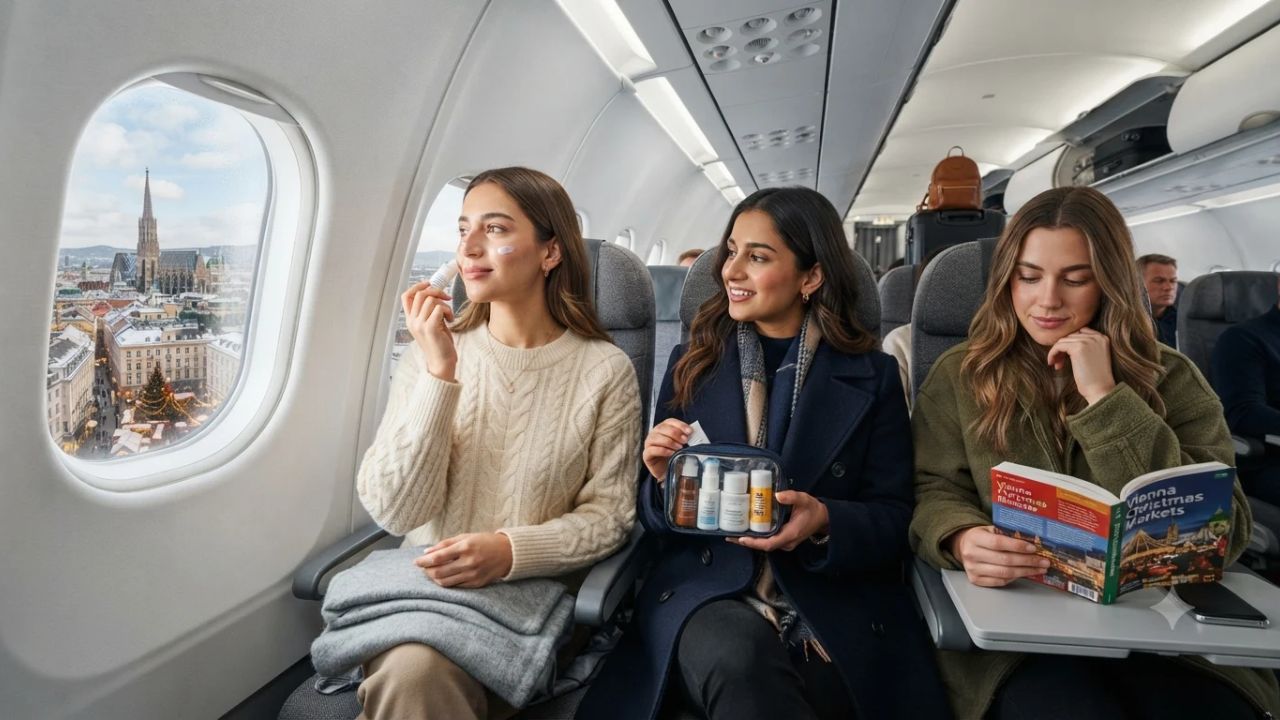
At a cruising altitude of 35,000 feet, aircraft cabin humidity plummets below twenty percent—drier than the Sahara Desert—while ultraviolet radiation intensity increases by roughly ten to twelve percent for every thousand meters of elevation. As millions of travelers prepare for festive winter city breaks and Christmas market holidays across Vienna, Prague, Budapest, Kraków, and Berlin, aviation wellness specialists and dermatological experts are drawing attention to how aircraft cabin environments and seat selection directly affect skin barrier health.
According to skincare specialists on the Fresha wellness platform, including beauty consultant Danielle Louise, passenger discomfort on short and medium-haul winter flights stems from an intense combination of dry recycled cabin air, sudden shifts into sub-zero outdoor weather, and unexpected UVA exposure when sitting beside unshaded airplane windows. By understanding the atmospheric mechanics of modern aircraft environmental control systems (ECS) and adopting targeted barrier-repair routines before boarding, travelers can arrive in Europe's winter capitals without tight, irritated, or compromised skin.
| Environmental Factor | In-Flight Condition | Impact on Passenger Wellbeing |
|---|---|---|
| Relative Cabin Humidity | Below 20% (Often 10%–15%) | Accelerates Trans-Epidermal Loss |
| Cruising Altitude UV | Significantly Higher than Sea | UVA Penetrates Airplane Windows |
| Seating Position Impact | Window Seat: High Sunlight | Aisle Seat: Greater Mobility |
| Winter Climate Shift | Dry Plane -> Cold Air -> Heat | Triggers Severe Barrier Stress |
| Skincare Pre-Flight | Avoid Retinol, AHAs, & BHAs | Apply Ceramide Barrier Creams |
Demystifying Aircraft Cabin Air: Window Seats vs. Aisle Dynamics
The physiological strain of flying is primarily driven by how commercial aircraft pressurize and condition ambient air. Outside an airliner at 36,000 feet, ambient temperatures drop to minus 50°C, and thin air holds virtually zero water vapor. When the aircraft's environmental systems compress and heat this exterior air to cabin standards, relative humidity drops below 20 percent. For comparison, comfortable residential indoor environments maintain humidity levels between 40 and 60 percent.
Window seats present an additional dermatological concern during daylight flights. While standard multi-pane aircraft acrylic windows effectively filter sunburn-causing UVB wavelengths, they allow significant percentages of longer-wave UVA rays to pass through. UVA radiation penetrates deeply into the dermis, contributing to cellular oxidative stress and collagen degradation. Because solar radiation is far less filtered by the thinner upper atmosphere, passengers sitting directly next to an open window shade for three to four hours receive concentrated daylight exposure.
Conversely, claims that specific cabin rows—such as seats directly over the wings or the first five rows—offer magical humidity pockets have been debunked by aviation engineers. Cabin air circulation is continuously refreshed every two to three minutes through high-efficiency particulate air (HEPA) filters, creating an evenly distributed humidity baseline across all rows regardless of where the wing attaches to the fuselage.
Navigating European Christmas Markets: Climate Transitions
The physiological challenge peaks when travelers disembark from dry airplane cabins directly into freezing European winter weather. In Austria, Vienna Tourism (Wien Info) welcomes visitors to the Rathausplatz Christkindlmarkt, where icy alpine winds sweep across illuminated gothic squares. Similar sub-zero temperatures greet travelers in the Old Town Square of Prague, along the Danube promenades of Budapest, around the medieval Rynek Główny in Kraków, and across Berlin's Gendarmenmarkt.
When travelers alternate repeatedly between sub-zero outdoor winds and intensely heated indoor cafes, wooden market huts, and hotel rooms, the skin's lipid barrier experiences thermal shock. Capillaries dilate and contract rapidly, leading to redness, dehydration lines, and sensitivity. Protecting skin during the initial flight ensures that your natural barrier remains resilient enough to withstand days of outdoor festive exploring.
Visitor Insider Tips
- The Pre-Flight Skincare Rule: 48 hours before boarding a flight, pause all strong exfoliating acids (glycolic, lactic, salicylic) and active retinoids; these ingredients thin the stratum corneum and make skin significantly more vulnerable to cabin moisture loss.
- Applying Barrier Balms Before Take-Off: Apply a rich ceramide, squalane, or shea-butter-based barrier cream thirty minutes before boarding rather than waiting until your skin feels tight mid-flight. Applying water-based sheet masks in an ultra-dry cabin can backfire by drawing water out of the skin into the dry air.
- Window Shade and SPF Protocol: If you choose a window seat for scenic aerial views, apply a broad-spectrum mineral SPF 30 or 50 containing zinc oxide or titanium dioxide before boarding, and lower the window blind during peak midday cruising hours.
- Aisle Seat Movement Advantages: Choosing an aisle seat allows you to stand up, stretch, and walk the cabin every 60 to 90 minutes, promoting venous blood circulation and making it easy to refill water bottles without disturbing seatmates.
- Christmas Market Cold-Weather Layering: In Central European markets, apply a soothing occlusive balm over cheekbones and lips before heading into evening freezing temperatures to prevent windburn while sipping hot Glühwein (mulled wine) or punch.
Cultural and Environmental Context
Winter city breaks across Central Europe are steeped in centuries of communal heritage. Vienna's festive market traditions date back to 1298 when Duke Albrecht I granted citizens the privilege of holding a December market (Krippenmarkt). In Kraków and Prague, seasonal markets support independent woodcarvers, glassblowers, and gingerbread bakers who preserve historic guild traditions.
Environmental sustainability has transformed modern European Christmas markets. Municipalities across Austria, Germany, and the Czech Republic mandate reusable ceramic mugs with deposit refund systems (Pfand), organic local farming produce, and low-energy LED illuminations powered by renewable municipal grids. Travelers are encouraged to arrive at city markets via electric tramways and pedestrian paths, purchase authentic handmade regional crafts from local artisans, and avoid disposable single-use plastics during their winter journeys.
FAQ: Inflight Skincare & Winter Market Travel 2026
Why does aircraft cabin air dry out your skin so quickly?
Cabin relative humidity drops below 20% because freezing high-altitude air drawn into the aircraft holds virtually no ambient moisture after being heated.
Do aircraft windows protect you from ultraviolet radiation?
Aircraft windows block most UVB rays but permit significant UVA transmission; closing window shades and wearing broad-spectrum SPF protects your skin.
Should I use a hydrating facial mist during a flight?
Avoid pure water mists without following up with a lipid moisturizer, as unsealed water evaporates rapidly in low humidity, pulling moisture from your skin.
What is the most comfortable cabin seat for long flights?
Aisle seats in the middle cabin offer easier movement, quicker access to hydration, and stable air circulation without direct window sun exposure.
[Whether gazing out over alpine peaks or strolling under market fairy lights, protecting your wellbeing turns winter travel into an effortless delight.]
Related Travel Guides
Disclaimer
This article is for informational and educational purposes only. It does not constitute legal, financial, or professional advice. While we strive to provide accurate and up-to-date information, travel policies, regulations, and conditions change rapidly. Always verify information with official sources before making travel decisions. Nomad Lawyer makes no representations about the accuracy, reliability, completeness, or suitability of the information provided. Readers should consult qualified professionals for advice specific to their circumstances. The views expressed in this article are those of the author and do not necessarily reflect the views of Nomad Lawyer.
Raushan Kumar
Founder & Lead Developer
Full-stack developer with 11+ years of experience and a passionate traveller. Raushan built Nomad Lawyer from the ground up with a vision to create the best travel and law experience on the web.
Learn more about our team →